


Understanding Monocrystalline Solar Panel Costs: A Smart Investment Guide
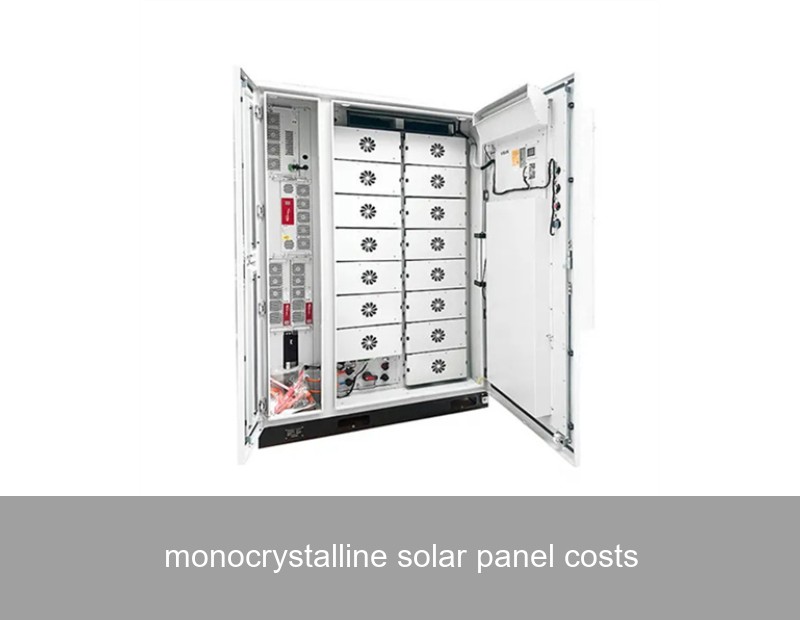
So, you're considering solar power and have heard that monocrystalline panels are the gold standard. But the upfront price tag can give anyone pause. You're not alone in wondering: are monocrystalline solar panel costs truly worth it? The answer isn't just about the sticker price; it's about understanding the value, performance, and long-term energy independence they provide. In this guide, we'll demystify the costs, break down the factors, and show you how pairing them with the right technology, like a smart battery storage system, maximizes your return on every dollar and euro invested.
Table of Contents
- The Price Premium: Why Monocrystalline Panels Cost More
- Breaking Down the Cost Components: More Than Just the Panel
- The Real Metric: Levelized Cost of Energy (LCOE)
- Case Study: A German Manufacturing Plant's Calculated Switch
- Highjoule's Synergy: Maximizing Your Solar Investment with Smart Storage
- Future-Proofing: Cost Trends and Your Next Step
The Price Premium: Why Monocrystalline Panels Cost More
Let's address the elephant in the room first. On a per-panel basis, monocrystalline silicon panels typically come at a higher initial cost compared to their polycrystalline counterparts. This isn't arbitrary. The manufacturing process, known as the Czochralski method, involves growing a single, pure silicon crystal. This process is more energy-intensive and results in more waste (the rounded edges are cut off to form the signature cells), which contributes to the cost.
But here's the crucial perspective shift: you're paying for superior efficiency. Monocrystalline panels convert more sunlight into electricity per square meter. Think of it this way: with higher efficiency, you need fewer panels to generate the same amount of power. This can be a decisive factor if your roof space is limited or aesthetically important. The higher efficiency also means they generally perform better in low-light conditions and have a longer lifespan, often backed by 25-year+ performance warranties.

Image Source: Unsplash (Photographer: Andreas Gücklhorn)
Breaking Down the Cost Components: More Than Just the Panel
When evaluating monocrystalline solar panel costs, it's vital to look at the total system cost. The panels themselves are just one piece of the puzzle.
| Cost Component | Approx. Share of Total | What It Includes |
|---|---|---|
| Hardware (Panels, Inverter, Mounting) | 50-60% | Monocrystalline panels, string/micro-inverters, racking system. |
| "Soft Costs" (Installation, Permits) | 30-40% | Labor, engineering, permits, inspection, grid connection fees. |
| Additional Technologies (e.g., Storage) | 10-25%+ | Battery systems, advanced energy management software. |
As you can see, while choosing high-efficiency panels might increase the hardware portion slightly, it can reduce soft costs related to design and installation time for a given energy output. Furthermore, incentives like the U.S. federal Investment Tax Credit (ITC) or various European Union grants and feed-in tariffs can significantly offset the total installed cost. Always consult a local professional for the latest applicable incentives.
The Real Metric: Levelized Cost of Energy (LCOE)
For a commercial or industrial decision-maker, the most important financial metric isn't the upfront cost—it's the Levelized Cost of Energy (LCOE). LCOE calculates the average net present cost of electricity generation for a system over its lifetime. In simpler terms, it's the "price per kWh" your solar system will produce.
Due to their higher efficiency and longer lifespan, monocrystalline panels often boast a lower LCOE than other technologies. They simply produce more electricity, more reliably, for more years. According to the International Renewable Energy Agency (IRENA), the global weighted average LCOE for utility-scale solar PV fell by 88% between 2010 and 2021, with technological advances in modules like monocrystalline being a key driver.
Case Study: A German Manufacturing Plant's Calculated Switch
Let's look at real data from a German medium-sized manufacturing plant in Bavaria. In 2021, the facility faced rising grid electricity costs and carbon reduction targets. They evaluated two options: a polycrystalline system and a high-efficiency monocrystalline system.
- Goal: Offset 70% of daytime energy consumption.
- Polycrystalline Option: Required 400 panels due to lower efficiency, using all available roof space. Total installed cost: €185,000.
- Monocrystalline Option: Required only 340 panels to meet the same output, leaving room for future expansion. Total installed cost: €195,000.
The monocrystalline system had a €10,000 higher upfront cost. However, its higher yield in Bavaria's sometimes overcast climate and superior degradation rate meant it was projected to generate 8% more electricity annually. Over 25 years, this performance advantage translated to a LCOE that was 12% lower than the polycrystalline option. The monocrystalline system paid back the initial premium in under 4 years and provided greater long-term savings and energy security.
Highjoule's Synergy: Maximizing Your Solar Investment with Smart Storage
This is where the true magic happens. Optimizing monocrystalline solar panel costs isn't just about the panels; it's about ensuring not a single watt of that premium-generated electricity goes to waste. This is Highjoule's core expertise.
Even the best solar panels produce only when the sun shines. Without storage, excess energy is exported to the grid (often at low rates), and you draw power back at night (at high rates). A high-efficiency monocrystalline system paired with a Highjoule advanced battery storage system (BESS) changes this equation entirely.

Image Source: Unsplash (Photographer: American Public Power Association)
Our HPS Series for commercial and industrial applications and HRS Series for residential use are designed to seamlessly integrate with high-performance solar arrays. They store your surplus solar energy for use during peak tariff periods or at night, dramatically increasing your self-consumption rate. For our German case study, adding a Highjoule BESS could increase their on-site consumption of solar power from 35% to over 80%, slashing grid dependence and further improving ROI.
Moreover, Highjoule's intelligent energy management platform can participate in grid services (where available), turning your solar+storage system into a revenue-generating asset. By combining top-tier monocrystalline generation with smart storage, you're not just buying hardware—you're building a resilient, cost-optimizing energy ecosystem.
Future-Proofing: Cost Trends and Your Next Step
The trend for monocrystalline solar panel costs continues to be downward as manufacturing scales and technology, like PERC (Passivated Emitter and Rear Cell) and half-cut cells, becomes standard. Simultaneously, their efficiency ceiling keeps rising. Investing in this technology today future-proofs your energy system against volatile utility rates.
The conversation is no longer just about panel cost per watt. It's about the total value of an integrated, intelligent energy solution. How will you ensure that the premium energy generated by your investment delivers maximum financial and operational resilience for your home or business?
We invite you to connect with Highjoule's energy experts. Share your energy profile and goals with us, and let's model a scenario where high-efficiency solar and smart storage work together to optimize your costs for decades to come.
 Inquiry
 Online Chat