


Net Accounting Solar System: Your Guide to Smarter Energy Management
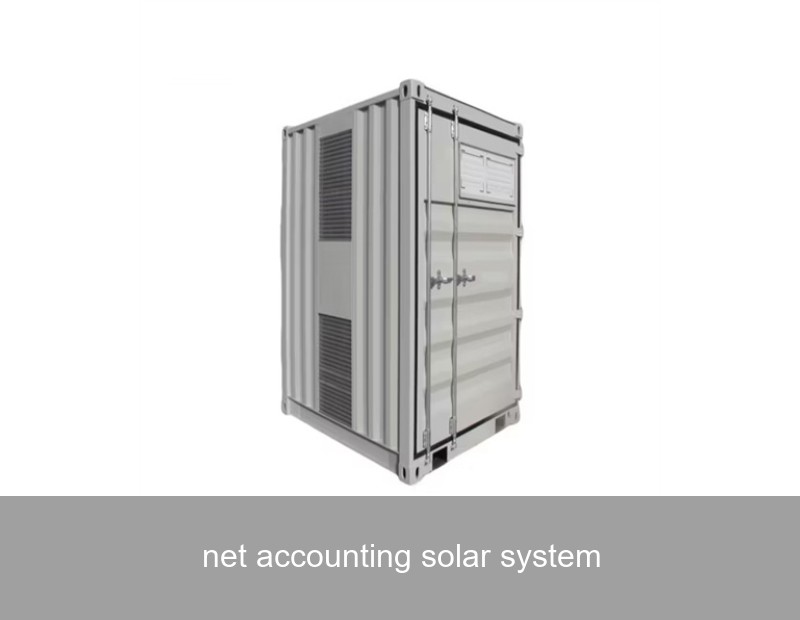
If you've recently installed solar panels or are considering them, you've likely heard the term "net metering" or "net accounting." But what does it truly mean for your wallet and your energy independence? At its core, a net accounting solar system is a brilliant, two-way conversation between your home and the grid. Instead of just consuming power, you become a prosumer—both producing and consuming. The "net" part is crucial: it's the difference between the electricity you send to the grid and the electricity you draw from it. This simple accounting mechanism is transforming how homeowners and businesses think about power, turning rooftops into personal power plants and utility bills into potential revenue statements. But to truly master your energy economy, you need to look beyond just the meter.
How Does Net Metering Work? The Technical & Financial Flow
Let's break down the typical net metering process. On a bright, sunny afternoon, your solar panels are likely generating more electricity than your home can use. That excess power doesn't go to waste.
- Generation: Your solar panels convert sunlight into direct current (DC) electricity.
- Conversion: An inverter (a critical component) transforms that DC power into the alternating current (AC) used by your home and the grid.
- Consumption & Export: Your home uses the solar power it needs in real-time. Any surplus is automatically fed back into the public utility grid.
- The "Accounting": Your utility meter literally spins backwards, crediting your account for the exported kilowatt-hours (kWh). At night or on cloudy days, you draw power from the grid, using up those credits.
At the end of your billing cycle (usually monthly or annually), you settle the bill for the "net" energy used. If you've exported more than you imported, you often receive a credit or a payment, depending on local regulations. However, the financial terms of this exchange—the retail rate vs. a lower wholesale rate—are where policy changes, particularly in markets like California and parts of Europe, are shifting the landscape. Relying solely on grid export credits is becoming less predictable.
The Limitations of Grid-Only Net Accounting
Traditional net metering ties your solar system's economics directly to utility policies, which can change. The rise of time-of-use rates and less favorable export tariffs means the value of your solar energy can vary wildly by the hour. This volatility introduces uncertainty into your return on investment. The key to reclaiming control? Adding storage to the equation.
Beyond the Basics: Advanced Strategies for True Energy Independence
This is where the modern net accounting solar system evolves into an intelligent, self-optimizing energy asset. By integrating a battery storage system, you move from a simple import-export model to sophisticated energy management.
| Strategy | How It Works | Benefit |
|---|---|---|
| Peak Shaving | Using stored solar energy during peak evening hours when grid rates are highest. | Dramatically reduces demand charges (for businesses) and high time-of-use rates. |
| Backup Power | Isolating your home from grid outages by automatically switching to battery power. | Provides peace of mind and continuity for critical loads during blackouts. |
| Arbitrage | Storing solar or cheap off-peak grid energy and using or exporting it during expensive peak periods. | Maximizes the financial value of every kilowatt-hour you produce or purchase. |
Implementing these strategies requires more than just hardware; it requires smart software. This is precisely the challenge Highjoule addresses. As a leader in advanced energy storage since 2005, Highjoule designs systems that don't just store energy—they intelligently manage it. Our H-Stack Commercial & Industrial (C&I) and H-Cell Residential battery systems are integrated with an AI-driven energy management platform. This platform constantly analyzes weather forecasts, your consumption patterns, and real-time utility rates to decide the most economical action: charge from solar, discharge to power your home, or export to the grid—all to optimize your personal net accounting outcome.

Image Source: Unsplash (Representative image of a modern solar and storage installation)
A Real-World Case Study: Maximizing Returns in California Under NEM 3.0
Let's look at a concrete example from Fresno, California, where the shift to Net Billing Tariff (NEM 3.0) in 2023 significantly reduced the credit value for exported solar. A medium-sized manufacturing facility with a 250 kW rooftop solar array found its simple payback period stretch out unacceptably under the new rules.
The Solution: The facility partnered with Highjoule to design a hybrid system: the existing solar was coupled with a 500 kWh Highjoule H-Stack C&I battery system.
- Data Point: Before storage, the facility exported ~60% of its solar generation at midday, receiving an average credit of ~$0.08/kWh under NEM 3.0.
- Implementation: The Highjoule system was programmed to store this midday surplus instead of exporting it.
- Result: The stored energy was then used to power the facility's late afternoon and early evening operations (4 PM - 9 PM), when grid electricity costs peaked at over $0.45/kWh. It also provided critical backup for refrigeration units.
By shifting from low-value export to high-value self-consumption and peak shaving, the project's financial outlook was restored. The integrated system is now projected to reduce the facility's annual energy costs by 72% and achieve a payback period of under 6 years, even under the challenging NEM 3.0 tariff. This case underscores a vital insight: the future of profitable solar is storage-enabled self-consumption.
For more details on California's policy shift, you can review the official California Public Utilities Commission page on Net Billing Tariff.
Choosing the Right Technology Partner
Not all storage solutions are created equal. When evaluating a battery system to enhance your net accounting solar system, consider these factors:
Key Considerations for Battery Storage
- Depth of Discharge (DoD) & Cycle Life: Can you regularly use 90%+ of the battery's capacity without degrading it prematurely? Highjoule's lithium iron phosphate (LFP) chemistry is engineered for thousands of deep cycles.
- Integrated Intelligence: Does the system have the software to automatically optimize for economics and resilience? Our platform makes these complex decisions for you.
- Scalability & Warranty: Can the system grow with your needs? Is it backed by a strong, long-term warranty? Highjoule offers modular designs and industry-leading warranties for peace of mind.
For a deeper understanding of battery technologies, the U.S. Department of Energy's basics on solar and storage is an excellent resource.

Image Source: Unsplash (Representative image of a sophisticated battery energy storage system)
The Future of Your Energy Accounting
The journey from a passive consumer to an active energy manager is exciting. A net accounting solar system is the foundation, but adding intelligence and storage transforms it into a truly resilient and economically optimal asset. Whether you're a homeowner in Germany navigating the EEG framework, a business owner in Texas dealing with volatile prices, or a community developing a microgrid, the principle is the same: maximize the use of your self-generated, clean power.
Highjoule is at the forefront of this transition. Our solutions for residential, commercial, industrial, and microgrid applications are designed to provide smart, efficient, and sustainable power precisely when and where it's needed most. We help you not just participate in net accounting, but master it.
A Question to Consider
Given the increasing volatility in both energy prices and net metering policies, what specific energy cost or reliability concern is driving you to explore a more intelligent solar and storage solution for your property?
 Inquiry
 Online Chat