


Off-Grid Solar System with Generator Backup: Your Ultimate Guide to Energy Independence
Imagine this: you're living in a remote cabin or running a critical operation far from the utility grid. The sun powers your days, but what happens during a string of cloudy days or when your energy needs spike? This is the fundamental challenge of off-grid living, and it's precisely where an off-grid solar system with generator backup transforms from a luxury into an absolute necessity. This integrated system isn't just about having power; it's about having reliable, resilient, and intelligent power on your terms. As a leading energy storage provider since 2005, Highjoule has engineered solutions that make this seamless integration not just possible, but profoundly efficient and sustainable for homes and businesses across Europe and North America.
Table of Contents
- The Core Challenge: Beyond Sunny Days
- How an Off-Grid Solar System with Generator Backup Works
- Key Components of a Robust Hybrid System
- Highjoule's Role: The Intelligence at the Heart of Your System
- Making the Right Choice: Is This System for You?
The Core Challenge: Beyond Sunny Days
Pure off-grid solar systems have a critical vulnerability: weather dependency. Solar production can plummet by 60-80% during winter months or prolonged cloudy periods, according to data from the National Renewable Energy Laboratory (NREL). When your battery bank is depleted, you're left in the dark. A backup generator solves this, but a traditional, unintegrated setup is inefficient. It often runs at partial load, wastes fuel, and requires manual intervention. The modern solution is a fully automated, generator-integrated off-grid solar system. This hybrid approach ensures your batteries handle short-term fluctuations and daily cycles, while the generator acts as a powerful, on-demand charger for your batteries during extended shortages, operating only at optimal efficiency when needed.

Image: A true off-grid setting where a hybrid solar-generator system ensures uninterrupted power.
How an Off-Grid Solar System with Generator Backup Works: A Synergy of Power Sources
Think of it as a team with a clear playbook. The solar panels and batteries are your star players, handling the routine. The generator is the star substitute, called in only for critical situations. Here's the intelligent sequence:
- Primary Power (Solar): Solar panels generate DC electricity, which is converted to AC by an inverter to power your home and charge the battery bank.
- Secondary Power (Battery): When the sun sets or production is low, power is seamlessly drawn from the batteries. You likely won't even notice the transition.
- Tertiary Power (Generator): The system's brain—an advanced inverter/charger or controller—constantly monitors battery voltage. If it drops to a pre-set "low" level (e.g., 30% state of charge), it automatically starts the generator.
- Smart Charging: The generator doesn't power the home directly (though it can). Instead, it runs at peak efficiency to rapidly recharge the battery bank. Once batteries are replenished to a "high" level (e.g., 80%), the system automatically shuts the generator off. This minimizes runtime, fuel use, and maintenance.
Key Components of a Robust Hybrid System
Each component must be carefully selected and integrated for optimal performance.
| Component | Role | Key Consideration |
|---|---|---|
| Solar PV Array | Primary energy source | Size to meet annual load, considering winter lows. |
| Battery Energy Storage System (BESS) | Stores solar energy, buffers power, and enables generator control. | Capacity (kWh) for autonomy days; cycle life; depth of discharge. |
| Inverter/Charger | Converts DC to AC, manages battery charging from multiple sources. | Must have a generator start/stop function and grid-forming capability. |
| Backup Generator | On-demand bulk energy source. | Proper sizing (kW) for efficient battery charging; fuel type (propane, diesel). |
| System Controller | The "brain" that orchestrates all components. | Advanced logic for prioritizing renewables and minimizing generator use. |
Case Study: The Alpine Mountain Lodge in Colorado, USA
Let's look at a real example. A high-end, year-round rental lodge in the Rocky Mountains, USA, needed 100% energy independence. Their challenge was extreme: heavy snow cover on panels in winter and guests expecting hotel-like reliability.
- Old System: A large, loud diesel generator running almost continuously in winter, with high fuel costs and guest complaints.
- New Hybrid Solution (Installed 2022):
- 45 kW solar array (cleared with automated snow-melting systems)
- Highjoule H4 Commercial Energy Storage System with 120 kWh lithium-ion capacity
- Intelligent system controller programmed for peak efficiency
- Existing 40 kW diesel generator integrated as backup
- Results (First Year Data):
- Generator Runtime Reduced by 92%: From nearly 24/7 in winter to only 150 hours total.
- Fuel Costs Cut by $11,500 annually.
- Carbon Emissions Reduced by an estimated 28 tonnes CO2e.
- The Highjoule system's predictive algorithms now start the generator only during predicted low-solar, high-occupancy periods, ensuring full batteries for peak demand times.
This case exemplifies the triple win: economic savings, operational reliability, and environmental sustainability.

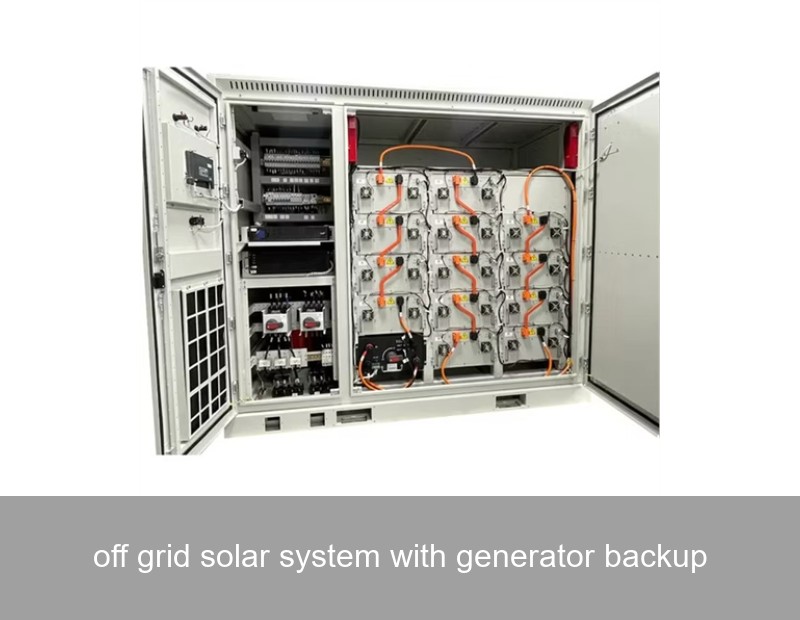
Image: A commercial-scale battery system, like Highjoule's H-Series, forms the core of a reliable hybrid setup.
Highjoule's Role: The Intelligence at the Heart of Your System
At Highjoule, we don't just supply components; we provide the intelligent core that makes an off-grid solar system with generator backup truly smart. Our expertise lies in the seamless integration and superior management of energy flows. For the demanding European and North American markets, our products are engineered for harsh climates and strict safety standards.
- Highjoule H-Series Residential & Commercial ESS: Our lithium iron phosphate (LiFePO4) battery systems are the perfect partner for hybrid off-grid setups. With exceptional cycle life (6,000+ cycles) and a wide operating temperature range, they reliably store solar energy. Their high charge/discharge efficiency ensures minimal energy is lost when the generator is topping them up.
- Advanced Energy Management System (EMS): This is our secret sauce. The Highjoule EMS continuously learns your consumption patterns and weather forecasts. It doesn't just react to low battery levels; it proactively manages energy, deciding the optimal moment to start the generator for the shortest runtime and even conditioning the generator by running it under load periodically.
- Global Support & System Design: Since 2005, we've partnered with certified installers worldwide. We provide detailed system design support to ensure your solar array, battery bank, and generator are perfectly sized and compatible, avoiding the common pitfalls of under-sizing or inefficient component matching.
Why Integration Matters More Than You Think
A non-integrated generator connected to a basic off-grid inverter will work, but it's like having a smart home where you must manually flip every switch. An integrated Highjoule system automates everything. It ensures the generator is loaded correctly (protecting it from harmful "wet stacking"), uses premium multi-stage charging profiles to extend battery life, and gives you remote monitoring and control via a smartphone app. You gain peace of mind, not another chore.
Making the Right Choice: Is an Off-Grid Solar System with Generator Backup for You?
This system is ideal for locations where grid connection is impossible or prohibitively expensive (often over $50,000 per mile in remote areas, as per U.S. Department of Energy estimates). It's also perfect for those who prioritize ultimate resilience, even in grid-tied areas prone to long-duration outages. Ask yourself:
- Is my site truly remote, or is the grid simply far away?
- What are my critical loads (well pump, refrigeration, medical equipment) and how many "days of autonomy" do I need?
- What is my tolerance for managing fuel and generator maintenance?
- Is reducing my environmental footprint a key goal, even with a fossil-fuel backup?
If your answers point towards needing absolute reliability with minimal hassle, then the hybrid path is your best bet.

Image: Modern systems offer complete remote control and monitoring, putting you in charge of your energy independence.
Your Energy, Your Rules
The journey to energy independence is a significant investment. The goal is to build a system that works tirelessly in the background, freeing you to enjoy the benefits of off-grid living without constant energy anxiety. By choosing an intelligently integrated off-grid solar system with generator backup, you're not just buying equipment; you're investing in a sophisticated, automated power ecosystem.
What's the first critical load you would need to secure to achieve true peace of mind at your off-grid property?
 Inquiry
 Online Chat