


Outdoor Gehäuse Kunststoff: The Unsung Hero Protecting Your Renewable Energy Investment
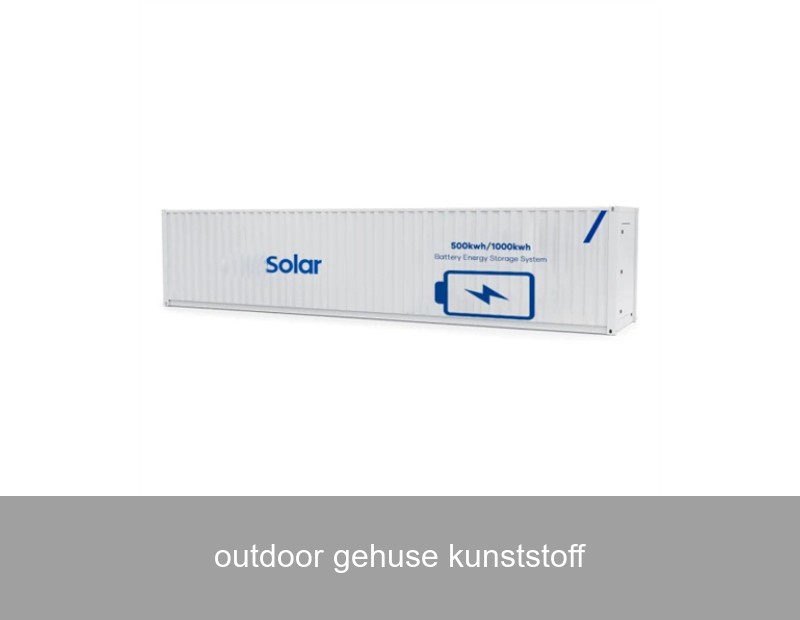
Imagine this: you've invested in a state-of-the-art battery storage system to harness solar power and achieve energy independence. It performs flawlessly for years. Then, after a particularly harsh winter or a scorching summer, you notice issues—corrosion, moisture ingress, or mysterious performance drops. The culprit? Often, it's not the battery cells themselves, but their first line of defense: the outdoor gehäuse kunststoff (outdoor plastic enclosure). This critical component is the silent guardian of energy storage systems, and choosing the right one is paramount for longevity and safety, especially in demanding European and American climates.
Table of Contents
- The Phenomenon: Why Enclosures Fail
- The Data: Material Matters in Extreme Conditions
- A Case Study: Alpine Resilience in Switzerland
- The Highjoule Solution: Engineered for the Elements
- The Science Behind High-Performance Kunststoff
- Future-Proofing Your Energy Assets
The Phenomenon: When an Outdoor Enclosure Becomes the Weakest Link
Outdoor battery storage systems face a relentless assault. From the freezing rains of Northern Europe to the UV-intensive sunlight and heat of the American Southwest, environmental stress is constant. A standard, off-the-shelf plastic enclosure might seem adequate initially, but over time, these forces lead to material fatigue. We see phenomena like UV degradation causing brittleness and color fading, thermal cycling (repeated expansion and contraction) creating micro-cracks, and moisture penetration leading to internal condensation and potential electrical hazards. This isn't just about a faded box; it's about the multi-thousand-dollar energy storage system housed inside. The enclosure is the system's skin, and its failure directly compromises the safety, performance, and ROI of your entire investment.

Image: Environmental stress on outdoor enclosures is a constant challenge. Source: Unsplash
The Data: Material Matters in Extreme Conditions
Let's talk numbers. Studies on polymer performance show vast differences. For instance, a standard polycarbonate blend might have a comparative tracking index (CTI) – a measure of electrical insulation resistance – that degrades significantly with moisture exposure. In contrast, engineered materials like fiberglass-reinforced polyester (GRP) or specific UV-stabilized, impact-modified polymers maintain their mechanical and electrical properties far longer. According to research by institutions like the ASTM International, the difference in weatherability between material grades can translate to a lifespan variance of 5-10 years for an enclosure in continuous outdoor service. This data underscores a critical point: not all outdoor gehäuse kunststoff is created equal. The specification process must account for local climate data—snow load, wind pressure, temperature ranges, and salt mist (for coastal areas)—to ensure compliance with standards like IEC 62933 for stationary energy storage systems.
A Case Study: Alpine Resilience in a Swiss Microgrid
Consider a real-world application in the Swiss Alps. A remote mountain community deployed a solar-plus-storage microgrid to ensure year-round power. Their primary challenge wasn't energy production, but protection. The site experiences temperatures from -25°C to +35°C, heavy snow loads exceeding 1500 Pa, and intense UV radiation at high altitude.
Their initial system used generic enclosures. Within 18 months, inspectors found hairline cracks near mounting points and concerning levels of internal humidity. The community partnered with Highjoule for a retrofit solution. We provided our Highjoule H-Series Commercial ESS, which features a proprietary outdoor gehäuse kunststoff engineered specifically for extreme environments. The enclosure is constructed from a multi-layer composite polymer with:
- UV inhibitors for >25 years of color and structural stability.
- Integrated thermal management channels that work with the system's cooling to prevent condensation.
- Reinforced structural ribs designed to handle snow loads >2000 Pa.
Three years post-installation, monitoring shows zero moisture-related faults and stable internal temperatures. The community's energy resilience is now secured, with the enclosure playing a vital, silent role. This case highlights that for critical infrastructure, the enclosure is not a commodity but a core component of system design.
The Highjoule Solution: Where Engineering Meets Environmental Intelligence
At Highjoule, we don't just put batteries in a box. We design integrated energy storage systems where the enclosure is a proactive part of the performance and safety ecosystem. Our philosophy is that an outdoor gehäuse kunststoff must be more than a container; it must be an environmental interface.
Our product lines, from the residential EcoNode to the industrial-scale GridMax, utilize custom-formulated housing materials. For our flagship commercial systems, we employ a glass-fiber reinforced, halogen-free polymer compound. This material offers exceptional flame retardancy (UL94 V-0 rated), high impact strength even at low temperatures, and superior resistance to corrosion, salts, and common chemical agents. Furthermore, our design incorporates IP65 (dust-tight and protected against water jets) as a standard, with options for higher ingress protection. The built-in climate control system actively manages the internal atmosphere, drawing filtered air when appropriate and sealing it off during adverse conditions, all controlled by the system's intelligent energy management platform.

Image: Modern energy storage requires seamless integration and robust protection. Source: Unsplash
Key Features of a Highjoule Outdoor Enclosure:
| Feature | Benefit | Highjoule Implementation |
|---|---|---|
| Material Science | Long-term weather resistance, structural integrity | UV-stabilized, fiberglass-reinforced polymers; corrosion-resistant metal fittings |
| Ingress Protection (IP) | Protection against dust and water | Standard IP65, with optional IP66/67 for flood-prone areas |
| Thermal Management | Prevents condensation, optimizes battery temperature | Passive and active cooling integrated with BMS, hydrophobic filters |
| Safety & Compliance | Ensures system safety and regulatory approval | Designed to meet IEC 62933, UL 9540, and regional building codes |
The Science Behind High-Performance Kunststoff for Energy Storage
Delving deeper, the choice of kunststoff (plastic) is a precise science. For outdoor energy storage, engineers prioritize several polymer families. Polycarbonate (PC) blends offer good impact strength, while Polypropylene (PP) is chemically resistant. However, for the most demanding applications, fiberglass-reinforced polymers (like GRP or PBT) are often selected for their excellent strength-to-weight ratio and dimensional stability. Additives are crucial: UV absorbers like carbon black or specialized organic compounds shield the polymer chains from solar radiation, while flame retardants—increasingly moving toward halogen-free solutions for environmental and safety reasons—are essential for battery safety standards. Resources like the SpecialChem material selection platform provide detailed insights into these complex formulations. Highjoule's R&D team works directly with material scientists to develop compound specifications that balance these properties, ensuring our enclosures are not just durable, but also contribute to the overall fire safety and environmental footprint of the system.
Future-Proofing Your Energy Assets: Questions to Ask Your Provider
As you evaluate energy storage systems for your home, business, or community project, the enclosure should be a key part of your due diligence. Don't hesitate to ask your provider specific questions:
- "What is the specific material grade of the outdoor enclosure, and what is its projected lifespan under local climate conditions?"
- "Can you provide test certificates for UV resistance (e.g., ISO 4892), impact resistance (e.g., IK rating), and flame retardancy relevant to my region?"
- "How does the enclosure's design actively manage thermal differentials to prevent condensation, which is a primary cause of internal component failure?"
- "Is the enclosure design integrated with the Battery Management System (BMS) for coordinated climate response?"
Choosing a system with a properly engineered outdoor gehäuse kunststoff is an investment in peace of mind. It ensures that your step towards energy independence is built on a foundation that can withstand the test of time and nature.
Given the critical role this component plays, what specific environmental challenge in your region—be it coastal salt spray, desert heat, or heavy snowfall—are you most concerned about when planning a long-term energy storage installation?
 Inquiry
 Online Chat