


10,000-Watt Solar Panels: Powering Your Future with High-Output Energy Independence
Have you ever wondered what it takes to completely power a large home or a small business with the sun? The conversation often turns to system size, and a 10,000-watt solar panel system (10 kW) is a benchmark for serious energy production. It's not just about mounting panels on a roof; it's about creating a resilient, intelligent, and self-sustaining power ecosystem. In an era of rising electricity costs and increasing grid instability, a 10kW system represents a decisive step toward energy autonomy. But the true potential of such a powerful array is only unlocked when paired with equally advanced energy storage and management. This is where the future of solar truly shines.
Table of Contents
- What is a 10,000-Watt Solar Panel System?
- Why Consider a 10kW Solar Power Plant?
- Beyond Panels: Key Components for a Robust 10kW System
- From Theory to Reality: A German Case Study in 10kW Performance
- The Highjoule Advantage: Intelligent Storage for Maximum Solar ROI
- Is a 10,000-Watt Solar System Right for You?
What is a 10,000-Watt Solar Panel System?
Simply put, a 10,000-watt (10 kilowatt or 10kW) solar system is an array of photovoltaic (PV) panels designed to have a peak power output of 10,000 watts under ideal laboratory conditions. In the real world, factors like geographic location, roof orientation, shading, and weather affect production. A 10kW system typically requires 25-30 modern high-efficiency panels, depending on the wattage of each individual module, and occupies roughly 500-600 square feet of roof space.
It's crucial to understand the difference between production and consumption. A 10kW system in sunny California might produce 14,000-16,000 kWh of electricity annually. The same system in Germany might produce 9,500-11,000 kWh annually due to less solar irradiation. Comparing this to your annual electricity usage (found on your utility bill) is the first step in sizing a system.

Image: A typical 10kW residential solar array requires significant, unshaded roof space.
Why Consider a 10kW Solar Power Plant?
The shift to a 10kW system is often driven by more than just environmental goodwill. It's a strategic financial and operational decision.
- Substantial Bill Elimination: For homes with high consumption (electric heating, pools, EVs) or small-to-medium commercial operations, a 10kW system can cover 80-100% of annual electricity needs, slashing utility bills to a minimum.
- Grid Independence & Resilience: With a sufficiently large battery storage system, you can keep the lights on during outages. This is increasingly valuable as noted by the International Energy Agency (IEA) in reports on grid modernization and resilience.
- Future-Proofing: As we adopt electric vehicles and smart home technologies, our electricity demand grows. A 10kW system builds in capacity for this future.
- Increased Property Value: Studies consistently show homes with solar, and particularly solar-plus-storage, sell at a premium and faster than those without.
Beyond Panels: Key Components for a Robust 10kW System
Thinking only of panels is like buying a car and only considering the tires. A complete, high-performance system has three core technological pillars:
| Component | Function | Critical Consideration for 10kW |
|---|---|---|
| Solar Panels (PV Modules) | Convert sunlight into direct current (DC) electricity. | Efficiency & degradation rate. Higher efficiency panels (21%+) need less space. Tier-1 manufacturer warranties are essential. |
| Inverter(s) | Convert DC electricity from panels into usable AC electricity for your home/business. | For 10kW, consider multiple string inverters or microinverters for better shade management and panel-level monitoring. |
| Battery Energy Storage System (BESS) | Stores excess solar energy for use at night or during outages. | This is the game-changer. Capacity (kWh), power rating (kW), depth of discharge, and cycle life determine how much of your 10kW production you can actually use on your terms. |
Without a sophisticated storage solution, a significant portion of your 10kW system's daytime production may be exported to the grid for minimal feed-in tariffs, while you buy expensive power in the evening. The system's economics and resilience hinge on the battery.
From Theory to Reality: A German Case Study in 10kW Performance
Let's look at real data. A dairy farm in Bavaria, Germany, installed a 10.2kW rooftop system in 2022. Their goals were to power the farm's cooling facilities, office, and farmstead, and to secure operations against frequent local grid fluctuations.
- System: 28 x 365W panels, a hybrid inverter, and a Highjoule H2 Series modular battery storage system with an initial 20 kWh capacity.
- Annual Production: ~10,800 kWh (aligning with PVGIS solar data for Europe estimates).
- Pre-Storage Self-Consumption: Only ~35% of solar energy was used directly; 65% was exported.
- Post-Storage Result: With the Highjoule system's intelligent energy management, self-consumption rose to over 85%. The farm reduced its grid purchases by an additional 70% beyond the initial solar savings and maintained seamless operation through several grid dips.
"The panels generate the energy, but the Highjoule battery is what gives us control," noted the farm manager. "We now treat the grid as a backup, not a primary source."
The Highjoule Advantage: Intelligent Storage for Maximum Solar ROI
At Highjoule, we understand that a 10,000-watt solar panel system is a major investment. Our role is to ensure you maximize its return through intelligent storage and software. Founded in 2005, we specialize in transforming raw solar production into reliable, dispatchable power.
For a 10kW solar array, our H2 Series Commercial & Residential battery systems are an ideal match. Their modular design allows you to start with, say, 10 kWh of storage and expand as your needs grow—perfect for scaling alongside a large solar installation. With a peak power output of 5kW per module, they can handle the heavy loads a 10kW solar system is meant to support.

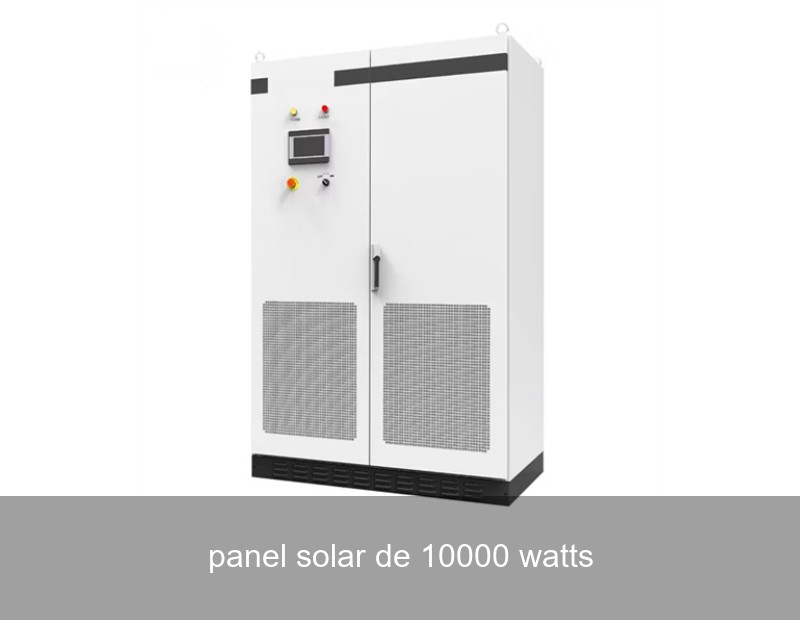
Image: A modern battery storage unit, like Highjoule's H2 Series, turns solar overproduction into reliable nighttime power.
Our EnergyOS software platform is the brain of the operation. It uses predictive algorithms based on weather forecasts and your consumption history to decide when to charge the battery from solar, when to discharge to power your home, and when to perform strategic grid charging (if beneficial). This ensures every possible kilowatt-hour from your 10kW array is put to optimal use, protecting you from peak-time electricity rates.
For larger applications, such as industrial sites or microgrids pairing a 10kW solar system with other generation, our MegaJoule Grid-Scale solutions provide utility-grade stability and management. We don't just sell hardware; we provide a complete, intelligent, efficient, and sustainable power solution tailored from residential to industrial scale.
Is a 10,000-Watt Solar System Right for You?
Deciding to invest in a high-output solar system requires careful analysis. Ask yourself and your energy consultant these questions:
- What is my total annual electricity consumption (kWh), and what is my peak demand (kW)?
- Do I have adequate, unshaded roof or ground space (south-facing in the Northern Hemisphere)?
- What are my local net metering or feed-in tariff policies? (Are exports to the grid poorly compensated, making storage essential?)
- Is my primary goal bill savings, backup power, environmental impact, or a combination?
- Have I modeled the system's performance with storage, not just panels alone?
The most successful solar projects are those planned holistically from day one. A 10kW solar array is a powerful engine, but without the right "fuel tank" and "navigation system"—a robust battery and intelligent software—you're not prepared for the full journey to energy independence.
What would you power first if you knew you had 10,000 watts of clean, reliable energy at your disposal every day?
 Inquiry
 Online Chat