


Unlocking Higher Efficiency: Your Guide to the 580W Solar Panel for Sale
If you're exploring solar options for your home or business, you've likely noticed a significant shift. The search for a "placa solar 580w for sale" is becoming more common, moving beyond the standard 400W or 450W modules. This isn't just a random number; it represents the forefront of photovoltaic technology, offering a powerful solution to generate more clean energy from the same rooftop space. But what makes these high-wattage panels so compelling, and are they the right choice for your project? Let's demystify the 580W solar panel and explore how it fits into a modern, intelligent energy system.
Why 580W is a Sweet Spot for Modern Solar Installations
The evolution towards 580W panels is a direct response to a universal challenge: maximizing energy output per square meter. For homeowners with limited roof space, or commercial operations aiming to meet a significant portion of their energy demand, every watt counts. A 580W panel, typically utilizing advanced monocrystalline PERC (Passivated Emitter and Rear Cell) or even TOPCon (Tunnel Oxide Passivated Contact) cells, packs more power into a slightly larger but highly efficient format. Think of it as upgrading from a standard car engine to a high-performance one—you get more power (kilowatt-hours) for your journey without needing a bigger garage (roof).
This efficiency translates into tangible benefits. You need fewer panels to reach your target system size, which can reduce installation time, balance-of-system costs (like racking and wiring), and often improve the overall aesthetics of the installation. For large-scale projects, the logistical advantages are even greater, simplifying shipping, handling, and installation of thousands of modules.

Image: High-wattage solar panels enable more power generation on limited roof space. (Source: Unsplash)
Key Features to Look for in a Quality 580W Panel
Not all 580W panels are created equal. When evaluating options for sale, focus on these critical specifications that guarantee long-term performance and reliability:
- Cell Technology: TOPCon or HJT (Heterojunction) cells often offer higher efficiency and better temperature coefficients than standard PERC, meaning they lose less power on hot days.
- Temperature Coefficient: This percentage (e.g., -0.29%/°C) indicates power loss as panel temperature rises. A lower (closer to zero) negative number is better for performance in warm climates.
- Durability Ratings: Look for panels certified to withstand heavy snow loads (≥ 5400 Pa), high winds (≥ 2400 Pa), and hail impact. This is non-negotiable for long-term ROI.
- Warranty: A strong product warranty (15+ years) and a linear performance warranty (guaranteeing 90%+ output after 25 years) are hallmarks of a manufacturer that stands behind its product.
A Real-World Case Study: Maximizing a Commercial Rooftop in Southern Spain
Let's move from theory to practice. A medium-sized food processing plant in Andalusia, Spain, faced rising energy costs and wanted to lock in long-term price stability. Their flat rooftop had space for a 250 kW system. Using standard 450W panels, the design called for 556 modules. However, by opting for premium 580W bifacial panels (which capture light from both sides), the same system capacity was achieved with only 431 panels.
The data speaks for itself. The Highjoule engineering team, which managed this project, calculated a 12% reduction in installation hardware and labor costs. More importantly, the bifacial gain and higher efficiency of the 580W panels led to an estimated annual energy yield increase of over 8% compared to the initial design. This case, detailed in a renewable energy case study archive, highlights how the right panel choice directly impacts project economics and energy yield. The plant now covers 65% of its daytime energy consumption, a figure made possible by the density of 580W technology.
| Parameter | 450W Panel Design | 580W Bifacial Panel Design | Advantage |
|---|---|---|---|
| Panels Required | 556 | 431 | 22.5% fewer panels |
| Estimated Installation Cost | €285,000 | €251,000 | €34,000 saved (12%) |
| Estimated Annual Yield | 385 MWh | 416 MWh | +31 MWh/year |
Beyond the Panel: The Critical Role of System Integration
Here's a crucial insight often overlooked: a high-power panel is only as good as the system it's connected to. A 580W panel operates at a higher current and voltage. Pairing it with an outdated or undersized inverter is like putting a sports car engine in a chassis with bicycle brakes—you won't realize its full potential and could even create safety risks.
This is where DC-optimized or microinverter systems shine. They ensure each panel, or a small string of panels, operates at its individual maximum power point (MPP), mitigating losses from shading, soiling, or module mismatch. For a roof with complex angles or occasional shading, this technology is essential to protect your investment in high-efficiency panels. The U.S. Department of Energy emphasizes that system-level design is key to maximizing the value of solar technology.
Highjoule's Smart Energy Solutions: Where 580W Panels Truly Shine
At Highjoule, we view the solar panel as the cornerstone of a broader energy ecosystem. Since 2005, we've specialized in integrating advanced hardware with intelligent software to create resilient and adaptive power solutions. Our approach ensures that when you source a "placa solar 580w for sale," it's not just a component purchase but a step towards a comprehensive energy strategy.
For instance, our Highjoule HPS Series hybrid inverters are specifically engineered to handle the high input power of modern 500W+ panels efficiently. More importantly, they are the brain of our AI-powered energy management system. This system doesn't just convert DC to AC; it learns your energy consumption patterns, weather forecasts, and utility rate schedules to intelligently decide in real-time whether to use solar power, store it in a connected Highjoule BESS (Battery Energy Storage System), or export it to the grid for maximum financial return.
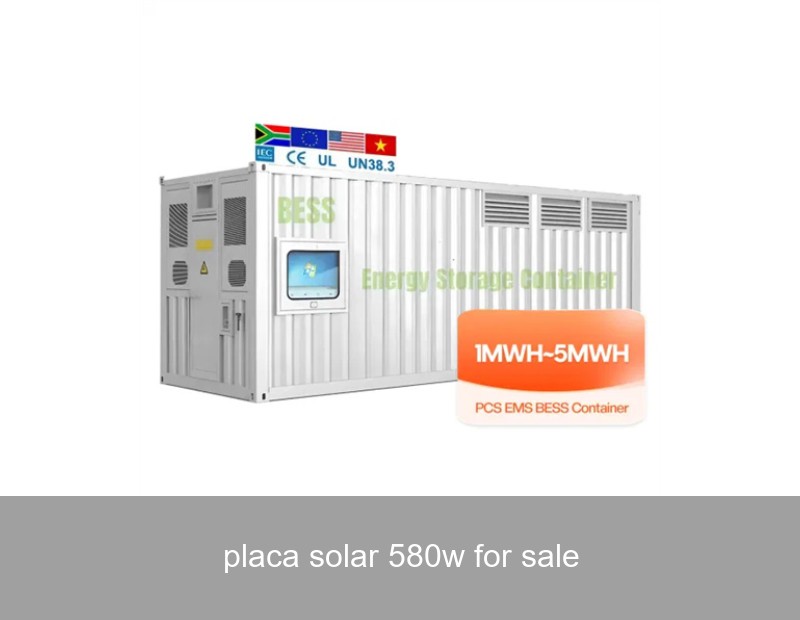
For commercial and industrial clients, this integration is vital. A factory can use 580W panels to generate massive amounts of solar energy during the day, store excess in a Highjoule containerized BESS, and then use that stored energy during expensive peak tariff periods in the evening, dramatically reducing demand charges and enhancing energy independence.

Image: Large-scale solar arrays paired with battery storage, like Highjoule's BESS, maximize ROI. (Source: Unsplash)
Making the Right Purchase: It's More Than Just a Panel
So, you're ready to search for a "placa solar 580w for sale." Before you click "buy," consider this final piece of advice: the cheapest panel per watt may end up being the most expensive long-term investment if it degrades quickly or isn't supported by robust system design and service.
Ask potential providers these questions:
- Can you provide a full system design that pairs these panels with compatible, high-efficiency inverters and mounting systems?
- How does your solution manage the higher electrical characteristics (voltage/current) of these panels for safety and performance?
- Do you offer an integrated monitoring and energy management platform to ensure I'm actually capturing the promised value from my high-power array?
The future of energy is not just about generation, but about intelligent control and storage. As you embark on your project, we leave you with this question: Is your goal simply to install solar panels, or is it to build a resilient, cost-effective, and intelligent energy asset for the next 25+ years?
 Inquiry
 Online Chat