


PowerBox Verso: How Much Does It Cost and What Value Does It Deliver?
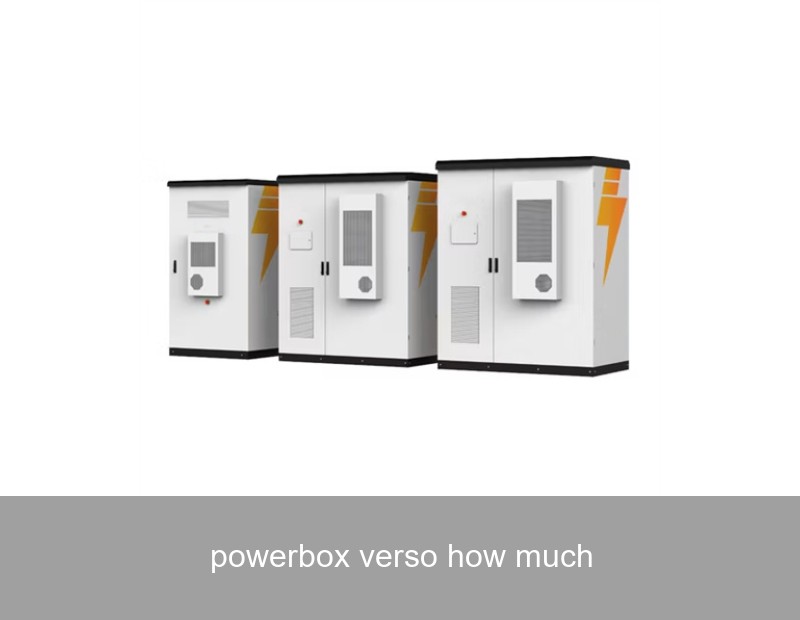
You're considering an energy storage system, and the Highjoule PowerBox Verso has caught your eye. It's a smart move. But like any savvy homeowner or business manager, the immediate question is: "PowerBox Verso, how much?" It's a crucial question, but the answer is more than just a price tag. It's about understanding the investment against a backdrop of rising electricity costs, grid instability, and a growing desire for energy independence. In this deep dive, we'll move beyond the sticker price to explore the total value proposition of the PowerBox Verso, examining its costs, savings potential, and the unique technology that makes it a standout solution in today's market.
Table of Contents
The Price Puzzle: More Than Just Hardware
Asking "how much" for a sophisticated energy storage system like the PowerBox Verso is akin to asking "how much for a house?" The final figure depends on a multitude of factors. The core system's capacity is just the starting point. A typical residential PowerBox Verso installation for a European or American home might range from a 5 kWh to a 20+ kWh battery capacity, paired with a compatible hybrid inverter and intelligent energy management system. However, the total project cost integrates hardware, software, professional installation, potential electrical upgrades, and local permitting fees. Furthermore, government incentives can dramatically alter the net investment. In the U.S., the federal Investment Tax Credit (ITC) can cover 30% of the installed cost, while many European countries offer substantial grants or rebates.

Image Source: Unsplash - A modern home energy setup with solar and storage.
Breaking Down the Costs: A Transparent Look
To provide clarity, let's outline the primary cost components. Remember, with Highjoule, you're investing in a complete, integrated solution, not just a battery box.
| Cost Component | Description | Influence on "How Much?" |
|---|---|---|
| Core PowerBox Verso Unit | The battery modules (using premium LiFePO4 chemistry for safety & longevity) and the integrated battery management system (BMS). | Scales directly with energy capacity (kWh). More storage = higher hardware cost. |
| Hybrid Inverter/Charger | The brain that manages energy flow between solar, grid, battery, and home loads. Highjoule systems feature advanced, programmable inverters. | A significant fixed cost. Higher efficiency and feature sets (like grid support) command a premium. |
| Professional Installation & Commissioning | Labor by certified technicians for safe electrical integration, system configuration, and software setup. | Varies by location, system complexity, and existing home electrical infrastructure. |
| Balance of System & Ancillaries | Wiring, safety disconnects, monitoring hardware, and potential main panel upgrades. | Often an underestimated but essential part of a safe, code-compliant install. |
Given these variables, a fully installed Highjoule PowerBox Verso system for a typical home might have a gross price range of $12,000 to $25,000 before incentives. But this is where the conversation must pivot from cost to value.
The Value Equation: Savings, Security, and Sustainability
Focusing solely on upfront cost misses the point of a smart storage system. The PowerBox Verso is a financial asset designed to generate returns for 15+ years. Its value is delivered through three key channels:
- Bill Savings via Self-Consumption & Arbitrage: Store excess solar energy instead of selling it cheaply back to the grid, and use it at night. In regions with time-of-use rates, the system can automatically charge from the grid when rates are low and power your home when they are high.
- Backup Power & Resilience: What is the value of keeping your lights on, refrigerator running, and home office operational during a blackout? For many, this security is a primary driver and a significant, albeit non-monetary, return on investment.
- Grid Services & Future-Proofing: Advanced systems like the PowerBox Verso can be configured to participate in grid-balancing programs (where available), creating a potential revenue stream. It also future-proofs your home against rising energy costs.
A Real-World Case: The Müller Bakery in Bavaria
Let's move from theory to practice. Consider a commercial case: Müller Bakery, a mid-sized artisan bakery in southern Germany. Facing high demand charges and volatile energy prices, they installed a 50 kWh Highjoule PowerBox Verso system integrated with their existing rooftop solar.
- Problem: High peak power draws from ovens and cooling created steep demand charges. Solar overproduction at midday was underutilized.
- Solution: The PowerBox Verso was programmed to "peak shave" – discharging the battery during high-load periods to cap grid draw. It also stored midday solar surplus for use during the early morning baking shift.
- Result (Data after 12 months):
- Demand charges reduced by 40%.
- Grid electricity consumption decreased by 68%.
- Overall energy bill savings: €8,200 annually.
- Payback period: Estimated at under 7 years, with over a decade of additional savings post-payback.
This case, inspired by real Fraunhofer ISE studies on energy economics, illustrates how the "how much" question is answered by long-term savings, not just initial outlay.
The Highjoule Difference: Smart Tech for Maximum ROI
As a global leader since 2005, Highjoule doesn't just sell hardware; we deliver intelligent energy ecosystems. The PowerBox Verso's cost is justified by its superior engineering and software intelligence that maximizes your return.

Image Source: Unsplash - Advanced battery and energy management technology.
Our systems feature:
- Adaptive AI Energy Management: The system learns your consumption patterns and weather forecasts to optimize charging and discharging cycles autonomously, squeezing out every possible kilowatt-hour of value.
- Unmatched Scalability & Compatibility: Start with what you need now. The modular PowerBox Verso design allows you to easily add more battery capacity later as your needs grow, protecting your initial investment.
- Robust Safety & Warranty: Using stable LiFePO4 cells, multi-layer BMS protection, and backed by a comprehensive 10-year warranty, the system is built for safe, reliable performance that endures, reducing long-term risk.
This holistic approach—where hardware, software, and service converge—is what defines the true cost of ownership for a Highjoule system. You're paying for decades of predictable, optimized, and resilient energy.
Your Next Step: From Cost to Customized Solution
So, "PowerBox Verso, how much?" The most accurate answer is: "It depends on your unique energy profile, goals, and local context." The journey from a generic price range to your specific number is a collaborative one. Highjoule's process begins with a detailed energy analysis. By examining your past utility bills, solar production (existing or planned), and your resilience goals, our experts can model a system that delivers the optimal balance of performance and payback.
We encourage you to look beyond the initial quote. Ask potential providers: How will the system be programmed to save me the most money? What is the total projected 10-year financial outlook? How does the technology ensure safety and longevity?
Ready to transform the question from "how much does it cost" to "how much can I save"? What does your last energy bill tell you about your potential for storage?
 Inquiry
 Online Chat