


Decoding "Price Solar Cell for Sale": Your Guide to Smart Solar Investment
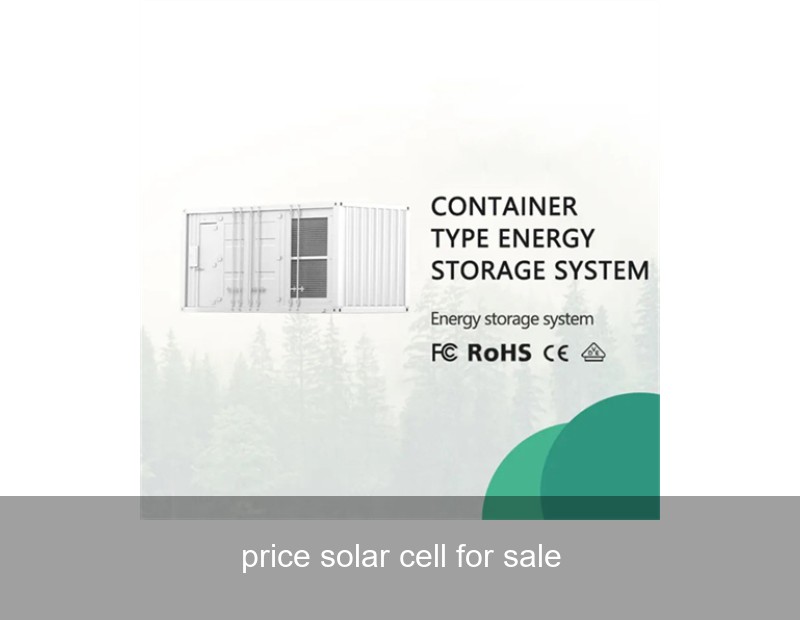
If you're searching for "price solar cell for sale," you're likely at the exciting beginning of your solar journey. It's a smart move, but here's a crucial insight from the industry: focusing solely on the cost per watt of an individual solar panel is like buying a car engine and expecting a smooth ride. The true value and return on your investment come from the entire, seamlessly integrated system. In this guide, we'll peel back the layers on solar pricing, explain what truly drives long-term value, and show you how pairing solar with intelligent storage unlocks the full potential of your renewable energy investment.
Key Factors Influencing Solar Cell Cost
Let's start with the basics. When you see a "price solar cell for sale," several technological and market factors are at play. Understanding these helps you compare options beyond just the sticker price.
- Cell Technology: Traditional polycrystalline cells are often more budget-friendly. Monocrystalline cells, with their higher efficiency (converting more sunlight to power in the same space), command a premium. Emerging technologies like PERC (Passivated Emitter and Rear Cell) or bifacial panels (which capture light from both sides) offer even greater performance for specialized applications.
- Efficiency Rating: A higher efficiency percentage means you need fewer panels to meet your energy goals. This can reduce balance-of-system costs like racking and labor, making a slightly more expensive, high-efficiency panel more economical overall.
- Manufacturing Scale & Supply Chain: Global demand, raw material (like polysilicon) prices, and trade policies can cause market fluctuations. For instance, the U.S. Inflation Reduction Act and European Green Deal initiatives are shaping local manufacturing and pricing dynamics.
- Brand & Warranty: Established manufacturers often price their products higher, backed by robust 25+ year linear performance warranties and proven reliability. This long-term peace of mind is a significant part of the value proposition.

Image Source: Unsplash - High-efficiency solar cells are a key component, but the full system determines value.
Beyond the Cell: The Real Cost is the Total System
Now, let's zoom out. The solar panel is just one component. The installed cost includes inverters (which convert DC solar power to usable AC), mounting hardware, electrical components, permitting, and professional installation. More importantly, the operational cost is defined by how much of the generated power you can actually use.
This is the modern energy dilemma: without storage, excess solar power produced midday is often exported to the grid at a low rate, only for you to buy back expensive power in the evening. The U.S. Department of Energy highlights integration as a key challenge. This drastically reduces the system's financial and practical value. The most savvy buyers looking for "price solar cell for sale" are now asking, "What is the price for a complete, self-sufficient energy solution?"
| Consideration | Solar-Only System | Solar + Highjoule BESS |
|---|---|---|
| Self-Consumption | Typically 30-50% (depends on daytime usage) | Up to 80% or more |
| Grid Dependence | High - vulnerable to outages & price hikes | Low - can operate independently (island mode) |
| Bill Savings Potential | Moderate, capped by net metering policies | Maximized, by avoiding peak tariffs |
| Long-Term ROI | Good, but subject to grid volatility | Excellent, with predictable energy costs |
Case Study: Maximizing ROI for a European Agri-Business
Let's look at real data. A medium-sized winery in Southern France was evaluating solar quotes. The cheapest "price solar cell for sale" option offered a 100kW system for €85,000. However, their energy consumption spiked during evening cooling and processing, misaligned with solar production.
They chose a different path: a slightly smaller 80kW system integrated with a Highjoule HI-Stack 100 battery energy storage system (BESS). The total project cost was €135,000—higher upfront. But let's examine the outcome:
- Energy Autonomy: The system stores midday surplus, powering evening operations. Grid electricity use during peak hours dropped by over 90%.
- Financials: By avoiding peak-time grid purchases and participating in a grid flexibility program, their annual energy bill savings increased from an estimated €12,000 (solar-only) to over €28,000.
- Payback & Resilience: The integrated system's payback period was calculated at 5.2 years, better than the solar-only option's 6.5 years when factoring in rising energy costs. Furthermore, they now have critical backup power for refrigeration during grid outages, protecting their valuable inventory.
This case, mirrored in many European Commission JRC studies on PV potential, proves that optimal value lies in system synergy, not component cost.
Highjoule: Where Intelligent Storage Meets Solar Value
This is where Highjoule's expertise transforms a simple solar purchase into a strategic energy asset. Since 2005, we've moved beyond just providing components to delivering intelligent, integrated power solutions.
Our HI-Stack Commercial & Industrial (C&I) Series battery storage systems are engineered to pair perfectly with new or existing solar arrays. They feature advanced lithium-iron-phosphate (LFP) battery chemistry for safety and longevity, coupled with our proprietary energy management system (EMS). This software is the brain of the operation, intelligently deciding when to store solar energy, when to discharge it, and even when to participate in grid services for additional revenue—all tailored to your specific consumption patterns and local utility rates.
For residential and smaller commercial applications, our Home Energy Hub offers a sleek, all-in-one solution that simplifies the transition to energy independence. By integrating with Highjoule storage, the question shifts from "price solar cell for sale" to "what is the value of predictable, controlled, and resilient clean energy for my home or business?"

Image Source: Unsplash - A modern BESS, like Highjoule's HI-Stack, is key to unlocking solar's full value.
Making the Right Investment for Your Needs
So, how should you approach your search? Start by auditing your energy usage. Look at your utility bills—identify your baseline consumption and peak demand charges. This data is gold. Then, partner with a certified installer who can model different scenarios: solar-only versus solar-plus-storage. Reputable installers will use tools like NREL's PVWatts Calculator and provide detailed financial analyses.
When evaluating quotes, scrutinize the levelized cost of energy (LCOE) over 20+ years, not just the installation cost. Ask about system expandability, software capabilities, and the warranty on both performance and cycle life for batteries.
Your Next Step
Given the evolving energy landscape in Europe and the U.S., with rising prices and increasing grid volatility, what specific energy challenge—be it unpredictable bills, demand charges, or resilience—is most critical for your home or business to solve with solar today?
 Inquiry
 Online Chat