


PV Edge Grid Connect Battery: The Smart Key to Unlocking Solar's Full Potential
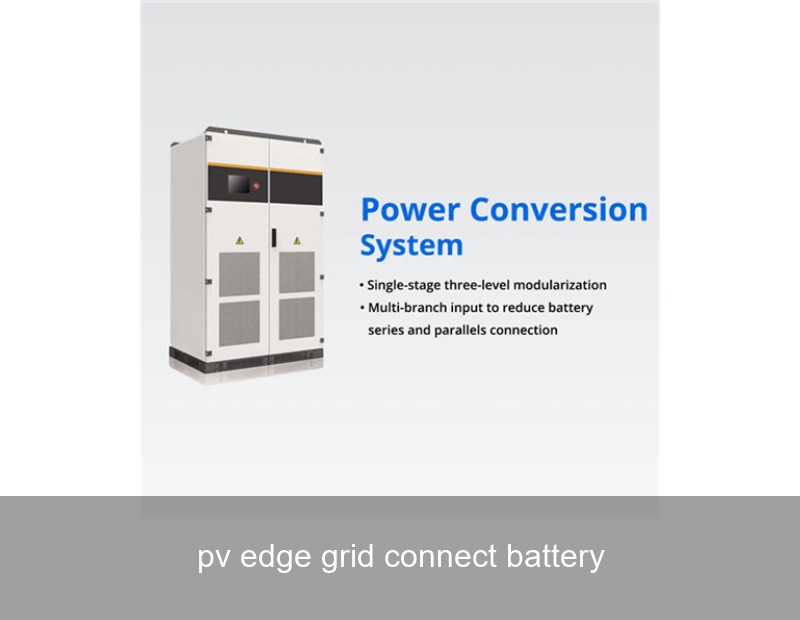
Have you ever looked at your solar panels on a cloudy day and wondered where all that clean energy goes? Or perhaps you've heard about grid constraints limiting new solar installations in your area. This is where the concept of a PV edge grid connect battery becomes not just useful, but essential. It's the intelligent bridge between your personal solar power and the wider electricity network, optimizing energy use right at the "edge" of the grid—your home or business. For over 18 years, Highjoule has been at the forefront of this intelligent energy revolution, designing systems that don't just store power, but think for themselves.
Table of Contents
- The Modern Grid Challenge: Too Much of a Good Thing?
- What Exactly is a PV Edge Grid Connect Battery System?
- By the Numbers: The Tangible Benefits of Edge Battery Storage
- Case Study: Stabilizing a European Microgrid
- The Highjoule Solution: Intelligence at the Edge
- The Future Outlook: Smarter Grids Start at the Edge
The Modern Grid Challenge: Too Much of a Good Thing?
Here's a paradox many regions in Europe and the US now face: we desperately need more solar power to meet decarbonization goals, but the traditional electricity grid is struggling to handle it. The issue isn't generation; it's integration. Solar production peaks in the middle of the day, often creating a surplus that can overload local transformers and distribution lines. This phenomenon, sometimes called the "duck curve," forces grid operators to curtail (waste) solar energy or delay new connections. It's a frustrating bottleneck for the energy transition.

Image Source: U.S. Department of Energy (Public Domain)
This is the core problem a PV edge grid connect battery is designed to solve. Instead of pushing all surplus solar energy onto the grid immediately, these systems store it locally for later use—smoothing out the peaks and valleys for both the consumer and the utility.
What Exactly is a PV Edge Grid Connect Battery System?
Let's break down the name to understand its power:
- PV: Photovoltaic. Your solar panels.
- Edge: The point where energy is consumed or generated, typically a home, factory, or commercial building. It's the "edge" of the centralized grid network.
- Grid Connect: The system remains connected to the main utility grid, enabling two-way energy flow when beneficial.
- Battery: The storage unit, typically lithium-ion, that holds the excess solar energy.
In essence, it's an intelligent energy manager. It makes real-time decisions: should solar power charge the battery, power the building, or be exported to the grid based on tariffs, grid needs, and consumption patterns? This intelligence is what separates a modern solution from a simple backup power unit.
By the Numbers: The Tangible Benefits of Edge Battery Storage
The value proposition is backed by compelling data. According to a 2023 report by the National Renewable Energy Laboratory (NREL), distributed storage can reduce peak demand on distribution feeders by 20-40%. Let's translate that into real-world benefits for you:
| Benefit | Impact for Homeowner/Business | Impact for the Grid |
|---|---|---|
| Increased Self-Consumption | Can increase direct solar usage from ~30% to 60-80%, slashing electricity bills. | Reduces mid-day solar flooding and associated volatility. |
| Peak Shaving | Use stored energy during expensive peak-rate hours (e.g., 4-9 pm). | Deferrs costly grid infrastructure upgrades by flattening demand. |
| Grid Services | Potential revenue by providing frequency regulation or capacity to utilities (in some markets). | Enhances stability and reliability, integrating more renewables. |
| Backup Power | Provides resilience during grid outages, keeping lights on. | Reduces restoration burden after widespread outages. |
Case Study: Stabilizing a European Microgrid
Consider the real-world challenge faced by a small municipality in Southern Germany. With a high penetration of residential PV, the local low-voltage grid experienced frequent voltage spikes on sunny days, threatening equipment and limiting further solar expansion. Their solution was a coordinated network of PV edge grid connect batteries.
The project involved deploying Highjoule's HES-Stack Commercial systems across 50 households and a local school. These systems were equipped with advanced grid-aware software that allowed them to respond to local grid conditions. The results over a 12-month period were significant:
- Grid Voltage Violations Reduced by 92%: The batteries absorbed excess solar, keeping voltage within safe limits.
- Local Solar Curtailment Eliminated: No solar energy was wasted, maximizing community investment.
- Average Household Grid Import Reduced by 73%: Most energy needs were met by solar + storage.
This case demonstrates that when individual PV edge grid connect battery systems are deployed with intelligence, they aggregate into a virtual power plant that solves grid problems at the community level.
The Highjoule Solution: Intelligence at the Edge
At Highjoule, we believe the hardware is only half the story. Our PV edge grid connect battery systems, like the HES-Stack for residential and HES-Stack Commercial/Industrial series, are built around our proprietary Adaptive Grid Interface (AGI) software platform. This is what makes our solution truly "smart."

Image Source: Unsplash (License: Free to use)
Our AGI platform enables:
- Predictive Energy Management: Using weather forecasts and usage history to optimize charge/discharge cycles.
- Grid-Friendly Mode: Systems can be configured to prioritize grid stabilization, automatically reducing export during periods of local congestion.
- Seamless Integration: Our systems are designed to work with both new and existing solar installations, providing a straightforward upgrade path to energy independence.
- Remote Monitoring & Diagnostics: Homeowners and installers can track performance via a user-friendly app, while Highjoule's support team can provide proactive maintenance.
We don't just sell a battery; we provide a future-proof energy asset that grows in value as the grid evolves.
The Technical Edge: What to Look For
When evaluating a PV edge grid connect battery, key specifications matter. Look for:
- Round-Trip Efficiency (RTE): Highjoule systems achieve over 96% RTE, meaning minimal energy is lost in storage.
- Depth of Discharge (DoD): Our batteries allow 100% DoD, meaning you can use all the stored energy without harming the battery lifespan.
- Scalability: Modular design allows you to start with a base unit and expand storage capacity as your needs grow.
- Grid Service Readiness: Ensure the system's software and hardware are capable of participating in future utility programs for additional revenue.
The Future Outlook: Smarter Grids Start at the Edge
The energy grid of the future will be decentralized, digital, and dynamic. It will rely less on massive power plants and more on millions of coordinated assets at the edge—like your solar panels and battery. A PV edge grid connect battery is your ticket to participating in this new energy economy, not just as a consumer, but as an active prosumer.
With policies like the EU's Smart Grids initiative and the US Inflation Reduction Act's storage incentives, the economic and regulatory landscape is increasingly favorable. The question is no longer if edge storage will become mainstream, but when.
Is your home or business ready to become an intelligent node in a cleaner, more resilient grid? What would you do with a personal energy system that not only saves you money but also contributes to community-wide grid stability?
 Inquiry
 Online Chat