


Understanding Solar Inverter Rankings: A Guide to Smarter Energy Choices
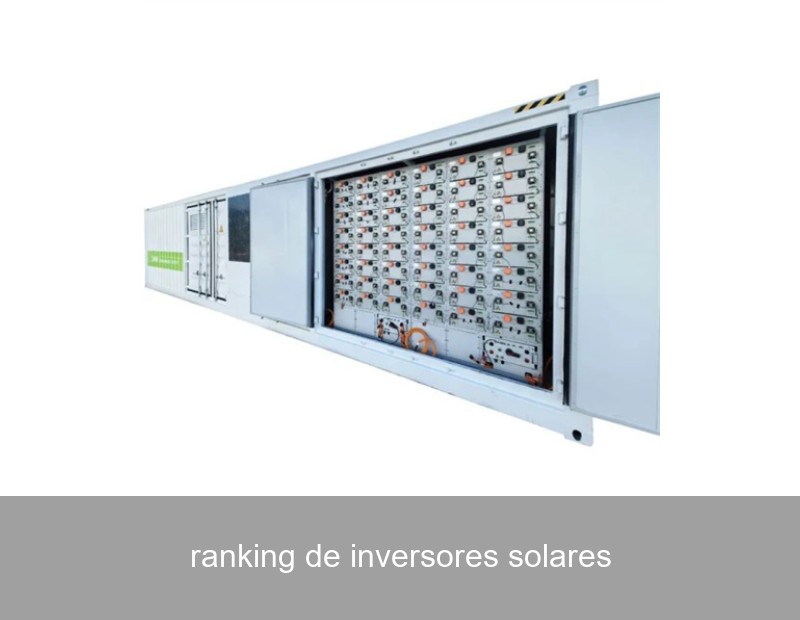
If you're looking into solar power for your home or business, you've likely encountered the term "ranking de inversores solares" or solar inverter rankings. But what do these lists really tell you? Simply picking the top name on a chart might not get you the best system for your specific needs. A truly smart energy setup goes beyond the inverter itself—it's about how all components, especially the battery, work in harmony. This is where understanding these rankings, paired with the right storage technology, becomes crucial for long-term savings and energy independence.
Table of Contents
- What Are Solar Inverter Rankings Really Measuring?
- Beyond Efficiency: The Critical Role of Energy Storage
- Case Study: A German Bakery's Recipe for Energy Resilience
- The Highjoule Solution: Intelligent Storage as the System's Brain
- Choosing Your System: Key Questions to Ask
What Are Solar Inverter Rankings Really Measuring?
Solar inverter rankings typically evaluate individual inverters on metrics like peak efficiency, reliability data from installers, warranty terms, and cost. These are important, no doubt. A high-ranking inverter efficiently converts the DC electricity from your panels into usable AC power for your home. However, this is only one part of the modern energy equation. Think of it this way: you might buy the most efficient engine on the market, but if your car's transmission and fuel system aren't perfectly matched, you won't achieve optimal performance.
Most rankings focus narrowly on the conversion efficiency at a single point in time. They often don't account for how the inverter performs when integrated with a battery storage system over the system's entire 15-25 year lifespan. Does it communicate seamlessly with the battery management system? Can it handle rapid shifts from grid-tied to off-grid mode during an outage? These operational intelligence factors are what separate a good system from a great one.
The Hidden Factor: System Integration
Your inverter is the conductor, but your battery storage system is the orchestra. The quality of communication between them dictates the symphony of your energy flow. A top-tier inverter paired with a mediocre battery system can lead to:
- Reduced Battery Lifespan: Poor communication can cause improper charging cycles.
- Inefficient Energy Use: Excess solar might be wasted instead of intelligently stored.
- Unreliable Backup Power: A clunky transition during a blackout can leave you in the dark.
Beyond Efficiency: The Critical Role of Energy Storage
The solar landscape has fundamentally shifted. The end goal is no longer just to offset grid consumption when the sun shines, but to maximize self-consumption and provide resilience. This is where your choice of battery energy storage system (BESS) becomes paramount. It's the cornerstone that determines how much of your self-generated power you actually get to use.
Let's look at some compelling data. According to the U.S. Department of Energy, solar power is one of the fastest-growing electricity sources. Yet, without storage, a typical household might only use 30-50% of its solar generation directly. The rest is exported to the grid, often at a lower price than retail electricity. A high-performance storage system can push that self-consumption rate to 70% or higher, dramatically increasing your return on investment.

Image Source: Unsplash. A modern energy-independent home requires more than just panels; it needs intelligent storage.
Case Study: A German Bakery's Recipe for Energy Resilience
Consider the real-world example of Schmidt & Söhne, a family-owned bakery in Bavaria, Germany. They installed a 50 kWp solar array with a standard, high-efficiency inverter. While their daytime energy costs dropped, they still faced high demand charges and had no protection against the region's occasional grid instability, which threatened their refrigeration units.
Their solution wasn't to change the inverter. Instead, they integrated a Highjoule HI-Core 30 Commercial battery storage system. The results, monitored over one year, were telling:
| Metric | Before Highjoule Storage | After Highjoule Storage |
|---|---|---|
| Self-Consumption of Solar | 41% | 89% |
| Grid Energy Demand During Peak Hours | ~85 kWh/day | ~12 kWh/day |
| Estimated Annual Savings | €6,200 | €14,800 |
The Highjoule system's intelligent controller acts as the central brain, deciding in milliseconds whether to power loads, charge the battery, or sell excess back to the grid, all while respecting the inverter's optimal operating parameters. For Schmidt & Söhne, this meant turning their solar investment into a true asset that provides both savings and uninterrupted operation—a critical need for any food business.
The Highjoule Solution: Intelligent Storage as the System's Brain
At Highjoule, we believe the storage system should elevate the entire energy ecosystem. Our products are designed to integrate seamlessly with a wide range of top-ranked solar inverters, enhancing their value rather than competing with them.
Our HI-Power Home Series and HI-Core Commercial Series are built around a sophisticated Energy Management System (EMS). This isn't just a battery box; it's the intelligent core of your power setup. Here’s how it complements your solar inverter choice:
- Advanced Communication Protocols: We ensure flawless dialogue between our batteries and major inverter brands, enabling perfect charging cycles and system health monitoring.
- Peak Shaving & Load Shifting: Our systems automatically store solar energy to use during expensive peak-rate periods, a feature most inverters alone cannot manage.
- Seamless Backup Power: In the event of a grid outage, the transition to backup power is sub-20 milliseconds—so fast that your lights won't even flicker.
- Scalable Design: Start with what you need and expand your storage capacity as your energy needs grow, protecting your initial investment.
By focusing on the intelligence behind the storage, Highjoule ensures that your investment in a high-ranking solar inverter delivers its full potential for decades. We provide the missing piece that turns a simple solar producer into a resilient, intelligent, and money-saving energy asset.
Image Source: Unsplash. The heart of a modern energy system: a sophisticated battery storage unit like Highjoule's HI-Core Series.
Choosing Your System: Key Questions to Ask
So, when you're evaluating "ranking de inversores solares," how do you make a decision that stands the test of time? Shift your focus from just the inverter to the total system performance. Here are critical questions to discuss with your installer:
- System Synergy: "How will this specific inverter communicate and optimize performance with the battery storage system you're recommending?"
- Long-Term Value: "Can the storage system be easily expanded if my energy needs increase in 5 years?"
- Resilience Testing: "Can you demonstrate the system's switch-to-backup performance during a simulated grid failure?"
- Software Intelligence: "What kind of energy management software comes with the system, and how does it help me save more money over time?"
For further independent research on inverter performance and standards, organizations like the National Renewable Energy Laboratory (NREL) provide valuable technical resources.
Your Energy Future
The journey to energy independence is exciting. Remember, the highest-ranked component doesn't guarantee the highest-performing system. True power lies in intelligent integration. As you consult those solar inverter rankings, ask yourself: is my goal just to buy an efficient component, or is it to build a smarter, more resilient, and truly independent energy future for my home or business?
What specific energy challenge—be it unpredictable bills, frequent outages, or a desire for true sustainability—are you most hoping to solve with your new solar and storage system?
 Inquiry
 Online Chat