


Unlocking Energy Independence: Your Complete Guide to a Solar Panel with Battery Bank
Imagine a sunny afternoon. Your solar panels are working hard, but you're at the office. Where does all that clean power go? For years, without a battery, it simply fed back into the grid. Now, picture a different scenario: that excess energy is stored in your home, ready to power your evening, charge your EV, and keep the lights on during an outage. This is the transformative promise of pairing a solar panel with battery bank. This integrated system is no longer a luxury; it's becoming the cornerstone of a resilient, efficient, and self-sufficient energy home. Let's explore how this technology works and why it's a game-changer for homeowners in Europe and the US.
Table of Contents
- The Phenomenon: From Sunlight to Security
- The Data: Why Storage is the Missing Piece
- A Real-World Case Study: The Smith Family in California
- Understanding the Components: More Than Just Panels and a Box
- The Highjoule Difference: Intelligent Storage Solutions
- Making the Decision: Is a Solar Battery Bank Right for You?
The Phenomenon: From Sunlight to Security
For decades, residential solar was a one-way street. Panels generated power when the sun shone, and any surplus was exported. This model worked, but it had a fundamental flaw: temporal mismatch. Our energy consumption peaks in the early morning and evening, often when solar production is low or nonexistent. A solar panel with battery bank solves this by shifting energy in time. It captures the midday surplus and holds it for when you truly need it, aligning production with consumption perfectly.
This shift transforms your relationship with the grid. You become less of a consumer and more of a prosumer—managing your own micro-energy ecosystem. The benefits are tangible: reduced electricity bills, backup power during outages, and a significantly larger personal contribution to decarbonization.
The Data: Why Storage is the Missing Piece
The numbers tell a compelling story. According to the U.S. Department of Energy, the cost of lithium-ion batteries, the core of most home systems, has fallen by nearly 90% in the last decade. Coupled with incentives like the U.S. Investment Tax Credit (ITC) and various European subsidies, the economic case is stronger than ever.
Consider this typical breakdown for a home in Germany or Texas:
| Scenario | Solar Only | Solar + Battery Bank |
|---|---|---|
| Self-Consumption | 30-40% | 70-80%+ |
| Grid Dependence at Night | High | Low to None |
| Resilience During Outage | None | Full Backup (Hours to Days) |
| Bill Savings Potential | Good | Excellent |
The data is clear: adding storage dramatically increases the value and utility of your solar investment.

Image: A modern home energy system integrating solar and storage. The battery unit (often called an AC battery) is neatly installed alongside the home. Credit: Unsplash
A Real-World Case Study: The Smith Family in California
Let's move from theory to practice. The Smith family in Sacramento, California, installed a 8kW solar array in 2020. While their summer bills plummeted, they still faced high charges during cloudy winter months and were anxious about Public Safety Power Shutoffs (PSPS). In 2023, they added a 13.5kWh battery bank to their system.
The results after one year were striking:
- Grid Independence: Their grid electricity import dropped by 94% annually.
- Financial: Their annual electricity bill went from an average of $1,200 post-solar to just under $150 (covering basic connection fees).
- Resilience: During a 14-hour grid outage, their home—including refrigeration, lights, internet, and essential outlets—operated seamlessly on battery power, still ending the day with 35% charge left.
- Environmental: Their household's carbon footprint from electricity was reduced by an estimated 98%.
The Smiths' experience, mirrored by thousands in Europe facing volatile energy prices, underscores that a solar panel with battery bank is an investment in both financial predictability and peace of mind.
Understanding the Components: More Than Just Panels and a Box
It's crucial to understand what makes up a high-performing system:
- Solar Panels: The generation asset. Modern high-efficiency panels produce more power in limited space.
- Battery Bank: The heart of storage. Typically using Lithium Iron Phosphate (LFP) chemistry for safety and longevity, it's rated by its usable energy capacity (kWh) and continuous power output (kW).
- Hybrid Inverter or System Controller: The brain. This critical device manages energy flow—from panels to home, to battery, and to grid. It must be intelligent and fast-acting.
Not all systems are created equal. An integrated solution, where all components are designed to communicate perfectly, offers superior efficiency, safety, and lifespan compared to a mix of disparate brands.
The Highjoule Difference: Intelligent Storage Solutions
This is where Highjoule's expertise shines. Since 2005, we've been at the forefront of advanced energy storage, designing systems that are not just components, but orchestrated solutions. For the residential and commercial market, our HES-1 Home Energy System exemplifies this philosophy.
The HES-1 is a fully integrated AC-coupled system, meaning it can be easily added to existing solar installations or designed into new ones. Its key features address the very challenges we've discussed:
- Adaptive Learning Software: Our system learns your consumption patterns and weather forecasts to optimize charging and discharging cycles, maximizing your self-consumption and savings.
- Seamless Backup Power: In the event of a grid failure, the HES-1 switches to backup mode in less than 20 milliseconds—so fast that your computers and lights won't even flicker.
- Scalable Design: Starting at 10kWh, the modular design allows you to expand capacity as your needs grow, protecting your investment long-term.
- Grid Services Ready: In some regions, our systems can participate in virtual power plant (VPP) programs, allowing you to earn revenue by supporting grid stability.
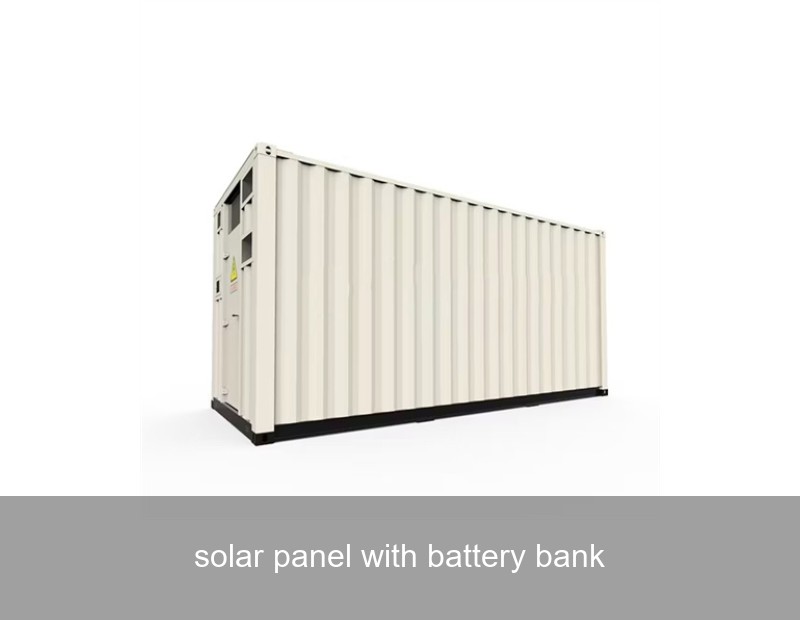
For larger commercial and microgrid applications, Highjoule's CESS Cube provides containerized, utility-grade storage that brings the same intelligence and reliability to businesses, factories, and communities. Our focus is always on delivering not just power, but predictable, sustainable, and controllable energy.

Image: Professional installation and monitoring are key for large-scale systems. Highjoule's commercial solutions are engineered for reliability. Credit: Unsplash
Making the Decision: Is a Solar Battery Bank Right for You?
Deciding to invest in a solar panel with battery bank system involves a few key considerations. Ask yourself:
- Is my goal maximum bill savings, backup power, or both?
- What is my typical nightly energy consumption (in kWh)?
- Does my utility have time-of-use rates or unfavorable net metering policies?
- How frequent and long are grid outages in my area?
Consulting with a certified installer who can model your home's specific energy profile is the essential first step. They can analyze your past bills, assess your roof, and provide a clear projection of costs, savings, and system sizing.
Looking Ahead: The Future is Integrated and Intelligent
The next evolution, already underway, is the full integration of electric vehicles (EVs), heat pumps, and smart appliances into this home energy system. Imagine your EV acting as an additional battery bank, or your system automatically charging your battery when grid carbon intensity is lowest. This holistic management is the future, and it's built on the foundation of a robust solar panel with battery bank system. Resources like the International Energy Agency consistently highlight this integration as critical for a clean energy transition.
So, as you consider taking control of your energy future, what specific concern about your home's power reliability or electricity bill would you most want a battery bank to solve?
 Inquiry
 Online Chat