


Building a Resilient Renewable Energy Facility: Beyond Generation
Imagine this: a vast solar farm basking under the midday sun, its panels converting photons into a steady stream of clean electricity. Now, imagine that same facility as the sun sets and the grid demand peaks. Without a crucial component, its output plummets to zero, leaving a gap often filled by fossil fuels. This is the central puzzle of the modern renewable energy facility. It's no longer just about generating power; it's about delivering reliable, dispatchable, and intelligent energy on demand. The true measure of success for any renewable project today is not just its nameplate capacity, but its ability to act as a steadfast pillar of the grid, day and night. This evolution requires a shift in mindset—from seeing storage as an optional add-on to recognizing it as the essential brain and battery of the entire operation.
The Intermittency Challenge: Phenomenon
Let's be honest, we all know the Achilles' heel of renewables: the sun doesn't always shine, and the wind doesn't always blow. This intermittency isn't just a technical hiccup; it's a fundamental challenge for grid operators who must balance supply and demand in real-time, every second of the day. A renewable energy facility that only operates part-time can create volatility, leading to curtailment (wasting clean energy) or, conversely, forcing reliance on quick-start gas peaker plants during shortfalls. This seesaw effect can undermine both the economic and environmental goals of the project. The phenomenon is clear—generation alone is insufficient for a sustainable, resilient grid.
The Grid Stability Data
The numbers paint a compelling picture. According to the U.S. Energy Information Administration (EIA), wind and solar generation are often highest when demand isn't, creating a mismatch. In markets like California (CAISO), renewable energy facility curtailment has reached significant levels during periods of low demand and high production. More critically, as renewable penetration increases, the grid loses the inherent inertia provided by spinning masses in traditional thermal plants, which is vital for frequency stability. A 2023 study by the National Renewable Energy Laboratory (NREL) emphasized that adding energy storage is key to achieving high renewable penetration, with the potential to support grid stability and reduce integration costs. The data unequivocally points to the need for a buffer—a solution that can time-shift energy and provide grid services.

Image Source: Unsplash - A modern solar farm, a key part of a renewable energy facility.
Case Study: The Texas Microgrid
Consider a real-world application in West Texas, a region abundant with wind but prone to grid isolation events. A commercial and industrial campus, reliant on its own wind turbines, faced frequent power quality issues and vulnerability during grid disturbances. Their goal was to transform their onsite generation into a truly resilient renewable energy facility.
The solution was an integrated Battery Energy Storage System (BESS) paired with advanced control software. The 5 MW / 10 MWh storage system was designed to perform multiple revenue-generating and protective functions:
- Energy Time-Shifting: Storing excess wind energy at night and discharging it during the afternoon peak.
- Frequency Regulation: Providing fast-responding signals to help stabilize the local grid.
- Black Start Capability: Allowing the facility to restart its own operations without the main grid.
The results were transformative. Within the first year, the facility reduced its demand charges by over 30%, generated significant revenue through grid service programs, and, most importantly, maintained critical operations during a major grid voltage dip that would have previously caused a shutdown. This case demonstrates that a renewable energy facility with intelligent storage is not a cost center, but a strategic asset enhancing both economics and resilience.
The Intelligent BESS: Insight
So, what separates a simple battery pack from the intelligent core of a modern renewable energy facility? The insight lies in software and system integration. An advanced BESS is more than just cells in a container; it's an orchestration platform. It uses sophisticated algorithms and forecasting (for weather, load, and electricity prices) to make millisecond-by-millisecond decisions: should it store, discharge, or hold? Should it prioritize self-consumption, arbitrage, or frequency support? This intelligence maximizes the Return on Investment (ROI) by stacking multiple value streams—a concept known as value stacking. The storage system becomes the active manager, ensuring every kilowatt-hour of renewable energy is used optimally, whether for saving money, generating revenue, or securing the site.
Key Components of a Modern Renewable Energy Facility
To visualize this integrated approach, let's break down the key technological layers:
| Component | Primary Role | Contribution to Facility Value |
|---|---|---|
| Generation (PV, Wind) | Primary energy production | Source of clean, low-cost electrons. |
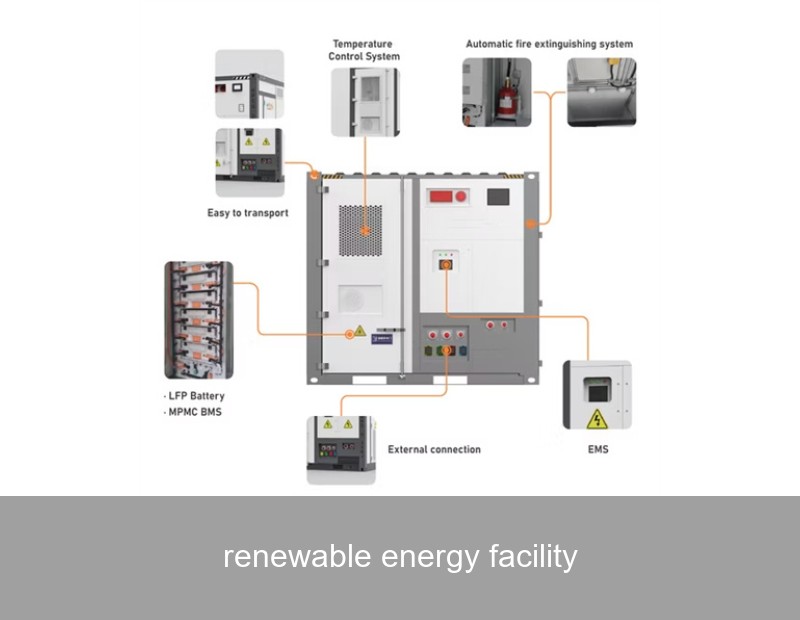
| Battery Energy Storage System (BESS) | Energy buffering & grid services | Enables dispatchability, stability, and revenue stacking. |
| Power Conversion System (PCS) | DC-AC conversion & grid connection | The "interpreter" between storage, generation, and the grid. |
| Energy Management System (EMS) | Brain of the operation | Optimizes performance across all value streams using AI and forecasts. |
| Thermal Management & Safety | System reliability & longevity | Ensures safe operation and maximizes system lifespan in all climates. |

Image Source: Unsplash - Technicians monitoring a battery energy storage control system.
Highjoule: Your Partner in Sustainable Power
This is where Highjoule's nearly two decades of expertise becomes critical. Since 2005, we've moved beyond simply supplying hardware to delivering complete, intelligent power solutions. We understand that a successful renewable energy facility requires seamless integration. Our HPS Series containerized BESS solutions are engineered for utility, commercial, and industrial scales, featuring industry-leading safety standards, robust thermal management for diverse climates from Scandinavia to the Southern US, and high cycle life. More importantly, our proprietary JouleMind AI EMS is the intelligence layer that unlocks true value. It doesn't just react; it predicts and optimizes, making your renewable asset work smarter and harder across energy arbitrage, demand charge management, and ancillary services.
For developers and owners, Highjoule acts as a single point of responsibility—from initial design and feasibility studies, through commissioning, to long-term performance monitoring and support. We ensure your facility is not just built, but optimized for the life of the project.
The Future is Integrated
The trajectory is undeniable. The next generation of renewable energy facility will be defined by its intelligence and resilience. As grid codes tighten and the value of flexibility soars, the question for project developers and asset managers is shifting. It's no longer "should we add storage?" but rather "how do we design our storage-integrated renewable facility to maximize its strategic advantage in a complex energy market?"
What specific grid challenge or revenue opportunity in your region is most compelling for making your next renewable project truly dispatchable and intelligent?
 Inquiry
 Online Chat