


Risen Energy America Inc: A Key Player in the U.S. Solar and Storage Landscape
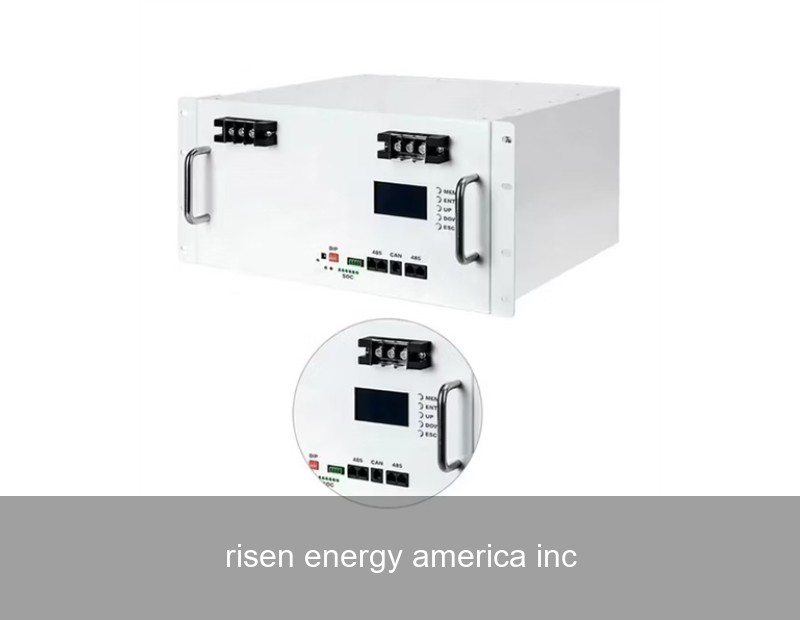
If you're involved in the U.S. renewable energy sector, you've likely heard the name Risen Energy America Inc. As the American subsidiary of a global solar module manufacturing giant, their presence signifies more than just panel imports; it represents a deepening integration of the solar supply chain and a growing demand for comprehensive energy solutions. But in today's market, solar panels are just the beginning. The true value—for businesses, communities, and grid operators alike—is unlocked when that solar generation is paired with intelligent, resilient energy storage. This is where the story of Risen Energy in America naturally dovetails with the expertise of advanced system integrators like Highjoule, who specialize in transforming raw generation into reliable, controllable power assets.
Table of Contents
The Phenomenon: Beyond the Solar Panel
Companies like Risen Energy America Inc have been instrumental in making high-efficiency solar modules more accessible across the United States. This has fueled a boom in both utility-scale solar farms and commercial & industrial (C&I) rooftop installations. However, a significant challenge persists: intermittency. The sun doesn't shine on demand, and this creates a mismatch between when energy is produced and when it's most needed and valuable. You see this in the famous "duck curve" in California, where midday solar oversupply can be followed by a steep evening ramp-up as the sun sets and demand remains. This isn't just a grid operator's problem; for a factory owner with a large Risen Energy solar array, it means potentially exporting power at low prices only to import it back at a premium later.

The 'Duck Curve' visualizes the grid challenge created by high solar penetration. Source: U.S. Department of Energy
The Data: Why Storage is Non-Negotiable
The numbers make a compelling case for pairing solar with storage. According to the Solar Energy Industries Association (SEIA), the U.S. solar market is expected to triple in capacity by 2033. Concurrently, the Energy Storage Association reports that the front-of-the-meter and behind-the-meter storage markets are on a parallel trajectory. Let's break down the value propositions:
| Challenge | Solar-Only Limitation | Solar + Storage Solution |
|---|---|---|
| Energy Time-Shift | Excess midday energy is sold at low wholesale rates. | Store midday excess, discharge during peak evening hours for higher revenue or greater savings. |
| Grid Resilience | During a grid outage, solar systems often shut down for safety (anti-islanding). | Storage systems with islanding capability can keep critical loads powered, providing backup security. |
| Demand Charge Management | Solar reduces consumption but may not blunt the highest 15-minute demand spike that sets monthly fees. | Storage can discharge precisely during short peak periods, dramatically cutting demand charges for C&I customers. |
This data-driven reality is why leading solar providers and their customers are increasingly looking for turnkey storage solutions.
The Case Study: From Solar Farm to Grid Asset
Consider a real-world scenario in Texas, a market with competitive retail electricity and an independent grid (ERCOT). A mid-sized manufacturing plant installed a 2.5 MW rooftop solar system using high-quality modules from a supplier like Risen Energy America Inc. While it offset 40% of their annual energy consumption, their demand charges remained stubbornly high, and they had no backup power.
The solution was to integrate a 2.5 MWh / 1.25 MW battery energy storage system (BESS). Here’s the impact, measured over one year post-installation:
- Demand Charge Reduction: The BESS was programmed to peak-shave, targeting the facility's highest usage periods. This resulted in a 28% reduction in monthly demand charges, translating to over $85,000 in annual savings on top of solar savings.
- ERCOT Market Participation: During periods of grid stress or high prices, the system's intelligent controller allowed it to participate in ERCOT's ancillary services market, generating an additional $15,000 in annual revenue by providing grid frequency regulation.
- Resilience Uplift: The system now provides 4 hours of backup power for critical manufacturing lines and safety systems, mitigating the risk of costly downtime from Texas grid events.
This case illustrates the multiplicative effect: solar provides the fuel, but intelligent storage creates financial, operational, and strategic value.
The System Architect: Beyond the Battery Box
It's crucial to understand that a storage system is far more than just racks of battery cells. It's an engineered ecosystem. As a leading provider since 2005, Highjoule designs and delivers these integrated systems. Our role is that of the architect and central nervous system. We source and integrate best-in-class components—including battery racks, inverters, and thermal management—into a cohesive, safe, and high-performing unit.
Our Highjoule H-Series BESS for commercial and industrial applications, for example, is a containerized or skid-mounted solution that includes:
- Advanced Battery Modules: Utilizing lithium iron phosphate (LFP) chemistry for safety and long cycle life.
- Bi-Directional Inverter: The heart that converts DC from the batteries to AC for the facility or grid.
- Integrated Energy Management System (EMS): This is the true brain, which we'll discuss next.
- Safety & Environmental Controls: Comprehensive fire suppression, HVAC, and monitoring systems.

Highjoule's H-Series BESS provides a scalable, all-in-one solution for C&I applications. Source: Highjoule
Where Highjoule Fits In: The Intelligence Layer
While companies like Risen Energy America Inc excel at providing the generation asset, Highjoule provides the intelligence and optimization layer. Our proprietary EMS software is what transforms a static battery into a dynamic financial and grid asset. It continuously analyzes data streams: electricity rates, solar production forecasts, facility load patterns, and even grid signals or market prices.
For a site with a Risen Energy solar array, our EMS doesn't just see "solar power." It sees an opportunity. It makes autonomous decisions: "Store the next 300 kWh from the solar peak to shave the 4 PM load spike." Or, "The grid frequency is dipping; dispatch 0.5 MW for the next 10 minutes to earn regulation revenue." This is the seamless integration that maximizes ROI for the asset owner.
The Future: Integration and Intelligence
The partnership between solar manufacturers, project developers, and specialized storage integrators is defining the next chapter of the energy transition. The goal is no longer just megawatts of solar installed, but megawatt-hours of dispatchable, clean energy delivered precisely when and where it's needed. This requires deep technical expertise in system design, grid interconnection, and software controls—the very expertise Highjoule has honed over nearly two decades across thousands of global deployments in microgrid, industrial, and utility applications.
As the U.S. market, bolstered by policies like the Inflation Reduction Act, continues its rapid growth, the question for project developers and asset owners is shifting. It's no longer "Should we add storage?" but rather "How do we design and optimize the storage system to meet our specific financial and resilience goals?" This is the critical conversation that bridges the gap between excellent solar generation and a truly future-proof energy strategy.
What specific operational or financial goal would you want a smart storage system to achieve for your next solar project?
 Inquiry
 Online Chat