


Finding the Right Rooftop Inverter for Sale: Your Guide to a Smarter Solar Investment
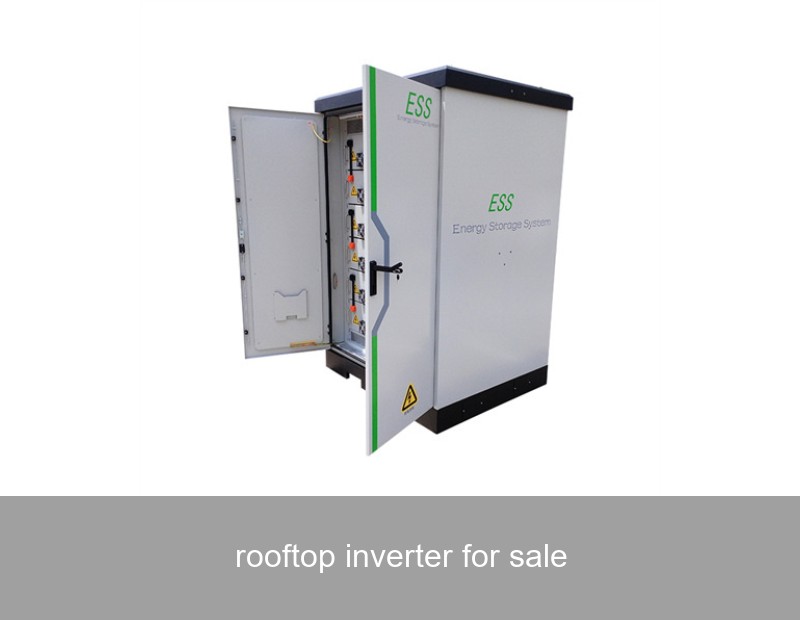
So, you're searching for a "rooftop inverter for sale." That's excellent. It means you're on the cusp of harnessing free energy from the sun, either for your home or business. But here's the thing: not all inverters are created equal. Choosing the right one isn't just about finding a product in stock; it's about selecting the intelligent brain for your entire solar energy system. This guide will walk you through everything you need to know, from core technology to real-world performance, helping you make a decision that maximizes your return on investment for years to come.
Table of Contents
- The Inverter: The Heart of Your Rooftop Solar System
- Key Considerations When Shopping for a Rooftop Inverter
- Case Study: Maximizing ROI on a Commercial Rooftop in Germany
- Beyond Conversion: The Modern Smart Inverter
- Highjoule's Integrated Solutions: More Than Just an Inverter for Sale
- Making Your Final Choice
The Inverter: The Heart of Your Rooftop Solar System
Think of your solar panels as diligent workers, producing raw materials (Direct Current, or DC electricity). The rooftop inverter is the factory manager, transforming that raw material into a usable product (Alternating Current, or AC electricity) that powers your appliances and feeds into the grid. Its efficiency, reliability, and intelligence directly determine how much value you extract from every sunbeam.
The market primarily offers three types for rooftop applications:
- String Inverters: The cost-effective, reliable workhorse. Multiple panels are connected in a series ("string"), and the inverter converts the combined DC power. Ideal for unshaded, uniformly oriented roofs.
- Microinverters: Attached to each individual panel. They optimize performance panel-by-panel, perfect for roofs with shading or multiple angles. They offer enhanced safety and granular monitoring.
- Power Optimizer Systems: A hybrid approach. DC optimizers at each panel condition the power, which is then sent to a central string inverter. This combines panel-level optimization with the simplicity of a central inverter.

Image Source: Unsplash - Representative image of a modern inverter installation.
Key Considerations When Shopping for a Rooftop Inverter
When you see a "rooftop inverter for sale," look beyond the price tag. Here’s what truly matters:
| Feature | Why It Matters | Question to Ask |
|---|---|---|
| Efficiency (Peak & Weighted) | Determines how much DC power is lost during conversion. A 98% vs. 96% efficiency can mean significant energy gains over 25 years. | What is the European (CEC) or California Energy Commission weighted efficiency? |
| Warranty & Lifespan | Inverters are the most likely component to need replacement. A standard warranty is 10-12 years, but extended options are crucial. | Can the warranty be extended? What are the real-world MTBF (Mean Time Between Failures) figures? |
| Monitoring & Smart Features | Real-time monitoring via an app helps you track production, identify faults (like a shaded panel), and understand your energy habits. | Is the monitoring platform user-friendly and free? Does it offer actionable insights? |
| Grid Services & Compliance | In regions like Europe and the U.S., grid support functions (like frequency regulation) are becoming mandatory for new installations. | Is the inverter compliant with local grid codes (e.g., VDE-AR-N 4105 in Germany, UL 1741 SA in the U.S.)? |
Case Study: Maximizing ROI on a Commercial Rooftop in Germany
Let's move from theory to practice. A mid-sized logistics company in Bavaria, Germany, had a large, south-facing warehouse roof with minor morning shading from a neighboring structure. Their primary goal was to maximize self-consumption to offset high daytime energy costs.
The Challenge: A traditional string inverter would see the entire string's output reduced by the morning shade, losing precious energy. Microinverters were considered but presented a higher upfront cost for a 250kW system.
The Solution: They opted for a Highjoule H-Energy Titan Smart String Inverter system integrated with DC power optimizers. This hybrid solution provided panel-level maximum power point tracking (MPPT) to mitigate shading losses, while the central inverter's high 98.6% efficiency handled the bulk conversion. Crucially, the system was paired with a Highjoule BESS-50 battery storage unit.
The Data-Driven Outcome (First 12 Months):
- Energy Yield: Achieved 99.2% of projected yield despite shading, outperforming a standard string inverter estimate by ~8%.
- Self-Consumption Rate: Increased from an estimated 35% (solar only) to 82% with solar + battery, drastically reducing grid imports during peak pricing.
- ROI Timeline: Projected payback period shortened from 7 to 5.2 years due to higher energy autonomy and taking advantage of time-of-use arbitrage with the battery.
This case highlights that the right "rooftop inverter for sale" is often part of a broader, intelligent ecosystem. Fraunhofer ISE, a leading research institute, consistently emphasizes in its studies that system-level optimization, not just component efficiency, is key to economic viability.
Beyond Conversion: The Modern Smart Inverter
Today's leading inverters are grid-interactive hubs. For instance, in the U.S., as the National Renewable Energy Laboratory (NREL) notes, smart inverters are essential for maintaining grid stability as renewable penetration grows. They can provide voltage support, ride through minor grid disturbances, and communicate with utility operators.
This means your choice isn't just about today. It's about ensuring your system is "future-proofed" for evolving grid requirements and can participate in potential revenue programs, like virtual power plants (VPPs).
Highjoule's Integrated Solutions: More Than Just an Inverter for Sale
At Highjoule, with nearly two decades of experience since 2005, we understand that you're not just buying an inverter; you're investing in energy resilience and independence. Our products are designed with this holistic view.
For residential and commercial rooftops, our H-Energy Nexus Series of smart hybrid inverters is a prime example. It's not merely a device for sale; it's the core of a pre-integrated system:
- Seamless DC-Coupling: Designed from the ground up to integrate with Highjoule battery storage, reducing conversion losses and simplifying installation.
- Advanced Energy Management System (EMS): The built-in intelligence learns your consumption patterns, automatically deciding when to use solar power, charge the battery, or export to the grid to maximize savings.
- Grid-Agnostic Operation: Perfect for both stable grids and areas with frequent outages. In the event of a blackout, it can seamlessly island your home or critical loads using solar and battery power.
- Global Compliance: Engineered to meet the strictest international standards, ensuring smooth permitting and interconnection in Europe and North America.

Image Source: Unsplash - Conceptual diagram of a home energy system.
We provide comprehensive support, from initial design and simulation using tools that model shading and economics, to after-sales monitoring via our Highjoule Pulse platform. This turns a simple inverter purchase into a long-term energy partnership. For a deeper dive into how grid-forming inverters are shaping the future, the NREL's research on grid-forming inverters is an authoritative resource.
Making Your Final Choice
Your rooftop is unique. The best "rooftop inverter for sale" for your neighbor might not be the best for you. It depends on your roof's layout, local climate, energy consumption profile, electricity rates, and your goals (pure savings vs. backup power vs. full independence).
We encourage you to think beyond the component. Consider the system intelligence, the ease of integration with storage (a near-necessity for modern energy independence), and the provider's track record of innovation and support. A IEA report on solar PV supply chains underscores the importance of quality and reliability in long-term energy assets.
Ready to explore what a truly intelligent energy system, built around a high-performance inverter, can do for your home or business? What's the first question about your energy future that you'd like to solve?
 Inquiry
 Online Chat