


Understanding Your Solar Panel Converter: The Heart of a Modern Energy System
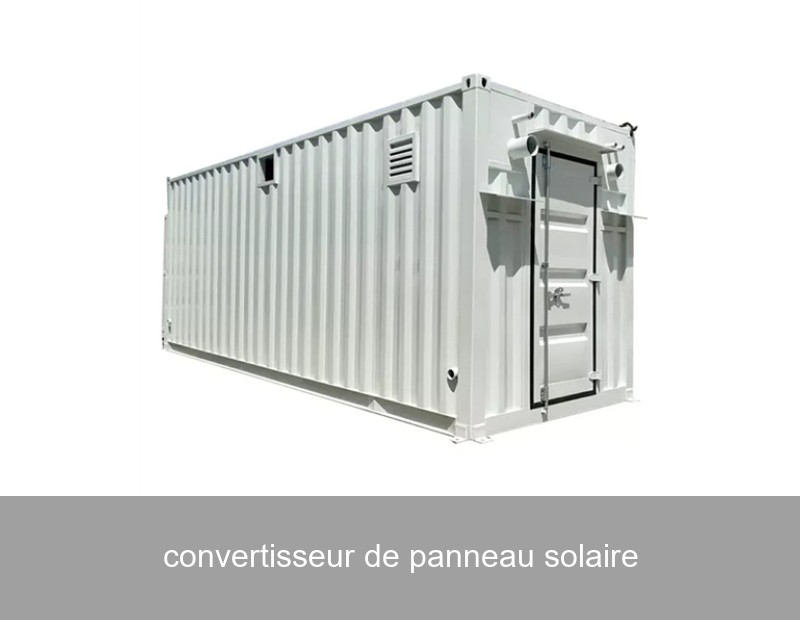
So, you've decided to harness the sun's power. You see the solar panels on your roof, but the real magic happens with a less visible component: the solar panel converter. Often called an inverter, this device is the critical link between your solar array and your home or business. It's the translator that converts the direct current (DC) electricity generated by your panels into the alternating current (AC) electricity that powers everything from your lights to your machinery. As Europe and the US accelerate their transition to renewable energy, understanding and choosing the right converter technology is paramount for maximizing your investment and energy independence.
Table of Contents
- The Core Role: More Than Just Conversion
- The Evolution of Converter Technology
- Key Metrics for Choosing a Quality Converter
- Case Study: A Real-World Impact in Commercial Solar
- The Future is Integrated: Converters and Energy Storage
- Highjoule's Intelligent Solutions for Modern Energy Needs
- What Should You Ask Your Solar Installer?
The Core Role: More Than Just Conversion
While "conversion" is in its name, a modern solar panel converter is a sophisticated energy manager. Its primary function is indeed to transform DC to AC with maximum efficiency. But today's advanced models do so much more. They continuously track the maximum power point (MPPT) of your solar array, ensuring you capture every possible watt of energy, even on cloudy days or when panels are partially shaded. They provide critical system monitoring data, allowing you to see your energy production in real-time. Furthermore, they include essential safety features, automatically shutting down during grid outages to protect utility workers—a requirement known as anti-islanding.
The Evolution of Converter Technology: From Central to Micro
The technology has evolved significantly from bulky central inverters. Here’s a quick breakdown of the main types:
- String Inverters: The most common and cost-effective for standard installations. Multiple panels are connected in a "string" to a single inverter.
- Microinverters: Small units attached to each individual solar panel. They optimize performance panel-by-panel, mitigating shade issues and offering granular monitoring.
- Power Optimizer Systems: A hybrid approach. DC optimizers at each panel condition the electricity, which is then sent to a central string inverter for conversion.
The choice depends on your roof's layout, shading, budget, and expansion plans. For complex roofs, microinverters or optimizers often yield significantly higher overall energy harvest.
Key Metrics for Choosing a Quality Converter
Not all converters are created equal. When evaluating options, look beyond just the price tag. Focus on these key performance indicators:
| Metric | What It Means | Why It Matters |
|---|---|---|
| Peak Efficiency | The highest conversion efficiency the unit can achieve. | Shows the technology's potential under ideal lab conditions. |
| Weighted Efficiency (e.g., CEC, EU) | An average efficiency across a range of operating powers. | A more realistic measure of real-world energy yield. Aim for 97%+. |
| MPPT Range & Channels | The voltage window and independent tracking circuits. | A wider range with more channels allows better design flexibility and shade tolerance. |
| Warranty Length | Typically 10-25 years. | Reflects the manufacturer's confidence in product longevity and reliability. |
Case Study: Boosting ROI for a German Logistics Warehouse
Let's look at a real example from our work at Highjoule. A mid-sized logistics company near Hamburg had a 250 kW rooftop solar system installed in 2018 using standard string inverters. The large roof had multiple ventilation units causing intermittent shading across several panel strings. The system was underperforming initial estimates by nearly 15%.
The Challenge: The central inverter couldn't mitigate the shading losses; if one panel was shaded, the output of its entire string dropped dramatically.
The Solution: In 2022, Highjoule engineers retrofitted the system with our HJ-PowerOptima Series power optimizers on every shaded string. These devices allowed each panel to operate independently at its own maximum power point before sending power to the upgraded central inverter.
The Data-Driven Result: Post-retrofit monitoring data over one year showed a 12% increase in total annual energy production. For this business, that translated to an extra 33,000 kWh per year, significantly improving their ROI and covering a larger portion of their warehouse's operational energy needs. This case highlights that sometimes, the biggest gain comes from optimizing the solar panel converter technology, not just adding more panels. You can explore similar field data from the National Renewable Energy Laboratory (NREL).

Image: Modern power optimizer units on a commercial solar array. Source: Unsplash
The Future is Integrated: Converters and Energy Storage
The conversation about solar is no longer complete without discussing storage. This is where the solar panel converter evolves into a true energy hub. Hybrid or battery-ready inverters are designed to seamlessly integrate with battery systems. They manage the bidirectional flow of energy: from panels to home, to battery, and even back to the grid where permitted.
For homeowners and businesses, this means maximizing self-consumption. Excess solar energy produced during the day is stored for use at night, dramatically increasing energy independence. During grid outages, these systems can often form an instant microgrid, keeping critical loads running. The U.S. Department of Energy outlines the grid-supportive capabilities of advanced inverters.
Highjoule's Intelligent Solutions for Modern Energy Needs
At Highjoule, we've been at the forefront of this evolution since 2005. We understand that the converter is the intelligent core of any storage system. That's why our product development focuses on seamless integration, robustness, and smart energy management.
Our EcoHub Home Energy Manager is a prime example. It's not just a hybrid inverter; it's a unified platform that combines a high-efficiency solar converter, a modular battery inverter, and a smart energy router in one compact unit. For our commercial and industrial clients, the GridSynch Industrial Series provides scalable, utility-grade power conversion that can manage complex multi-MW solar-plus-storage projects and provide grid-forming capabilities for microgrids.
What sets Highjoule apart is our system-level approach. We don't just sell components; we provide complete, intelligent power solutions. Our cloud-based OmniView AI Platform gives users unparalleled insight and control over their energy assets, predicting usage patterns, optimizing for time-of-use rates, and ensuring every system operates at peak performance for its entire lifecycle.

Image: Monitoring a modern integrated home energy system. Source: Unsplash
What Should You Ask Your Solar Installer?
As you plan your solar or solar-plus-storage project, empower yourself with the right questions about the heart of the system:
- What type of solar panel converter are you proposing, and why is it the best fit for my specific site?
- What is the weighted (real-world) efficiency of this model, and what is its operational voltage range?
- Is this inverter "storage-ready"? If I want to add a battery in 2-3 years, what will that process and cost look like?
- What monitoring platform comes with it, and what granularity of data (panel-level, system-level) will I have access to?
- Can you provide case studies or performance data from similar installations in our region?
The answers will tell you a lot about the quality and future-proofing of your proposed system. After all, your energy future deserves a strong and intelligent heart. What's the first energy goal you want your solar system to achieve for you?
 Inquiry
 Online Chat