


Unlocking Scotland's Renewable Potential: The Critical Role of Advanced Battery Storage
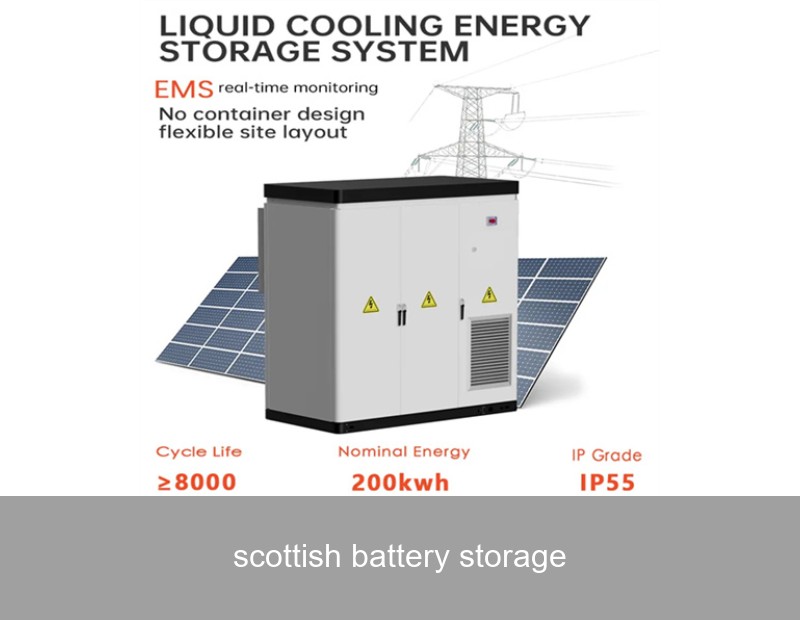
Scotland's windswept glens and coasts are home to some of Europe's most abundant renewable energy resources. Yet, harnessing this green power consistently presents a unique challenge. This is where Scottish battery storage systems are emerging as the unsung heroes of the nation's energy transition, turning intermittent generation into a reliable, clean power supply. For businesses, communities, and grid operators across Scotland, understanding this technology is key to a sustainable and cost-effective energy future.
The Scottish Energy Challenge: A Land of Plenty, A Grid Under Pressure
Let's paint a picture. On a stormy winter day, Scotland's wind turbines are spinning at full capacity, often generating more electricity than the local grid can instantly absorb. Conversely, on a calm, cold evening, demand spikes while renewable generation falls. This mismatch isn't just a technical hiccup; it leads to curtailment (wasting clean energy), grid instability, and reliance on backup fossil fuel plants. In 2022, National Grid ESO paid over £200 million to curtail mostly wind power in Great Britain, a significant portion originating from Scotland. That's clean energy—and money—literally blowing away.

This is the core phenomenon: Scotland is a renewable energy powerhouse, but its grid needs a shock absorber. That's precisely the role of large-scale and distributed Scottish battery storage.
How Battery Energy Storage Systems (BESS) Power Stability
Think of a battery storage system as a giant, high-tech reservoir for electricity. Instead of water, it stores electrons.
- Charging: When wind or solar generation is high and demand is low, the excess energy is used to charge the battery bank.
- Storing: The energy is held securely as chemical potential, ready for use in seconds.
- Discharging: When demand rises, clouds roll in, or the wind drops, the battery discharges its stored energy back to the grid or directly to a facility.
Modern systems, like those developed by Highjoule, go beyond simple storage. They are integrated with intelligent energy management software that autonomously makes decisions—buying, storing, and selling electricity based on real-time market prices and grid signals, maximizing value and support.
Case Study: The Whitelee Wind Farm & Battery Project
One of the most prominent examples of Scottish battery storage in action is at Whitelee, the UK's largest onshore wind farm. Here, a 50-megawatt (MW) battery storage facility sits alongside the 539 MW wind farm.
| Metric | Detail |
|---|---|
| Capacity | 50 MW / 100 MWh (can power ~30,000 homes for 2 hours) |
| Primary Function | Grid balancing, frequency response, reducing curtailment |
| Key Outcome | Enables more efficient use of Whitelee's wind power, stabilizes the local grid, and provides critical grid services to the National Grid. |
This project exemplifies the synergy between renewables and storage. The battery captures excess wind energy that would otherwise be lost and releases it when needed, smoothing the wind farm's output and making it a more predictable and valuable asset for the grid. It's a tangible model for future projects across Scotland.
Tangible Benefits of Scottish Battery Storage
The advantages extend far beyond a single wind farm. Widespread adoption offers:
- Enhanced Grid Security: Batteries provide ultra-fast frequency response, acting as a stabilizer to prevent blackouts, a service detailed by the International Energy Agency (IEA).
- Reduced Carbon Footprint: By enabling more renewables and displacing gas peaker plants, storage directly cuts CO2 emissions.
- Lower Energy Costs: They reduce expensive grid congestion and constraint payments, ultimately saving money for consumers.
- Energy Independence: For businesses and remote communities, on-site storage paired with renewables reduces reliance on the volatile national grid.
Highjoule's Intelligent Solutions for the Scottish Market
For nearly two decades, Highjoule has been at the forefront of advanced energy storage. We understand that Scotland's landscape—both physical and economic—requires tailored solutions. Our approach to the Scottish battery storage opportunity is built on three pillars:

- High-Density, Containerized BESS: Our pre-integrated, weatherproof battery systems are ideal for Scotland's often harsh environments, from the Highlands to industrial estates. They offer plug-and-play deployment for rapid grid support or commercial use.
- AI-Powered Energy Management Software: This is the brain of the operation. Our platform continuously analyzes electricity prices, weather forecasts, and consumption patterns to autonomously optimize the charge/discharge cycles of your storage asset, ensuring maximum return on investment.
- End-to-End Project Support: From initial feasibility and grid connection studies to commissioning and long-term performance monitoring, Highjoule provides a full suite of services. We partner with developers, asset owners, and businesses to deliver turnkey Scottish battery storage projects that are safe, reliable, and profitable.
Whether it's a 5 MW system supporting a local manufacturing plant's operations or a 100 MW+ asset providing grid-scale stability, Highjoule's technology is designed to integrate seamlessly and deliver value from day one.
Looking Ahead: The Future Grid
The path to a net-zero Scotland is undeniable. As targets tighten and fossil generation phases out, the grid's need for flexibility will only intensify. Battery storage is not just an option; it's becoming a fundamental infrastructure component. The next wave of innovation will likely involve longer-duration storage technologies and even more sophisticated virtual power plants that aggregate thousands of distributed assets.
So, the question for Scottish businesses, energy developers, and community leaders is no longer if battery storage will play a part in their future, but how and when. How will you leverage this technology to secure your energy costs, contribute to national targets, and build resilience? What energy challenge on your site could be solved by having your own intelligent reservoir of power?
 Inquiry
 Online Chat