


Why Your Business Needs a Server Battery Backup Unit: Beyond Basic Power Protection
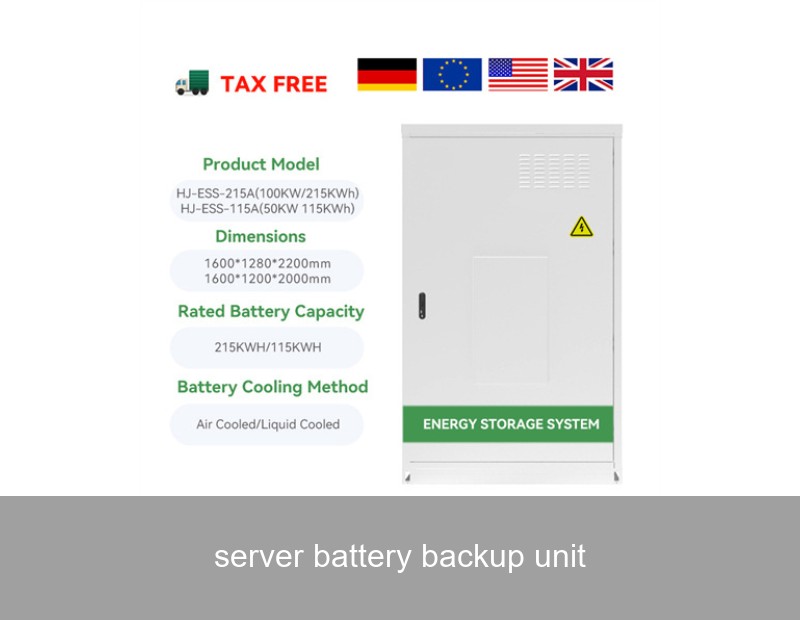
In our hyper-connected world, a millisecond of power interruption can translate into massive data loss, frozen transactions, and crippled operations. For IT managers and business owners, the traditional Uninterruptible Power Supply (UPS) has long been a staple. But as digital infrastructure evolves, so do its power needs. This is where the modern server battery backup unit emerges not just as a battery, but as an intelligent, integrated energy resilience system. It's the critical bridge between fleeting grid power and your long-term operational continuity, especially for data-sensitive applications across Europe and the US.
Table of Contents
- The Phenomenon: Digital Fragility in an Unstable Grid
- By the Numbers: The Real Cost of Downtime
- Case Study: A German FinTech's Resilience Transformation
- The Modern Server Battery Backup Unit: More Than a Battery
- Highjoule's Integrated Approach to Server Backup Power
- Choosing the Right Unit for Your Infrastructure
The Phenomenon: Digital Fragility in an Unstable Grid
Think about the last time your lights flickered at home. Now, imagine that flicker hitting a server rack hosting customer databases, real-time analytics, or e-commerce platforms. The phenomenon is clear: our reliance on 24/7 digital availability is at odds with aging grid infrastructure and increasing volatile weather events. In the US, the Department of Energy notes that power outages cost the economy billions annually [1]. In Europe, the push towards renewables, while essential, introduces new grid dynamics that can lead to frequency fluctuations. A basic UPS might handle a short blip, but what about a sustained brownout or a multi-hour outage? The gap in protection is where advanced server battery backup systems become non-negotiable.

Credit: Photo by Patrick Schneider on Unsplash. Modern data centers demand more than momentary backup.
By the Numbers: The Real Cost of Downtime
Let's talk data, because the numbers are staggering. According to a 2023 report by ITIC, a single hour of downtime can now cost over $300,000 for 40% of enterprises. For critical sectors like finance or healthcare, it exceeds $5 million per hour. But it's not just about catastrophic failure. Poor power quality—sags, surges, and harmonics—can silently degrade server hardware, leading to premature failure and hidden costs. An intelligent server battery backup unit does more than keep the lights on; it conditions incoming power, ensuring your expensive hardware receives only clean, stable electricity, thereby extending its lifespan and ROI.
Case Study: A German FinTech's Resilience Transformation
Consider "FinSecure AG," a Munich-based financial technology company (name changed for privacy). They operated a private cloud for high-frequency trading algorithms. Their legacy UPS systems failed to prevent a 0.9-second voltage dip from a nearby industrial facility, causing a server cluster to reboot and resulting in €450,000 in lost arbitrage opportunities and client penalties.
The Solution & Outcome: FinSecure moved beyond commodity UPS units. They deployed a modular, lithium-ion based server battery backup system with integrated power management software. This system provided:
- Seamless ride-through for all minor grid disturbances.
- 12 minutes of full-load runtime, enough for their generators to stabilize.
- Real-time monitoring of power quality and battery health.
The Modern Server Battery Backup Unit: More Than a Battery
Today's solution is a system, not a singular box. What differentiates it?
| Traditional UPS | Advanced Server Battery Backup Unit |
|---|---|
| Lead-acid batteries | Lithium-ion (LiFePO4) batteries: longer lifespan, faster charging, compact size. |
| Basic "failover" operation | Intelligent, software-defined management with grid interaction capabilities. |
| Isolated power component | Can integrate with on-site solar/storage for partial self-consumption and peak shaving. |
| Limited visibility | Cloud-based monitoring with predictive analytics for battery and load health. |
Highjoule's Integrated Approach to Server Backup Power
At Highjoule, with nearly two decades of expertise in advanced energy storage, we view the server battery backup unit as the core of a smarter energy ecosystem. Our IntelliBESS Cabinet Series is engineered specifically for critical IT environments.
It combines UL 9540-certified LiFePO4 battery modules with a high-efficiency inverter and our proprietary EnergyOS platform. This isn't just backup; it's intelligent power management. For a hospital in Texas, we configured a system that not only guarantees 15 minutes of runtime for their patient records servers but also uses its capacity to reduce peak demand charges by strategically discharging during the hottest part of the day. The system pays for itself through both resilience and direct cost savings.
For commercial and industrial clients, our team provides end-to-end service: from initial load audit and design to seamless integration with existing power distribution and remote lifetime monitoring. We ensure the solution scales with your IT growth, thanks to a modular design that allows capacity to be added with minimal disruption.

Credit: Photo by Patrick Schneider on Unsplash. Modular battery systems allow for scalable, maintainable backup power.
Choosing the Right Unit for Your Infrastructure
Selecting a system requires a strategic assessment:
- Critical Load Analysis: Precisely calculate the total kW/kVA and kWh needed for your essential servers, storage, and networking gear. Don't guess—measure.
- Runtime Requirements: Is the goal to bridge to generator start (5-15 minutes), or to enable a graceful, full shutdown over several hours? Your answer dictates battery capacity.
- Future-Proofing: Choose a modular system. If you plan a 20% server expansion next year, your backup power should be able to grow with it without a full replacement.
- Management & Insights: Demand a system that gives you data. Visibility into power quality, battery state-of-health, and energy usage patterns is invaluable for IT and facilities management.
Highjoule's design consultants specialize in this precise workflow, helping businesses from Barcelona to Boston move from a reactive to a proactive power posture. We often find that a holistic view of a site's energy flow—combining backup, solar PV, and grid interaction—unlocks the greatest value.
Ready to Transform Your Backup Power from a Cost Center to a Strategic Asset?
The conversation is shifting from "how long can it last?" to "how smart can it be?" As you evaluate your current infrastructure's vulnerability, what would be the impact on your business if your servers experienced not a full blackout, but a sustained period of poor-quality power that corrupted data and stressed hardware silently? The right server battery backup unit is your defense. We invite you to connect with Highjoule's experts for a complimentary, no-obligation resilience assessment of your primary server room or data center. What's the single most critical application you need to protect, and how much downtime would it truly tolerate?
 Inquiry
 Online Chat