


Shipping Container Offices for Sale: A Smart, Sustainable Power Solution for Modern Workspaces
You're probably here because you've seen those sleek, modern offices built from repurposed shipping containers. They're popping up everywhere, from urban co-working spaces to remote construction sites. The appeal is clear: cost-effective, modular, and incredibly stylish. But here's the question every savvy buyer or business owner should be asking: "What powers this innovative workspace?" A shipping container office for sale represents more than just four walls and a roof; it's a statement of efficiency and sustainability. And its true potential is unlocked only with a power system that matches its innovative spirit. Let's explore how integrating advanced energy storage transforms a simple container into a resilient, independent, and smart commercial asset.
The Silent Power Problem in Container Offices
Imagine this: You've found the perfect shipping container office for sale. It's fitted with premium insulation, stunning glass doors, and efficient HVAC. You place it on a scenic plot for a creative agency or at a bustling industrial site for a project team. Then, reality hits. Grid connection is prohibitively expensive or simply unavailable. Even if you are grid-tied, power outages disrupt operations, or peak demand charges from running air conditioning and computing equipment eat into your profits. The container itself is a marvel of efficiency, but its traditional power source often is not. This disconnect between the innovative structure and a archaic power supply is the core challenge.
The Data Reality: Energy Demands of Modern Workspaces
A modern office, even a compact one, is energy-intensive. Let's break down the typical load profile for a 40-foot container office:
| Equipment | Estimated Power Consumption | Daily Runtime | Impact |
|---|---|---|---|
| HVAC (Mini-Split System) | 1.5 - 2.5 kW | 8-10 hours | Largest single load, critical for comfort. |
| Lighting (LED) | 0.2 - 0.5 kW | 10 hours | Moderate, but constant. |
| Computers & Monitors (4 stations) | 0.4 - 0.8 kW | 8 hours | Core business function, sensitive to outages. |
| Internet/Networking | 0.05 kW | 24 hours | Low power, but must be always on. |
| Kitchenette (Microwave, Kettle) | 1.5 - 2.2 kW | Intermittent | Short, high-power bursts that strain systems. |
Data from the U.S. Department of Energy confirms that space heating and cooling account for about 35% of a typical commercial building's energy use. For an off-grid or resiliency-focused shipping container office, managing these peaks is not just about cost—it's about continuous operability.

Image Source: Unsplash
Case Study: Powering a Remote Construction Site Office in Colorado, USA
Consider a real-world scenario from the Rocky Mountains. A mid-sized construction company purchased a high-end shipping container office for sale to serve as the on-site command center for a 2-year highway project. The challenges were significant: no grid access for the first 8 months, temperature extremes from 20°F to 95°F, and a critical need for uninterrupted power for blueprint printers, comms equipment, and tools charging.
The Initial (Failed) Setup: They initially used a diesel generator. The costs were staggering: approximately $15-20 per day in fuel, plus weekly maintenance. Noise pollution hampered clear communication, and emissions violated the company's sustainability pledge. Most critically, an overnight generator failure led to frozen pipes and a week of downtime, costing over $5,000 in delays.
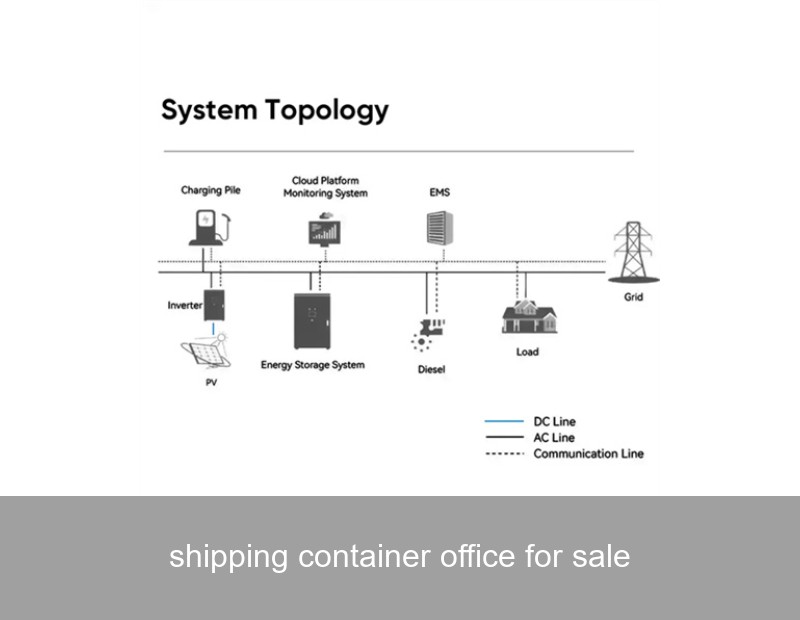
The Renewable-Powered Solution: The company partnered with a local integrator who installed a hybrid system:
- 6 kW of rooftop solar panels mounted on the container's roof.
- A 20 kWh Highjoule CubeStack lithium-ion battery storage system installed in a secure compartment under the office floor.
- A smart inverter/charger and a small, quiet backup generator for extreme weather contingencies.
- Fuel Savings: Generator runtime reduced by 92%. Annual fuel costs dropped from ~$7,000 to under $600.
- Reliability: Zero work stoppages due to power failure. The battery system seamlessly carried the load during night and cloudy days.
- ROI: The complete system paid for itself in less than 3 years, factoring in fuel savings and avoided downtime costs.
Battery Energy Storage: The Non-Negotiable Core
Solar panels alone are not the full answer. They only produce when the sun shines. The battery energy storage system (BESS) is the heart of an independent office. It does three critical things:
- Energy Time-Shifting: Stores excess solar energy generated at noon to use in the evening or at night.
- Provides Instantaneous Backup Power: Acts as an uninterruptible power supply (UPS) during grid outages or generator switch-over, keeping your computers and network alive.
- Manages Load Peaks: Prevents high-demand appliances (like the AC compressor) from overloading a generator or requiring a more expensive grid connection.
The Highjoule Solution: Intelligent Power for Intelligent Spaces
At Highjoule, we've spent nearly two decades perfecting energy storage for demanding applications. We understand that a shipping container office for sale needs a power solution that is as robust, compact, and intelligent as the office itself. Our products are engineered specifically for these scenarios.
For commercial and industrial container applications, our CubeStack Commercial Series is ideal. Its modular design allows you to scale capacity from 15 kWh to over 100 kWh in the same compact footprint—perfect for the spatial constraints of a container base. With industry-leading cycle life and a robust battery management system (BMS), it's built for daily, deep cycling from solar charging.
Furthermore, our Energy Management System (EMS) software is what makes your office truly smart. It can be configured to:
- Prioritize solar self-consumption, maximizing free energy.
- Automatically manage generator run-times to minimize fuel use and maintenance.
- Provide remote monitoring and control via a smartphone app—so you can check your office's power status from anywhere in the world.

Image Source: Unsplash
Your Office, Unplugged: What's the Next Step?
The market for shipping container offices for sale is evolving. The leaders aren't just selling space; they're selling turn-key, functional ecosystems. The conversation is shifting from "How many square feet?" to "How resilient and efficient is its operation?" When you evaluate your next container office purchase, the specification sheet should include not just the cladding and floor plan, but the details of its energy system.
Ask the vendor: "What integrated battery storage solution does this include, and how does its management system ensure my operational continuity and lower my total cost of ownership?" If they don't have a compelling answer, you're only buying half a solution.
So, as you browse the latest designs of shipping container offices for sale, we leave you with this: Is your vision for a mobile, sustainable workspace limited by a 20th-century idea of power, or are you ready to equip it with a 21st-century energy backbone that truly sets it free?
 Inquiry
 Online Chat