


Unlocking Efficiency and Resilience: A Deep Dive into the Modern Sistema de Gestión de Energía
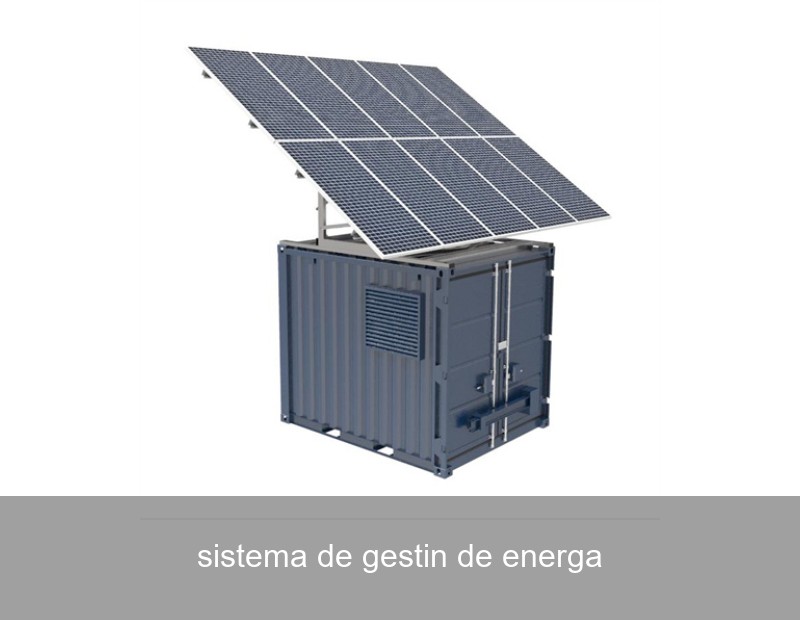
Have you ever felt a pang of frustration looking at your commercial or industrial electricity bill, wondering where all that energy—and money—is truly going? You're not alone. Across Europe and the United States, businesses and homeowners alike are grappling with volatile energy prices and a growing desire for sustainability. The solution lies not just in generating cleaner power, but in mastering its flow. This is where a sophisticated Sistema de Gestión de Energía (Energy Management System - EMS) transforms from a technical concept into a strategic powerhouse. It's the intelligent brain that coordinates, optimizes, and controls your energy assets, turning passive consumption into active, informed management.
Table of Contents
- The Modern Energy Challenge: More Than Just Bills
- What Exactly is a Sistema de Gestión de Energía (EMS)?
- Core Components of a Smart Energy Management System
- The Data Tells the Story: Quantifying EMS Benefits
- From Theory to Practice: A Spanish Retail Case Study
- Highjoule's Role: Intelligent Storage as the EMS Cornerstone
- The Future of Energy Management: AI and Grid Independence
The Modern Energy Challenge: More Than Just Bills
The energy landscape is shifting beneath our feet. We're seeing a dual phenomenon: the rapid adoption of renewable sources like solar PV and the unsettling reality of grid instability. For a factory in Germany or a supermarket chain in California, a simple power flicker can mean spoiled inventory, halted production, and massive revenue loss. Relying solely on the traditional grid is becoming a risky business strategy. An advanced sistema de gestión de energía addresses this by providing visibility and control, allowing you to react to grid signals, mitigate peak demand charges, and ensure continuity through on-site stored power.
What Exactly is a Sistema de Gestión de Energía (EMS)?
Think of an EMS as the conductor of your energy orchestra. It doesn't just monitor; it intelligently orchestrates all the players—solar panels, battery storage, grid connection, and even building loads like HVAC and lighting. At its core, an EMS is a combination of hardware (sensors, meters, controllers) and sophisticated software that uses algorithms to make real-time decisions. Its primary mission is to optimize energy costs, enhance reliability, and support sustainability goals, all autonomously.

Image Source: Unsplash - Representative image of an energy management dashboard.
Core Components of a Smart Energy Management System
A robust EMS is built on several interconnected pillars:
- Data Acquisition & Monitoring: The system's eyes and ears. Smart meters and IoT sensors collect granular data on energy consumption, generation, and storage levels every few seconds.
- Analytics & Forecasting Engine: The brain. This software analyzes historical and real-time data, predicts energy production (e.g., from solar), and forecasts consumption patterns and grid electricity prices.
- Control & Automation Layer: The hands. It executes strategies by sending commands to battery storage systems, adjusting non-essential loads, or switching between power sources seamlessly.
- User Interface (UI): The window. A clear, often cloud-based dashboard visualizes energy flows, savings, carbon footprint, and system health, empowering users with insights.
The Data Tells the Story: Quantifying EMS Benefits
Let's move beyond theory. The impact of a well-implemented EMS is measurable and significant. According to a U.S. Department of Energy resource, systematic energy management can lead to typical savings of 10% to 30% on energy bills. But how?
| Benefit | Mechanism | Typical Impact |
|---|---|---|
| Peak Shaving | Using stored battery energy during periods of highest grid demand to avoid peak charges. | Can reduce demand charges by 20-40%. |
| Energy Arbitrage | Charging batteries when grid electricity is cheap (e.g., at night) and discharging when it's expensive. | Optimizes time-of-use rates, enhancing ROI on storage. |
| Increased Self-Consumption | Directing surplus solar generation to charge batteries instead of exporting at low feed-in tariffs. | Can increase solar self-use from ~30% to over 70%. |
| Enhanced Resilience | Automatic islanding to provide backup power during grid outages. | Ensures critical operations continue uninterrupted. |
From Theory to Practice: A Spanish Retail Case Study
Consider a real-world example. A medium-sized retail distribution warehouse in Valencia, Spain, faced erratic demand charges and wanted to leverage its existing 500 kW rooftop solar array more effectively. They installed a 360 kWh battery storage system governed by a high-level sistema de gestión de energía. The EMS was programmed with the facility's load profile, solar generation forecasts, and Spain's specific tariff structure.
- Demand Charge Reduction: The system successfully shaved peak loads by 28%, directly cutting a major line item on the utility bill.
- Solar Self-Consumption Rate: Increased from 35% to 82%, dramatically reducing reliance on grid purchases.
- ROI Acceleration: The combined savings paid for the EMS and storage system integration in under 5 years, a timeframe validated by the International Renewable Energy Agency (IRENA) as competitive for commercial storage projects.

Image Source: Unsplash - Representative image of commercial solar and storage installation.
Highjoule's Role: Intelligent Storage as the EMS Cornerstone
An EMS is only as good as the assets it controls. This is where Highjoule, with nearly two decades of experience, becomes a pivotal partner. Our advanced battery energy storage systems (BESS) are designed from the ground up to be the perfect physical counterpart to a smart sistema de gestión de energía.
Highjoule's HiveMind™ EMS platform is the proprietary intelligence layer that comes integrated with our commercial and industrial storage solutions. It doesn't just react; it learns and predicts. For a microgrid project in Scandinavia, HiveMind coordinates diesel generators, wind turbines, and Highjoule's long-duration battery banks to minimize fuel use. For a residential community in Texas, it manages fleets of home batteries to collectively provide grid stability services.
Our products, like the Highjoule C.I. Series modular storage units, offer the power, scalability, and safety features needed for rigorous EMS-driven cycles. We provide a holistic service—from initial energy audit and system design to commissioning and ongoing support—ensuring your sistema de gestión de energía delivers on its promised financial and operational resilience.
The Future of Energy Management: AI and Grid Independence
The next evolution is already underway. Artificial Intelligence and Machine Learning are taking EMS from smart to genius. Future systems will predict equipment failures before they happen, participate autonomously in complex energy markets, and enable entire communities to form resilient energy-sharing collectives. The goal is a self-optimizing, grid-interactive ecosystem.
As we move towards this future, one thing remains clear: the foundation is a robust, interoperable, and intelligent sistema de gestión de energía. It is the essential tool for anyone serious about taking control of their energy destiny, reducing costs, and contributing to a decarbonized grid.
Is your organization ready to move from being a passive energy consumer to an active energy manager? What would a 25% reduction in your annual energy expenditure mean for your strategic investments?
 Inquiry
 Online Chat