


How Much Does a Socomec UPS Cost? A Guide to Investment and Value
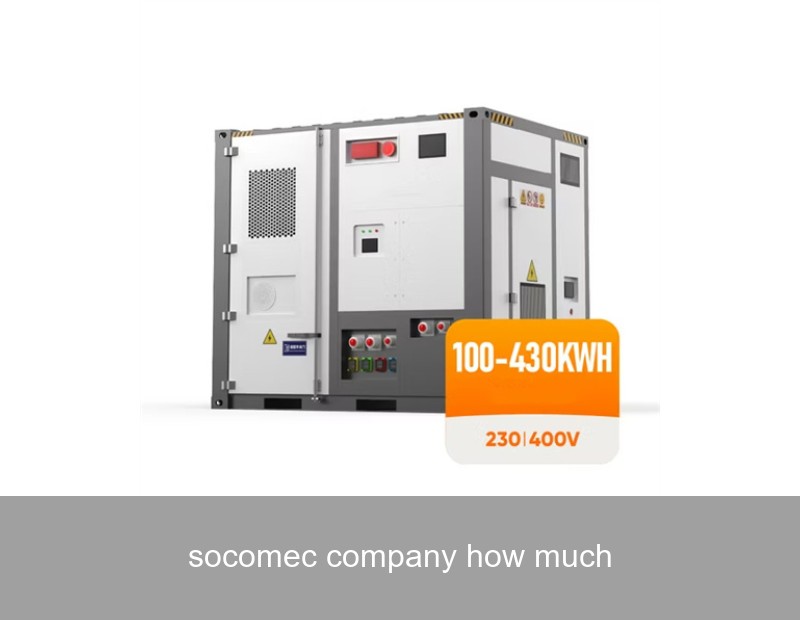
If you're managing a data center, a hospital, or a critical industrial process, the question of power continuity is not a matter of "if" but "when." A momentary power dip or a complete blackout can translate into catastrophic data loss, halted production, or even life-threatening situations. This is where Uninterruptible Power Supply (UPS) systems from renowned brands like Socomec become non-negotiable. But when planning your budget, the first question that arises is often: How much does a Socomec company UPS cost? The short answer is: it's not a simple sticker price. The true cost is an investment in resilience, and it varies significantly based on your specific needs. Let's unpack the factors that determine the price and explore how modern energy storage solutions are redefining value in backup power.
Table of Contents
Key Factors Influencing Socomec UPS Pricing
Asking for the price of a Socomec UPS is like asking for the price of a car—it depends on the model, features, and performance. Several core technical and commercial factors directly impact the final figure:
- Power Rating (kVA/kW): This is the most significant cost driver. A small 10 kVA unit for a server rack costs vastly less than a massive 800 kVA system protecting an entire data hall. You must accurately calculate your critical load.
- Topology and Technology:
- Offline/Standby: Lowest cost, suitable for non-critical equipment.
- Line-Interactive: Mid-range price, offers voltage regulation.
- Online Double Conversion: The premium, most reliable option for critical infrastructure. Socomec's strengths often lie here, commanding a higher initial investment for superior protection.
- Runtime Requirements: How long do you need to run on battery? A 5-minute runtime for graceful shutdown is standard and cheaper. Extending to several hours requires larger, more expensive battery banks, which can sometimes rival the UPS unit itself in cost.
- Additional Features: Remote monitoring cards, advanced communication protocols (SNMP, Modbus), redundancy modules (N+1 configuration), and special transformers add to the cost.
- Service and Support: Don't overlook the long-term value of installation, commissioning, and a comprehensive maintenance contract. These are crucial for ensuring uptime and are typically quoted separately.
As a ballpark, for a standard online double-conversion UPS, you could be looking at a range from a few thousand dollars/euros for a small unit to well over $50,000/€45,000 for large, feature-rich systems, excluding extended battery cabinets.
Beyond the Price Tag: The Shift to Integrated Energy Storage
Here's where the conversation gets interesting. The traditional role of a UPS is to be a silent guardian, sitting idle 99% of the time, waiting for a grid failure. This is a pure cost center. Modern energy challenges—like volatile electricity prices and the push for sustainability—are prompting businesses to think differently. What if your backup power system could also save you money every single day?
This is the paradigm shift brought by advanced Battery Energy Storage Systems (BESS). Unlike a standard UPS with limited battery function, a smart BESS can perform multiple revenue-generating or cost-saving functions:
- Peak Shaving: Drawing from batteries during times of high, expensive grid demand, slashing your peak demand charges, which can constitute up to 30-50% of a commercial electricity bill.
- Load Shifting (Arbitrage): Storing cheap energy (e.g., overnight or from solar) and using it during expensive peak periods.
- Frequency Regulation: In some markets, providing grid services for additional revenue.
- Backup Power: Of course, it still provides seamless backup during outages.
Suddenly, the question changes from "How much does a Socomec company UPS cost?" to "What is the return on investment (ROI) and total cost of ownership (TCO) of my energy resilience system?" A system that pays for itself over time presents a fundamentally different value proposition than a pure insurance policy.

A modern Battery Energy Storage System (BESS) goes beyond backup, enabling daily cost savings.
Case Study: Cost-Benefit Analysis in Action
Let's look at a real-world scenario to illustrate the financial calculus. Consider a medium-sized manufacturing plant in Germany with a peak demand of 500 kW and significant electricity costs driven by demand charges.
| Scenario | Traditional 500 kVA UPS (30-min runtime) | Integrated 500 kW / 1000 kWh BESS |
|---|---|---|
| Primary Function | Backup only | Backup + Peak Shaving + Arbitrage |
| Estimated Capital Outlay | ~ €80,000 - €120,000 | ~ €250,000 - €350,000 |
| Annual Operational Savings/Revenue | €0 (pure cost) | €45,000 - €65,000 (from demand charge reduction & arbitrage)* |
| Payback Period | N/A (No direct payback) | 5-7 years | 10-Year TCO (Net Cost) | €80,000 - €120,000 + maintenance | Potential Net Positive (Savings may exceed initial cost) |
*Savings estimates based on German industrial electricity price structures and peak shaving models. Actual figures depend on local tariffs and usage patterns. Source: Analysis based on data from the U.S. Department of Energy and European market reports.
This case shows that while the integrated BESS has a higher upfront cost, it transforms a capital expense into a strategic investment with a clear ROI. The traditional UPS remains a cost, albeit a necessary one for basic protection.
How Highjoule Complements Your Power Resilience Strategy
This is precisely where Highjoule, as a global leader in advanced energy storage systems, adds immense value. We don't just sell batteries; we provide intelligent, software-driven solutions that maximize the financial and operational return on your energy assets.
For businesses considering a Socomec UPS for their critical protection needs, a Highjoule BESS can be the perfect companion or even an alternative for broader energy management. Imagine a layered approach:
- Tier 1 (Critical Loads): A Socomec online UPS provides millisecond-level protection for your most sensitive IT and process control equipment.
- Tier 2 (Facility-Wide Resilience & Savings): A Highjoule industrial-scale BESS is deployed at the facility level. It manages the entire building's energy profile, performs peak shaving, integrates with on-site solar, and provides extended backup for essential operations during longer outages. Our AI-powered energy management system automatically decides the most economical way to charge and discharge the batteries daily.
Highjoule's solutions, from commercial to utility-scale, are designed for high-cycle, daily use. We use lithium iron phosphate (LFP) battery chemistry known for its safety, longevity (10,000+ cycles), and stability—making it ideal for the demanding role of both daily cycling and reliable standby. Our systems come with comprehensive monitoring and control, ensuring you see and realize the savings every day.

Intelligent control systems are key to unlocking the value of a BESS, turning stored energy into daily savings.
Making the Right Investment Decision
So, when you're evaluating "how much a Socomec company UPS" will cost, we encourage you to broaden the scope of your inquiry. Start with a detailed energy audit and ask these strategic questions:
- What are my truly critical loads (seconds of backup) vs. my essential loads (minutes/hours of backup)?
- What is my current electricity bill structure, and how much could I save by shaving 20-30% off my peak demand?
- Do I have, or plan to install, on-site renewable generation like solar PV?
- Is my goal purely compliance and risk mitigation, or can energy resilience be a profit center?
By answering these, you move from buying a commodity to designing a solution. A qualified partner can then help you model the TCO and ROI for different configurations—be it a standalone premium UPS, a hybrid system, or a comprehensive BESS that handles both optimization and backup.
For further reading on the technical standards and importance of power quality, you can refer to the IEEE website, which sets many industry benchmarks.
Ready to Calculate Your Specific ROI?
Instead of just searching for a price, why not start a conversation about value? What single energy cost on your bill—peak demand charges, time-of-use rates, or grid dependency—would you most like to reduce starting next month?
 Inquiry
 Online Chat