


Solar Storage in Barcelona 2024: Powering a Sustainable Future
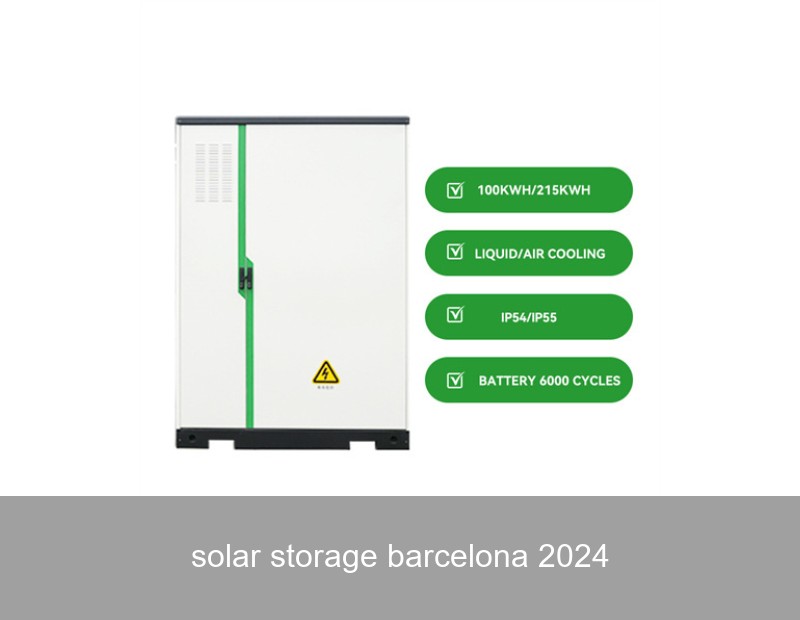
As Barcelona strides towards its ambitious 2030 climate goals, a quiet revolution is taking place on its rooftops and within its businesses. The conversation around solar energy has decisively shifted from simple generation to intelligent, round-the-clock solar storage. In 2024, the integration of advanced battery systems with photovoltaic (PV) panels is no longer a luxury; it's the cornerstone of a resilient, cost-effective, and truly green energy strategy for the city. This article explores why solar storage in Barcelona 2024 is a critical development, backed by data, real-world examples, and insights into the technology making it possible.
Table of Contents
- The Phenomenon: Barcelona's Solar Surge Meets a Nighttime Challenge
- The Data: Economics and Grid Stability in Focus
- The Case Study: A Barcelona Business's Journey to Energy Independence
- The Solution: What to Look for in a Modern Solar Storage System
- Highjoule's Role in Barcelona's Energy Landscape
- Looking Ahead: The Intelligent Grid
The Phenomenon: Barcelona's Solar Surge Meets a Nighttime Challenge
Walk through the neighborhoods of Poblenou or the industrial belts of the Zona Franca, and you'll see a sea of glistening solar panels. Barcelona's high solar irradiance, a well-documented advantage, makes it an ideal candidate for PV generation. However, this creates a familiar curve: a massive peak of production during midday sun, often exceeding immediate consumption, followed by a steep drop as the sun sets—precisely when households and businesses ramp up energy use.
This mismatch means two things: first, a lot of that precious solar energy is exported to the grid at low compensation rates. Second, reliance on the grid (and its associated costs) returns every evening. The phenomenon isn't unique to Barcelona, but the city's dense urban fabric and commercial activity make the need for a solution particularly acute.

Image: Barcelona's rooftops are prime real estate for solar, but storage unlocks their full potential. Source: Unsplash
The Data: Economics and Grid Stability in Focus
Let's talk numbers. The economic argument for adding storage to solar is becoming undeniable.
| Scenario | Solar PV Only (Typical Home) | Solar PV + Storage (Typical Home) |
|---|---|---|
| Self-Consumption Rate | 30-40% | 70-85%+ |
| Grid Import Reduction | ~35% | ~80% |
| Payback Period | 6-8 years | 7-10 years (with greater long-term savings) |
Beyond individual savings, the grid benefits are immense. A study by Catalonia's energy research institute suggested that widespread solar storage could help shave peak demand on the local grid by significant margins, deferring costly infrastructure upgrades and enhancing overall stability, especially during heatwaves when air conditioning load is high.
The Case Study: A Barcelona Business's Journey to Energy Independence
Consider "Bodega Moderna," a mid-sized wine storage and distribution warehouse in the Sant Martí district. Facing rising energy costs and a need for consistent cooling, they installed a 100 kW solar array in 2022. While daytime bills dropped, evening and nighttime grid dependence remained high.
In early 2024, they integrated a 240 kWh commercial battery storage system. The results after six months are telling:
- Grid Independence: The facility now operates 94% off-grid during its operational hours (6 AM - 10 PM).
- Cost Savings: Overall energy costs have been reduced by 76% compared to pre-solar levels.
- Peak Shaving: The system intelligently discharges during peak tariff periods (7-10 PM), completely avoiding the most expensive grid electricity.
- Backup Power: The storage system provides seamless backup for critical refrigeration units during brief grid outages.
This tangible example from Barcelona's commercial sector highlights the transformative power of coupling generation with storage.
The Solution: What to Look for in a Modern Solar Storage System
Not all storage solutions are created equal. For a robust system in 2024, key features are non-negotiable.
1. Battery Chemistry: The Heart of the System
Lithium Iron Phosphate (LFP) has become the dominant chemistry for good reason: exceptional safety, long cycle life (often over 6,000 cycles), and excellent thermal stability—crucial for Barcelona's warm climate.
2. Intelligent Energy Management (EMS)
The brain of the operation. A smart EMS should do more than just store and release. It must forecast solar production, learn consumption patterns, and consider time-of-use tariffs to optimize every kilowatt-hour for maximum economic return.
3. Scalability and Modularity
Energy needs evolve. A modular system allows you to start with what you need and cost-effectively add capacity as your business grows or your electric vehicle fleet expands.
4. Grid Services and Future-Proofing
Advanced systems can participate in grid-balancing services (where regulations permit), creating a potential revenue stream. This requires robust communication interfaces and grid-forming inverter capabilities.

Image: A modern, modular battery storage installation for commercial use. Source: Unsplash
Highjoule's Role in Barcelona's Energy Landscape
This is where global expertise meets local challenges. At Highjoule, with nearly two decades of experience since 2005, we design storage solutions that address the precise needs outlined above. For the Barcelona market in 2024, our approach is tailored.
Our H-Series Commercial & Industrial (C&I) storage systems are built on LFP technology and feature our proprietary Adaptive Energy OS. This platform doesn't just manage energy; it continuously analyzes data to maximize ROI. For a hotel in Eixample or a manufacturer in Zona Franca, the system can be configured to prioritize cost savings, carbon footprint reduction, or resilience.
For larger-scale applications, such as community housing projects or microgrids for industrial parks, our Microgrid Controller Platform can seamlessly integrate multiple solar arrays, storage units, and even backup generators into a single, stable, and self-optimizing network. This is particularly relevant for Barcelona's push towards energy communities.
Our services extend beyond hardware. We provide comprehensive feasibility analysis, system design, and long-term performance monitoring, ensuring our clients' investments deliver for decades.
Looking Ahead: The Intelligent Grid
The future of solar storage in Barcelona is interconnected. Imagine a city where thousands of distributed storage systems, from homes to factories, act in concert as a virtual power plant (VPP). This aggregated capacity could provide critical grid support during stress events, democratize energy markets, and accelerate the transition from fossil fuels. The technology to do this exists today.
The question for building owners, facility managers, and sustainability officers in Barcelona is no longer if to consider storage, but how to implement it strategically. With the right partner and technology, the goal of true energy independence is within reach.
What is the first step your organization would take to evaluate its potential for solar and storage integration in the coming year?
 Inquiry
 Online Chat