


Unlocking Grid Stability and Savings: The Power of Energy Management Software
Have you ever looked at your business's electricity bill and felt a pang of confusion? You're not alone. For facility managers, energy directors, and homeowners with solar panels alike, the modern electrical grid presents both a challenge and an opportunity. The challenge is managing volatile costs, unpredictable supply from renewables, and increasing demand. The opportunity lies in intelligent control. This is where energy management software (EMS), or software de gestion electrica, transforms from a technical term into your most powerful tool for energy independence and efficiency. It's the digital brain that orchestrates energy flows, making your storage systems, solar panels, and grid connection work in intelligent harmony.
Table of Contents
What is Energy Management Software (EMS)? Beyond Basic Monitoring
Think of energy management software not as a simple dashboard, but as the central nervous system for your electrical infrastructure. At its core, EMS is a platform that collects data from meters, inverters, battery storage systems, and even weather forecasts. It then uses advanced algorithms—often incorporating artificial intelligence (AI) and machine learning—to analyze this data and execute automated decisions in real-time. The goal? To optimize energy consumption, storage, and generation for economic and operational benefits.
Key functions of a modern EMS include:
- Predictive Analytics: Forecasting energy production (from solar/wind) and consumption patterns to plan ahead.
- Automated Peak Shaving: Discharging batteries during periods of high, expensive grid demand to reduce capacity charges.
- Arbitrage: Buying and storing grid energy when it's cheap, using or selling it when prices are high.
- Renewables Integration: Maximizing self-consumption of solar power by intelligently shifting loads to sunny periods.
- Grid Services Participation: Enabling battery systems to provide stability services to the local utility, creating a new revenue stream.

Image Source: Unsplash - A visualization of energy flow data crucial for management software.
The Phenomenon: Why We Can't Manage Energy the Old Way
For decades, energy was a one-way street: utility generates, consumer pays the bill. The rise of distributed energy resources (DERs)—like rooftop solar, residential and commercial battery storage, and electric vehicles—has turned this model on its head. We've moved from a centralized grid to a decentralized, bidirectional one. This is a fantastic development for sustainability, but it introduces immense complexity.
Here’s the simple phenomenon: Solar panels flood the grid with excess power at midday, sometimes causing local voltage issues. Then, as the sun sets, everyone turns on their appliances, creating a massive "duck curve" demand spike that utilities must meet with often costly and carbon-intensive peaker plants. Without intelligent management, your battery might discharge at the wrong time, or you might sell solar power back to the grid at a low price only to buy it back later at a premium.
The Data Reality: Quantifying the Grid Challenge and Savings Potential
The numbers paint a clear picture of both the problem and the value of a solution like EMS. According to the U.S. Department of Energy, commercial buildings alone account for nearly 36% of U.S. electricity consumption. A significant portion of their costs comes not just from total usage, but from peak demand charges, which can constitute 30-50% of a commercial bill. These charges are based on the highest 15-minute average power draw in a billing cycle.
Now, let's talk savings. Studies and real-world deployments show that an integrated EMS can:
- Reduce peak demand charges by 20-30%.
- Increase self-consumption of rooftop solar by up to 50%, drastically improving ROI.
- Provide ancillary grid services that can generate hundreds to thousands of dollars in annual revenue per installation.
The table below breaks down the typical value streams unlocked by advanced EMS:
| Value Stream | Mechanism | Typical Benefit |
|---|---|---|
| Bill Reduction | Peak shaving, time-of-use optimization | 15-40% on electricity costs |
| Asset ROI | Maximized battery cycling, solar self-use | 2-3 year faster payback on storage |
| Revenue Generation | Frequency regulation, capacity markets | Varies by market; significant long-term income |
| Resilience | Automated islanding & backup power management | Uninterrupted operations during outages |
Case Study: A California Winery's Strategic Shift with Intelligent Management
Let's move from theory to a concrete example. A mid-sized winery in Napa Valley, California, faced a perfect storm of energy challenges: high time-of-use rates, critical need for temperature control for wine storage, and an increasing corporate sustainability mandate. They had installed a sizable solar array, but were still facing high bills because their production peak didn't align with their late-afternoon and evening energy needs.
Their solution was a comprehensive battery energy storage system (BESS) governed by a sophisticated, cloud-based software de gestion electrica. Here's what changed:
- Data & Automation: The EMS analyzed historical usage, real-time electricity prices (from CAISO), and solar forecast. It automatically charged the batteries with excess solar at midday.
- Peak Shaving in Action: From 4-9 PM, during "Critical Peak Pricing," the system discharged the batteries to power the facility, avoiding drawing expensive power from the grid.
- Resilience as a Bonus: The software was configured to maintain a reserve capacity, allowing the winery's critical cooling systems to ride through public safety power shutoffs (PSPS) common in California.
The Results (12-month period):
- **35% reduction in overall electricity costs**, primarily through demand charge avoidance.
- Increased solar self-consumption from 40% to over 80%.
- ROI period for the combined solar+storage+EMS project shortened by an estimated 2.5 years.
This case underscores a vital insight: the hardware (solar panels, batteries) provides the capability, but it is the energy management software that unlocks and maximizes the financial and operational value.
The Highjoule Approach: Where Intelligence is Built-In, Not Bolted-On
At Highjoule, we've believed since our founding in 2005 that hardware and software cannot be an afterthought. Our advanced storage systems for commercial, industrial, and microgrid applications are designed with an integrated digital brain. The Highjoule Energy Operating System (EOS) is not a generic third-party platform; it's a proprietary EMS engineered in tandem with our battery modules and inverters for seamless, reliable, and optimized performance.
What does this mean for our clients across Europe and North America?
- Seamless Integration: EOS communicates natively with Highjoule hardware, enabling faster response times and deeper system diagnostics.
- Market-Agnostic Intelligence: Whether you're navigating the FRED frequency response market in the UK, FCR in Germany, or CAISO's markets in the US, our software can be configured to participate, turning your storage asset into a revenue generator.
- User-Centric Design: We provide clear, actionable insights through our dashboard, not just raw data. You see your savings, your carbon offset, and your system health at a glance.
Our software de gestion electrica is the cornerstone of our promise to deliver not just storage, but truly intelligent, efficient, and sustainable power solutions.

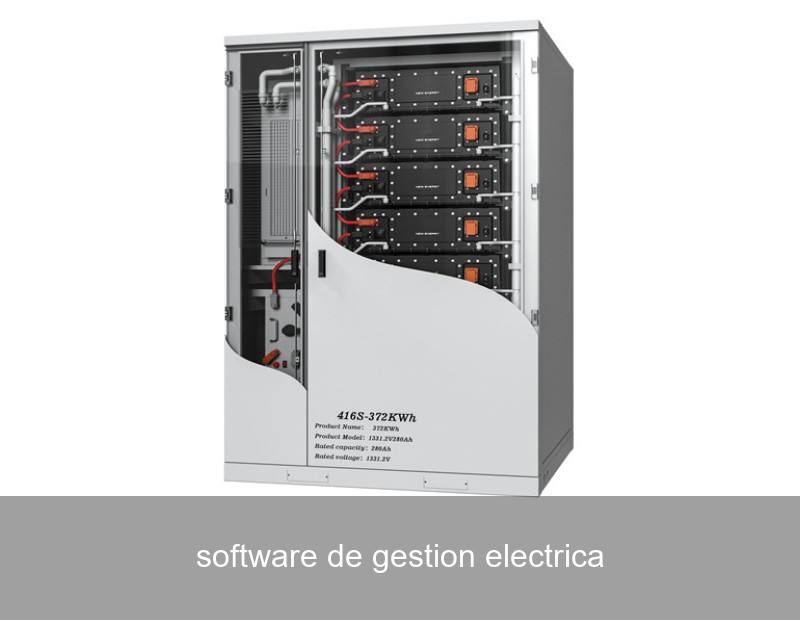
Image Source: Unsplash - Representative of a modern commercial battery energy storage system.
Your Role in the Future Grid: From Consumer to Prosumer Manager
The energy transition is democratizing power—literally. With the right tools, every business, community, and homeowner can become an active, intelligent node in the grid. Energy management software is the key that enables this transition. It allows you to take control, to make economic decisions in real-time, and to contribute to a more stable and renewable grid.
This isn't just about technology; it's about a new relationship with energy. It's about transitioning from a passive ratepayer to an active "prosumer" who both consumes and produces managed power.
So, what's the first step?
Begin with an audit of your current energy footprint. Look at your bills, identify your peak demand, and assess any on-site generation. Then, ask yourself: Is my current setup just operating, or is it optimizing? The gap between those two states is exactly where a sophisticated software de gestion electrica platform, like Highjoule's EOS, creates transformative value.
What single energy cost metric on your bill are you most eager to tackle—peak demand, time-of-use rates, or overall consumption volatility?
 Inquiry
 Online Chat