


Unlocking Energy Independence: The Comprehensive Guide to Solar 1500 Watt Power Energy Storage Cabinets
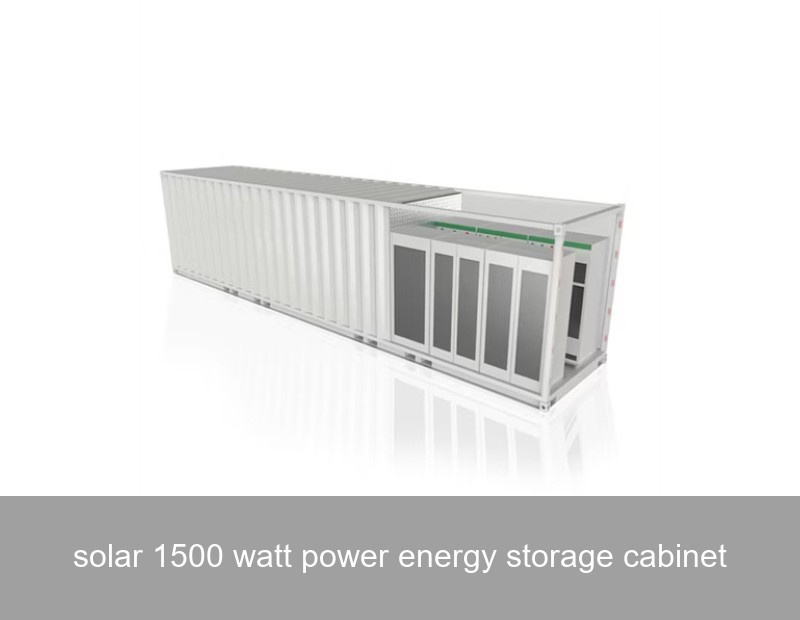
Have you ever watched your solar panels work hard all day, only to wonder where that clean energy goes when the sun sets or clouds roll in? You're not alone. Across homes in Europe and the US, a quiet revolution is happening. Homeowners and businesses are moving beyond just generating solar power; they're taking control of storing it. This is where the solar 1500 watt power energy storage cabinet becomes the centerpiece of a modern, resilient energy system. It's more than a battery; it's your personal energy hub, designed to maximize your solar investment and provide peace of mind during outages. Let's explore how this technology works and why it's becoming essential for energy-conscious consumers.
Table of Contents
- What is a 1500W Solar Energy Storage Cabinet?
- Why the Demand is Surging Now: Data & Drivers
- How It Works: From Sunlight to Socket
- A Real-World Case Study: Resilience in Practice
- Choosing the Right System: Key Considerations
- Highjoule's Smart Solution: The Atlas Home Energy Cabinet
- The Future of Home Energy
What Exactly is a Solar 1500 Watt Power Energy Storage Cabinet?
Think of it as the heart of your home's new energy circulatory system. A solar 1500 watt power energy storage cabinet is an integrated, all-in-one unit that typically houses a lithium-ion battery bank (often with a capacity of 10-20 kWh), a hybrid solar inverter, a battery management system (BMS), and safety components—all in a sleek, cabinet-style enclosure. The "1500 watt" rating often refers to the continuous power output it can deliver, which is sufficient to run essential home loads like refrigeration, lighting, internet, and critical appliances simultaneously during a grid outage. It's designed to seamlessly connect to your existing solar PV array, store the excess energy you produce, and dispatch it precisely when you need it most.

Image Source: Unsplash - A modern home solar and storage setup.
Why the Demand is Surging Now: Data & Market Drivers
The shift towards storage isn't just a trend; it's a logical response to several converging factors. The phenomenon of "solar clipping," where panels produce more than the home can use or export, is common. Without storage, this energy is often sold back to the grid at low rates.
Let's look at the data: In the US, residential storage installations grew by over 20% in 2023(SEIA Report). In Germany, driven by high electricity prices and a desire for Energieautarkie (energy autonomy), nearly 70% of new solar systems are now paired with storage. The logic is a simple economic and resilience ladder:
- Phenomenon: Rising energy costs, increased grid instability, and extreme weather events.
- Data: The International Energy Agency (IEA) notes a 90% decrease in lithium-ion battery costs since 2010, making storage viable.
- Case Insight: Homeowners see neighbors maintaining power during blackouts and maximizing self-consumption of solar, creating a compelling value proposition.
How It Works: From Sunlight to Your Socket
The operation of a solar energy storage cabinet is an elegant dance of energy management. Here’s a typical daily cycle:
| Time of Day | Solar Production | Cabinet Action | Home Power Source |
|---|---|---|---|
| Day (Sunny) | High | Charges battery first, powers home, exports surplus. | Solar → Battery → Grid |
| Evening (Peak) | Low/None | Discharges battery to power home, avoids expensive grid power. | Battery → Home |
| Night | None | Powers home from battery until a set reserve, then uses grid. | Battery → Grid |
| Grid Outage | Any | Islands the home instantly. Uses solar + battery to power critical loads. | Solar + Battery (Island Mode) |
The intelligent inverter inside the cabinet is the brain, making these split-second decisions to optimize for cost, efficiency, and resilience.
A Real-World Case Study: California Home Resilience
Let's ground this in reality. The Miller family in Northern California installed a 8 kW solar array in 2020. Despite having solar, they experienced 4 prolonged grid outages in 2022 due to wildfire safety shutoffs. Their solution: integrating a 1500 watt output energy storage cabinet with a 13.5 kWh capacity.
- Challenge: Ensure power for critical loads (refrigerator, medical equipment, lighting, comms) for up to 48 hours during PSPS events.
- Solution: A cabinet system with a seamless transfer switch was installed alongside their existing solar.
- Result: During the next outage, the system automatically islanded the home. The family maintained full critical power for 52 hours before the battery reached its 20% reserve. Their solar panels replenished the battery during the day, extending independence indefinitely as long as the sun shone. Annually, they also increased their solar self-consumption from 40% to 85%, drastically cutting their electricity bill.
This case highlights the dual benefit: emergency resilience and daily economic gain.
Choosing the Right System: Key Considerations
Not all storage cabinets are created equal. When evaluating a solar 1500 watt power energy storage cabinet, ask these questions:
- Usable Capacity (kWh): How much energy can it actually store and discharge? This dictates backup duration.
- Continuous & Peak Power (kW): Can it start your fridge compressor and well pump simultaneously? 1500W is a common base; ensure it matches your startup surge needs.
- Depth of Discharge (DoD): A 95% DoD means you can use almost all the rated capacity without harming the battery.
- Scalability: Can you add more battery modules later if your needs grow?
- Software & Grid Services: Can it participate in utility demand response programs for additional revenue?
The Highjoule Solution: Engineered for Simplicity and Performance
At Highjoule, with nearly two decades of expertise in grid-scale and commercial storage, we've distilled our advanced technology into a solution designed for your home: the Highjoule Atlas Home Energy Cabinet. We understand that a solar energy storage cabinet must be more than just components in a box; it must be a reliable, intelligent partner.
The Atlas Cabinet is a fully integrated, AC-coupled system. It features a modular LiFePO4 battery design (starting at 10 kWh, expandable to 30 kWh), a robust hybrid inverter with a 1500W continuous/3000W surge output, and our proprietary Neuron energy management platform. What sets it apart?
- Set-and-Forget Intelligence: Neuron learns your energy patterns and automatically optimizes for self-consumption or time-of-use savings, seamlessly switching modes during an outage.
- Unmatched Safety: Built with automotive-grade battery cells, an active liquid cooling system, and a multi-layer BMS that monitors every cell—technology proven in our utility installations.
- Future-Ready Design: Its modular nature means you can start with what you need and expand your capacity as your electric vehicle or other loads increase. The cabinet is designed for easy wall-mounting in a garage or utility room.
For us, it's about providing a complete energy service—from professional design consultation and installation support to ongoing system monitoring and performance optimization.

Image Source: Unsplash - Monitoring a modern energy storage system.
The Future of Home Energy: Beyond the Battery
Integrating a solar 1500 watt power energy storage cabinet is the first major step towards a true smart home energy ecosystem. The next phase involves integrating electric vehicle charging (bidirectional V2H charging turns your EV into a backup resource), smart appliance control, and even forming part of a community virtual power plant (VPP).
The question is no longer "Why should I get solar storage?" but rather "What specific outcomes—total blackout protection, maximum bill savings, or supporting the grid—do I want my energy storage cabinet to deliver for my home?"
What energy goal would you want your home to achieve first: complete peace of mind during a storm, or eliminating your peak-time electricity charges for good?
 Inquiry
 Online Chat