


Solar 2 Battery Connection: The Key to Unlocking True Energy Independence
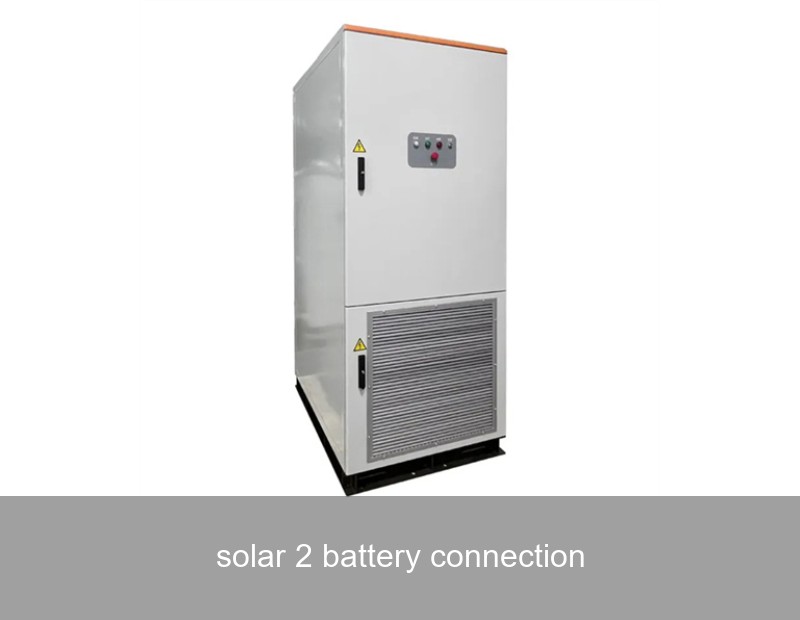
You've made a smart investment in solar panels. You watch them gleam on your roof, knowing they're generating clean power. But then the sun sets, grid prices spike, or an outage hits, and you're left wondering—where's *my* solar energy when I need it most? This common frustration points to a missing link in many home energy systems: the **solar 2 battery connection**. It's not just about having panels and a battery; it's about the intelligent, seamless integration between them that transforms sunlight into reliable, round-the-clock power. Let's explore how this connection works and why it's the cornerstone of a modern, resilient home.
Table of Contents
- The Solar Energy Gap: Generation vs. Consumption
- How a Solar 2 Battery Connection Actually Works
- Beyond the Basics: The Intelligence Behind the Connection
- Real-World Impact: A Case Study from California
- Choosing the Right System: AC-Coupled vs. DC-Coupled
- Highjoule's Role: Seamless Integration for Peak Performance
- The Future is Connected
The Solar Energy Gap: Generation vs. Consumption
Here's the fundamental mismatch: solar panels produce the most energy in the middle of the day. However, the average household's energy consumption often peaks in the early morning and evening. According to the U.S. Department of Energy, this "duck curve" phenomenon highlights the growing challenge of aligning solar production with demand. Without a battery, excess midday energy is sent back to the grid, often for minimal credit, leaving you to buy back expensive power when your panels are idle.
The **solar 2 battery connection** solves this by acting as a smart energy reservoir. It captures that surplus sunshine for personal use later, fundamentally changing your relationship with both the grid and your solar array.

Image Source: Unsplash - A visual representation of a complete home energy system.
How a Solar 2 Battery Connection Actually Works
Think of the connection not as a single wire, but as an intelligent energy management ecosystem. It involves hardware and software working in concert:
- Solar Panels: Generate direct current (DC) electricity.
- Inverter(s): The critical bridge. They convert DC from panels to usable alternating current (AC) for your home. In a system with a battery, you may have a hybrid inverter or a separate battery inverter.
- Battery System: Stores energy as DC power.
- Energy Management System (EMS): The true "brain" of the operation. This software platform decides, in real-time, whether to send solar power to your appliances, to the battery for storage, or to the grid.
The magic happens in milliseconds. When production exceeds consumption, the EMS instructs the system to charge the battery. When consumption rises (like at night), it draws from the battery before pulling from the grid.
Beyond the Basics: The Intelligence Behind the Connection
A sophisticated **solar 2 battery connection** does more than just store and release. It optimizes for:
- Time-of-Use (TOU) Rate Arbitrage: In regions like California or parts of the EU with variable electricity pricing, the system can be programmed to charge from the grid when rates are low (if allowed) and from solar, then discharge during expensive peak periods, maximizing bill savings.
- Backup Power Readiness: It maintains a reserve of energy specifically for outages, ensuring essential circuits stay on.
- Grid Services: Advanced systems can even support grid stability, a feature increasingly valued by utilities.
Real-World Impact: A Case Study from California
Let's look at data from a real installation. A family in Sacramento, California, upgraded their existing 8kW solar array with a **Highjoule HES-12 integrated battery system**. Their goal was to eliminate nearly all grid consumption during high-cost peak hours (4-9 PM) and ensure backup power.
| Metric | Before Battery | After Solar 2 Battery Connection |
|---|---|---|
| Average Grid Import during Peak Hours | ~12 kWh/day | < 1 kWh/day |
| Monthly Bill Savings (Beyond Solar) | -- | $85-$110 |
| Self-Consumption of Solar Energy | ~35% | ~85% |
| Backup Power Available | 0 hours | Essential loads for 18+ hours |
The **Highjoule Harmony EMS** platform was key. Its predictive algorithms, based on weather forecasts and usage history, optimized the charge/discharge cycles to their specific TOU rate schedule. During a planned public safety power shutoff (PSPS), the system automatically islanded the home, providing seamless backup power for 22 hours.
Choosing the Right System: AC-Coupled vs. DC-Coupled
When planning your **solar 2 battery connection**, you'll encounter two primary architectures. Here’s a quick breakdown:
- AC-Coupled: The most versatile solution, especially for retrofitting batteries to existing solar systems. The battery has its own inverter, connecting to the home's AC wiring. This allows independent operation of solar and storage.
- DC-Coupled: Often more efficient for new installations, as the solar DC power can be routed directly to the battery for storage with fewer conversions. It typically uses a single hybrid inverter for both solar and battery.
So, which is better? It depends entirely on your situation. A retrofit of an older solar system leans towards AC-coupled. A brand-new, designed-from-scratch system might benefit from DC-coupled efficiency. This is where expert guidance is crucial.

Image Source: Unsplash - Professional installation ensures safety and performance.
Highjoule's Role: Seamless Integration for Peak Performance
At Highjoule, we don't just sell batteries; we engineer **intelligent energy ecosystems**. Since 2005, our focus has been on making the **solar 2 battery connection** as efficient, reliable, and user-friendly as possible. Our product suite is designed to meet this need head-on:
- Highjoule HES Series (Home Energy System): Our flagship product is an AC-coupled, all-in-one unit combining a lithium-iron-phosphate (LiFePO4) battery, hybrid inverter, and the Harmony EMS in one sleek, wall-mounted cabinet. It's designed for simple retrofits and offers scalable capacity.
- Highjoule Harmony EMS: This proprietary software is the intelligence layer. Accessible via a simple mobile app, it provides real-time monitoring, customizable modes (like "Max Savings" or "Storm Watch"), and adaptive learning to optimize your system's performance over time.
- Highjoule Professional Network: We partner with certified, trained installers across Europe and North America. They ensure your system is not only correctly installed but also perfectly configured for your local climate, utility rules, and personal energy goals.
Our systems are built with a deep understanding of both European grid standards (like VDE-AR-N 4105 in Germany) and North American requirements (UL 9540), ensuring safety, compliance, and interoperability wherever you are.
The Future is Connected
The evolution of the **solar 2 battery connection** is moving towards even greater grid interaction and community resilience. Concepts like virtual power plants (VPPs), where thousands of distributed home systems aggregate to act as a single power plant, are becoming reality. With a Highjoule system, homeowners can potentially choose to participate in such programs, turning their energy asset into a source of additional revenue while supporting the broader clean energy transition.
The technology is here, and it's proven. The question is no longer *if* you should connect your solar to a battery, but *how* to do it in the smartest way possible.
What's the first energy-dependent appliance you would want to secure during an outage, and how would knowing it's powered by your own sun change your sense of security?
 Inquiry
 Online Chat