


Solar Africa Products in Kenya: Powering a Brighter Future with Smart Energy Storage
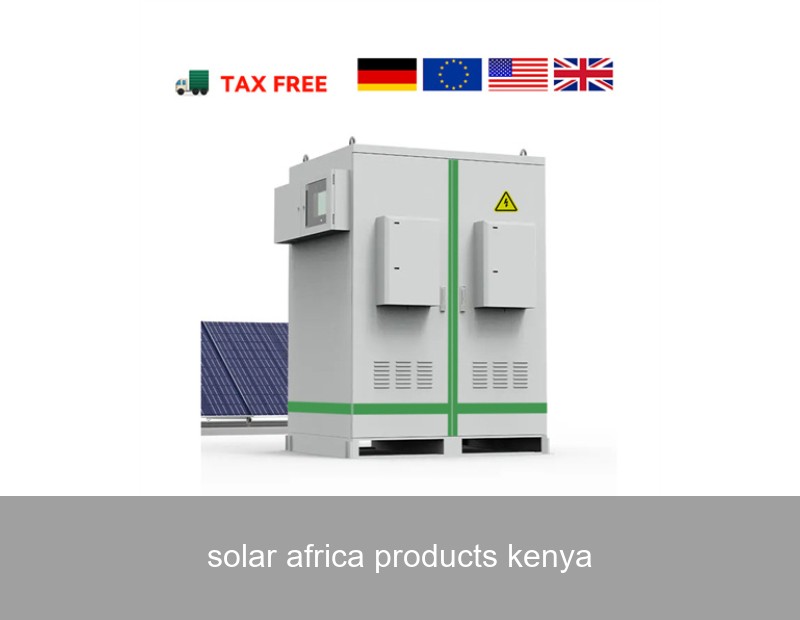
Imagine a farm in rural Kenya, where the sun is abundant but the electrical grid is unreliable. For years, this meant missed opportunities, spoiled goods, and reliance on expensive, polluting diesel generators. Today, a quiet revolution is underway. The conversation around solar Africa products in Kenya is evolving beyond just panels. It's now fundamentally about what happens when the sun goes down. The true game-changer for businesses and communities is no longer just generation, but intelligent storage. This shift from basic solar systems to integrated, smart energy solutions is unlocking unprecedented economic and social potential across the continent.
Table of Contents
- The Challenge: More Than Just Sunshine
- The Data: Why Storage is the Missing Link
- Case Study: A Kenyan Tea Factory's Transformation
- The Solution: Intelligent Battery Energy Storage Systems (BESS)
- Highjoule's Role: Delivering Reliability for Demanding Applications
The Challenge: More Than Just Sunshine
Africa receives more hours of bright sunlight than any other continent. It's a phenomenal resource. Yet, energy access remains a critical barrier. The issue? Solar energy is intermittent. Businesses that run on solar alone face a major dilemma: productivity plummets after sunset or during cloudy periods. For commercial and industrial (C&I) operations in Kenya—from agricultural processing and manufacturing to cold storage and telecom towers—this unpredictability is a direct threat to profitability and growth.
This is where the narrative around solar Africa products in Kenya must mature. A photovoltaic (PV) array is only half the system. To achieve true energy independence and operational resilience, you need a brain and a bank: a smart inverter and a robust battery storage system that stores the sun's bounty for use anytime.

Image Source: Unsplash - A typical commercial solar installation. The key question is: where does the power go at night?
The Data: Why Storage is the Missing Link
Let's look at the numbers. According to the International Energy Agency (IEA), Africa is home to 60% of the world's best solar resources, but only 1% of global solar generation capacity. In Kenya, while grid access is improving, reliability is a persistent issue for industry. A World Bank enterprise survey highlighted that firms experience an average of 7.8 power outages per month.
The financial impact is staggering. These outages force reliance on diesel gensets, with fuel costs often exceeding $0.30 per kWh. Compare that to the levelized cost of solar-plus-storage, which, in many Kenyan contexts, can now deliver reliable power at a significantly lower lifetime cost. The logic is clear: pairing solar with storage isn't just an environmental choice; it's a sound financial strategy that reduces operational risk and locks in long-term energy costs.
| Power Source | Avg. Cost per kWh | Reliability | Operational Risk |
|---|---|---|---|
| Grid + Diesel Backup | $0.18 - $0.35+ | Low (Frequent outages) | High (Fuel price volatility) |
| Solar PV Only | $0.07 - $0.12 | Medium (Daytime only) | Medium (Weather dependent) |
| Solar + Intelligent BESS | $0.10 - $0.15 | Very High (24/7) | Low (Predictable cost) |
Case Study: A Kenyan Tea Factory's Transformation
Consider the real-world example of a medium-sized tea processing factory in Kericho County. Tea processing is energy-intensive, requiring consistent power for withering, drying, and sorting. Unplanned outages were ruining batches and causing contract penalties.
The Problem: The factory had a 500 kW daytime load and a critical 200 kW nighttime load for drying and security. Their existing 300 kW solar array reduced daytime grid/diesel use but left them vulnerable at night.
The Solution: In 2023, they integrated a 500 kWh / 250 kW lithium-ion Battery Energy Storage System (BESS) with their existing solar. The BESS was configured to:
- Store excess solar energy generated during the day.
- Automatically discharge during the evening and night to cover the critical load.
- Provide instantaneous backup during any grid outage, ensuring seamless operation.
The Results (12-month period):
- Diesel consumption reduced by 92%, saving over $120,000 annually.
- Grid electricity purchases during peak tariff hours cut by 75%.
- Zero production losses due to power outages.
- Projected payback period: Under 4 years.
This case underscores how the right solar Africa products in Kenya—specifically, advanced storage—directly translate to bottom-line results and competitive advantage.
The Solution: Intelligent Battery Energy Storage Systems (BESS)
So, what makes a modern BESS "intelligent"? It's far more than a simple battery bank. Think of it as the energy management hub of your facility. A sophisticated BESS, like those engineered by Highjoule, includes:
- Advanced Battery Management System (BMS): The brain that ensures each cell operates safely and efficiently, maximizing lifespan and performance.
- Energy Management System (EMS): The strategic controller. It makes real-time decisions on when to charge (from solar or grid), when to discharge, and when to export, based on weather forecasts, energy tariffs, and consumption patterns.
- Thermal Management: A critical component for longevity, especially in Kenya's warm climate, ensuring batteries are kept at an optimal operating temperature.
- Grid-Forming Inverter Technology: This allows the system to create a stable "grid" of its own (a microgrid), essential for areas with weak or no grid connection.

Image Source: Unsplash - The interior of a modern containerized BESS unit, highlighting its complex and organized engineering.
Highjoule's Role: Delivering Reliability for Demanding Applications
Since 2005, Highjoule has been at the forefront of this energy storage revolution. We understand that a one-size-fits-all approach doesn't work for the diverse and demanding environments across Africa. Our products and services are engineered for resilience and simplicity.
For the Kenyan market and similar regions, Highjoule offers containerized, all-in-one BESS solutions. These pre-integrated units arrive site-ready, significantly reducing installation time and complexity. They combine our high-cycle life lithium-ion batteries, patented thermal management, and intelligent EMS in a single, robust package.
Our systems are designed for:
- Commercial & Industrial (C&I): Providing peak shaving, backup power, and energy cost optimization for factories, farms, hotels, and shopping malls.
- Microgrids: Serving as the core storage component for community or utility-scale renewable microgrids, often paired with solar PV.
- Off-Grid & Weak-Grid Applications: Delivering 24/7 power where the grid is absent or unreliable, forming the backbone of mini-utilities.
Highjoule's global experience, coupled with a deep understanding of local challenges—from dust and heat to voltage fluctuations—ensures that our solar Africa products in Kenya are not just imported hardware, but tailored power solutions built to last. We provide comprehensive support, from initial feasibility analysis to system commissioning and remote monitoring, ensuring our clients achieve their energy independence goals.
The Future of Solar in Africa: Questions to Consider
The journey towards a sustainable energy future in Africa is accelerating. As battery technology continues to advance and costs decline, the economic case for solar-plus-storage becomes irrefutable. But the path forward requires thoughtful consideration. For a business leader or project developer in Kenya looking at solar Africa products, the key question is no longer "Should we invest in solar?" but rather "How do we design a storage-integrated system that maximizes our return on investment and operational resilience for the next 20 years?"
What unique energy challenge in your operation could be solved by having a reliable, intelligent power bank for the sun's energy?
 Inquiry
 Online Chat