


Solar and Storage Paris 2025: The Pivotal Event Shaping Our Energy Future
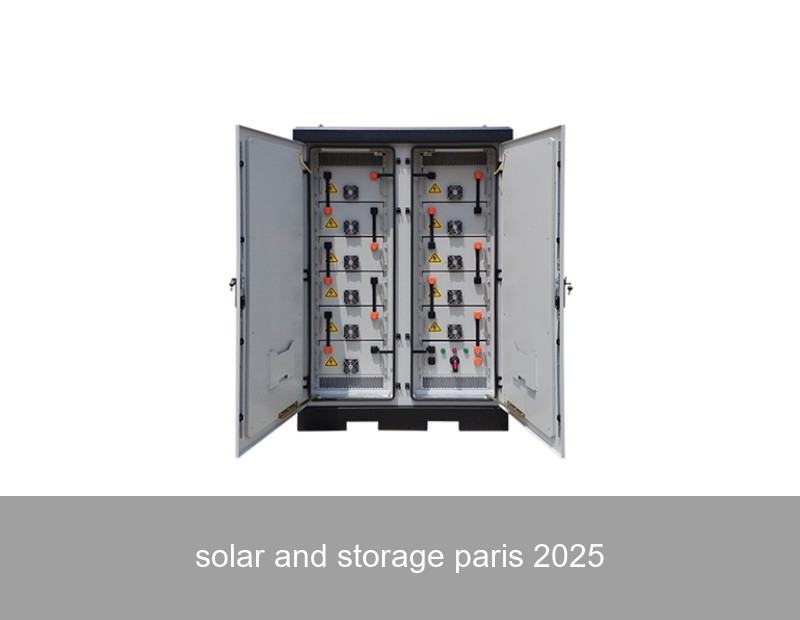
As we look towards the horizon of 2025, one event stands out as a critical milestone for the global energy transition: Solar and Storage Paris 2025. This isn't just another trade show; it's the convergence point where policy, innovation, and market demand will crystallize into actionable blueprints for a decarbonized world. For industry leaders, project developers, and forward-thinking communities, understanding the trends that will dominate this event is key to unlocking the next phase of renewable energy integration. The central theme? Moving beyond simple solar generation to creating resilient, intelligent, and self-sustaining energy ecosystems through advanced storage.
Table of Contents
- The Urgency Behind the Buzz: More Than Just Megawatts
- The Data Reality: Intermittency's True Cost
- Case Study: A German Industrial Park's Journey to Resilience
- Highjoule's Role: Intelligent Systems for a Complex Grid
- Anticipated Trends at Solar and Storage Paris 2025
- A Question for Your Business
The Urgency Behind the Buzz: More Than Just Megawatts
Let's be honest, the initial solar revolution was about deployment speed and cost-per-watt. And it was wildly successful. But a new challenge has emerged, one you've likely felt if you're managing a commercial facility or a community grid: what happens when the sun doesn't shine? The conversation has decisively shifted from pure generation to generation management. Solar and Storage Paris 2025 will be the definitive platform addressing this shift. It’s where the industry transitions from talking about hardware in isolation to discussing integrated software-defined energy systems. The goal is no longer just to produce green energy, but to guarantee its availability, optimize its economic value, and use it to strengthen grid stability.

Image Source: Unsplash - A visual representation of a combined solar and storage installation.
The Data Reality: Intermittency's True Cost
The phenomenon is clear. Solar generation creates a famous "duck curve" – a deep midday trough in net demand followed by a steep evening ramp as the sun sets. The data, however, reveals the financial and operational impact. According to the International Energy Agency (IEA), the value of solar PV electricity can fall by up to 50% during peak generation hours in markets with high penetration without storage. Conversely, the cost of grid electricity during the evening peak can be 2-3 times higher. This isn't just a utility problem; it directly impacts businesses with time-of-use tariffs and communities reliant on variable renewables.
This volatility creates a compelling business case for storage. But not all storage is created equal. The solution lies in:
- Duration & Cycle Life: Systems must be able to discharge for multiple hours and withstand daily cycling for decades.
- Intelligence: Software that can make real-time decisions based on weather forecasts, energy prices, and load patterns.
- Safety & Sustainability: Non-negotiable requirements, especially for commercial and residential settings.
Case Study: A German Industrial Park's Journey to Resilience
Consider a real-world example from Bavaria, Germany. A mid-sized manufacturing park with a 2 MW rooftop solar system faced two issues: they were exporting excess solar at low noon prices, only to buy back expensive power from the grid in the early evening, and they were vulnerable to grid outages disrupting production.
Their solution, implemented in 2023, was a turnkey solar and storage upgrade centered on a 1.5 MWh battery energy storage system (BESS) coupled with advanced energy management software. Here are the results after one year:
| Metric | Before Storage | After Storage | Change |
|---|---|---|---|
| Grid Energy Cost | €285,000/year | €178,000/year | -37.5% |
| Solar Self-Consumption | 35% | 89% | +154% |
| Grid Dependency During Peak | 95% | 15% | -84% |
| Backup Power for Critical Loads | 0 hours | Up to 4 hours | Full coverage |
This case, similar to projects we at Highjoule engineer across Europe and the U.S., demonstrates that the ROI extends beyond bill savings to include operational resilience and sustainability reporting benefits.
Highjoule's Role: Intelligent Systems for a Complex Grid
At Highjoule, with nearly two decades of experience since 2005, we've evolved alongside this market shift. We don't just see ourselves as storage providers; we are architects of energy independence. For commercial, industrial, and microgrid applications, our H-Series BESS is built on a philosophy of safety, longevity, and intelligence.
Our systems feature lithium iron phosphate (LFP) chemistry for superior safety and long cycle life, and are seamlessly governed by our JouleMind AI platform. This software is the true brain, performing economic dispatch, participating in grid services (where markets allow), and ensuring every kilowatt-hour is used optimally. Whether it's for maximizing self-consumption, providing critical backup, or creating a revenue stream through frequency regulation, our solutions are designed with the flexibility needed to meet the diverse challenges that will be showcased at Solar and Storage Paris 2025.

Image Source: Unsplash - Depicting advanced energy management and control.
Anticipated Trends at Solar and Storage Paris 2025
Based on our frontline work, we predict several key themes will dominate the discussions in Paris:
1. Software-Defined Energy (SDE) Takes Center Stage
The hardware, while improving, is becoming increasingly commoditized. The differentiator will be the intelligence layer. Expect a heavy focus on platforms that use machine learning for predictive energy trading, virtual power plant (VPP) aggregation, and seamless integration of electric vehicle fleets as grid assets. The conversation will move from "how much can you store" to "how smartly can you use it."
2. Regulatory Sandboxes and Market Access
Innovation is often gated by policy. Events like Solar and Storage Paris 2025 are crucial for aligning industry and regulators. We expect deep dives into new market mechanisms for distributed storage, like the evolving capacity markets in the UK or the Federal Energy Regulatory Commission (FERC) Order 2222 in the U.S., which aims to aggregate distributed resources into wholesale markets.
3. Sustainability of the Supply Chain
The environmental footprint of manufacturing batteries and panels will be under scrutiny. Leading providers will need transparent ESG reporting and plans for second-life applications and recycling. The industry's green credentials must be holistic, covering the entire product lifecycle. Resources from bodies like the International Renewable Energy Agency (IRENA) will be frequently cited in these discussions.
4. Hybridization for Microgrids
For remote communities, islands, or critical infrastructure, the future is in hybrid systems that combine solar, storage, and often a existing generator or other renewables like wind. The challenge is sophisticated control systems to manage multiple generation sources efficiently. This is a core application area for Highjoule, where our systems act as the stabilizing hub for complex microgrids.
A Question for Your Business
As we count down to Solar and Storage Paris 2025, the direction is unmistakable. The future belongs to integrated, intelligent, and resilient energy systems. The question is no longer if storage will partner with solar, but how and when. So, we leave you with this: When you analyze your organization's energy consumption and sustainability goals, what single constraint – be it cost volatility, reliability concerns, or carbon targets – would be most powerfully solved by having your own intelligent, on-site energy resilience hub?
 Inquiry
 Online Chat