


Solar Discharge Container: The Game-Changer for Off-Grid and Backup Power
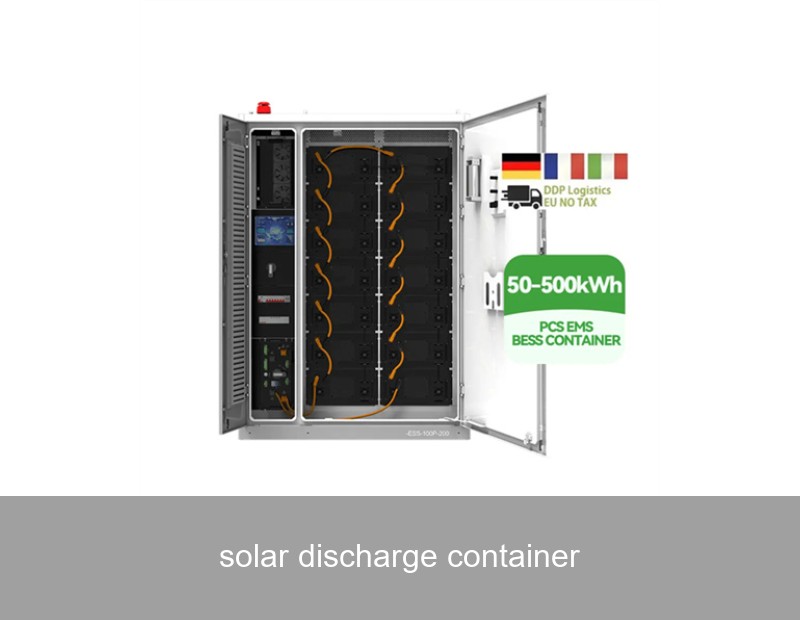
Imagine a robust, self-contained unit that arrives on-site, is quickly connected, and immediately begins delivering clean, reliable power from the sun. This isn't a vision of the future; it's the reality of today's solar discharge container. For businesses, communities, and projects in Europe and the US facing grid instability, high energy costs, or the need for rapid deployment power, these all-in-one systems are revolutionizing energy access. In this article, we'll demystify what a solar discharge container is, explore its transformative potential with real-world data, and show how companies like Highjoule are leading the charge with intelligent, turnkey solutions.
Table of Contents
- What is a Solar Discharge Container?
- The Problem: Intermittency, Cost, and Access
- The Solution: An All-in-One Power Plant
- Case Study: Powering a Remote US Construction Site
- Highjoule's Advanced Containerized Solutions
- Key Benefits and Applications
- The Future of Deployable Solar Power
What Exactly is a Solar Discharge Container?
Let's break it down. A solar discharge container is a fully integrated energy system built inside a standardized shipping container. Think of it as a "power plant in a box." Its core function is to capture solar energy, store it, and discharge it on demand. The key components typically include:
- High-Efficiency Solar Panels: Often mounted on the container's roof or as a deployable array.
- Lithium-Ion Battery Energy Storage System (BESS): The heart of the "discharge" capability, storing excess solar for use at night or during cloudy periods.
- Power Conversion System (PCS): Inverters and converters that manage AC/DC power flow.
- Thermal Management & Safety Systems: Critical climate control and fire suppression for optimal performance and safety.
- Energy Management System (EMS): The brain that intelligently controls charging, discharging, and grid interaction.
This plug-and-play design eliminates complex, multi-vendor construction projects, offering a rapid path to energy independence.
The Problem: Intermittency, Cost, and Grid Gaps
The global push for renewables faces a fundamental challenge: solar power is intermittent. The sun doesn't always shine when you need power most. This creates a mismatch between generation and consumption, leading to curtailment (wasted energy) or reliance on fossil-fuel peaker plants, which are expensive and polluting.
Furthermore, in many regions—from remote industrial sites in the American West to island communities in Europe—grid connection is either non-existent, prohibitively expensive, or unreliable. Diesel generators have been the default, but with volatile fuel prices and carbon emissions under increasing scrutiny, this is no longer a sustainable or cost-effective answer.
Image Source: Unsplash - Solar power potential is vast, but harnessing it reliably requires storage.

The Solution: An All-in-One, Intelligent Power Plant
This is where the modern solar discharge container shines. It directly solves the intermittency problem by pairing generation with storage. During the day, solar panels charge the battery. In the evening, during peak demand, or when the grid fails, the system discharges stored energy seamlessly.
The economic case is compelling. According to the International Renewable Energy Agency (IRENA), the cost of lithium-ion batteries has fallen by over 90% in the last decade. When combined with similarly declining solar PV costs, the Levelized Cost of Electricity (LCOE) for solar-plus-storage is now competitive with, and often beats, traditional generation in many applications. You're not just buying power; you're locking in predictable energy costs for decades.
A Real-World Case Study: Construction Site Electrification, Nevada, USA
Consider a recent project for a large-scale construction site in a remote area of Nevada. The challenge was to power site offices, tool charging stations, and partial overnight security lighting without running miles of expensive temporary grid lines or relying on noisy, fume-producing diesel generators that required daily refueling.
The solution was the deployment of a 40-foot solar discharge container equipped with:
| Component | Specification |
|---|---|
| Solar Capacity | 80 kWp (roof-mounted + ground array) |
| Battery Storage | 240 kWh (Lithium Iron Phosphate) |
| Continuous Power Output | 50 kVA |
| Key Feature | Integrated remote monitoring & control |
- Diesel Displacement: Reduced diesel generator runtime by over 90%, saving approximately 25,000 liters of fuel.
- Cost Savings: Achieved a 40% reduction in energy costs compared to the pure diesel scenario.
- Emissions Avoided: Prevented an estimated 67 tons of CO2 emissions.
- Operational Simplicity: The system required minimal on-site intervention, with performance monitored and optimized remotely.
This case clearly illustrates the tangible operational, financial, and environmental benefits of a containerized approach.
How Highjoule is Pioneering Smarter Containerized Solutions
At Highjoule, with nearly two decades of experience since 2005, we've moved beyond the basic container concept. Our PowerCube ESS and SolarCube Hybrid systems represent the next evolution of the solar discharge container. We understand that reliability is paramount, so we engineer for it from the ground up.
Our systems feature industry-leading Lithium Iron Phosphate (LFP) battery chemistry, renowned for its long cycle life and superior safety profile. More importantly, they are driven by our proprietary Highjoule Energy Operating System (EOS). This intelligent software doesn't just store and release energy; it learns consumption patterns, forecasts weather, and optimizes every kilowatt-hour to maximize self-consumption and ROI. For our commercial and industrial clients, this smart dispatch capability is what transforms a capital expense into a strategic asset.
Image Source: Unsplash - Intelligent control systems are key to maximizing value.

Key Benefits and Diverse Applications
The versatility of the solar discharge container makes it suitable for a wide range of applications across our key markets:
- Microgrids for Remote Communities: Providing primary, clean power for islands or off-grid villages in Europe, reducing dependence on imported fuel.
- Commercial & Industrial Backup Power: Offering critical uptime for data centers, manufacturing plants, and cold storage facilities, often combined with existing solar arrays to create a resilient "behind-the-meter" solution.
- Event & Temporary Power: Delivering silent, emission-free power for festivals, film sets, and disaster relief operations.
- Electric Vehicle (EV) Charging Hubs: Deploying fast-charging infrastructure in grid-constrained areas without costly upstream upgrades, using solar to offset demand charges.
The core benefits consistently include:
- Rapid Deployment: From delivery to operation in weeks, not years.
- Scalability: Units can be combined like building blocks for larger power needs.
- Predictable Costs: Hedge against volatile utility and fuel prices.
- Sustainability: Drastically reduce carbon footprint and noise pollution.
The Future: Smarter, More Integrated Grid Partners
Looking ahead, the role of the solar discharge container will expand. With advancements in software and grid integration standards like those outlined by the National Renewable Energy Laboratory (NREL), these systems will become active participants in grid stability. Imagine fleets of containers providing frequency regulation, virtual power plant (VPP) services, or absorbing excess renewable energy from the main grid to prevent congestion.
The technology is here, it's proven, and it's economically viable. The question is no longer "if" but "how" to integrate this flexible asset into your energy strategy.
Is your organization evaluating how to achieve greater energy resilience, reduce operational costs, and meet sustainability goals? What specific energy challenge could a scalable, turnkey solar discharge container solve for you?
 Inquiry
 Online Chat