


Solar Energy Companies in Tamil Nadu Are Powering a Green Revolution
When you think of global renewable energy leaders, Tamil Nadu might not be the first name that comes to mind for a European or American audience. But it should be. This vibrant Indian state is a silent titan, home to some of the most ambitious and successful solar energy companies in Tamil Nadu. Driven by abundant sunshine, progressive policy, and industrial demand, Tamil Nadu has become a living laboratory for solar integration. Its journey offers crucial insights for any region aiming to transition from fossil fuels. However, as the sun sets each day, a critical question emerges: how do you keep the lights on and the factories running? The answer, increasingly, lies not just in generating solar power, but in storing it intelligently.

Image source: Unsplash (Representative image of solar farms in India)
Beyond the Panel: The Challenge of Intermittency
The phenomenon is clear: solar power is variable. Generation peaks at midday and falls to zero at night. For solar energy companies in Tamil Nadu and their commercial & industrial (C&I) clients, this creates a mismatch. A textile mill in Tiruppur or an automotive plant in Chennai needs reliable, round-the-clock power. Relying solely on the grid, which in many regions still depends on coal, undermines both sustainability goals and operational cost savings.
Let's look at the data. Tamil Nadu has an installed solar capacity of over 5 GW, consistently ranking among India's top states. The state government targets 9 GW by 2023. Yet, a report by the International Energy Agency (IEA) highlights that integrating such high shares of variable renewable energy requires massive investments in grid flexibility and storage. The "duck curve" – the deep dip in net load during sunny days followed by a steep evening ramp-up – is becoming a real grid management challenge. Without solutions, this can lead to curtailment (wasting solar energy) or instability.
The Storage Imperative: Unlocking 24/7 Solar Power
This is where the story evolves from generation to optimization. The most forward-thinking solar energy companies in Tamil Nadu are no longer just panel installers; they are becoming comprehensive energy solution providers. Their value proposition now hinges on delivering firm, dispatchable solar energy. The key technology enabling this? Advanced Battery Energy Storage Systems (BESS).
Think of BESS as a "energy bank" for your solar array. Excess solar power generated during the day is stored instead of being fed back to the grid at low value. Then, during peak evening hours, when grid tariffs are highest, or during a power outage, the stored energy is discharged. This simple shift delivers profound benefits:
- Maximized Self-Consumption: Use more of the solar power you generate, slashing electricity bills.
- Peak Shaving: Avoid expensive demand charges from the grid during peak periods.
- Enhanced Reliability: Provide backup power critical for industrial processes and data centers.
- Grid Support: Help stabilize the local grid, facilitating more renewable integration.
Case Study: A Coimbatore Industrial Success Story
Let's make this tangible. A major pump manufacturing unit in Coimbatore, working with a progressive solar EPC (Engineering, Procurement, and Construction) company, installed a 1.2 MW rooftop solar system. While it reduced daytime grid consumption, the facility still faced high demand charges during evening shifts and was vulnerable to grid fluctuations.
In 2023, they integrated a 500 kWh / 1000 kW containerized battery storage system from Highjoule. The results, monitored over one year, were striking:
| Metric | Before BESS | After BESS Integration |
|---|---|---|
| Solar Self-Consumption Rate | 68% | 94% |
| Peak Demand from Grid | 800 kW | 450 kW |
| Annual Electricity Cost Savings | ₹ 42 Lakh (approx. $50,000) | ₹ 68 Lakh (approx. $82,000) |
| ROI Period for Storage System | N/A | ~4.5 years |
This case, documented in part by the NITI Aayog (India's public policy think tank), exemplifies the multiplier effect of pairing solar with smart storage. The project didn't just save more money; it transformed the facility's energy profile, making it resilient and predictable.
Highjoule's Smart Energy Architecture for Tamil Nadu
As a global leader in advanced储能系统 founded in 2005, Highjoule understands that every region's energy puzzle is unique. For the dynamic market served by solar energy companies in Tamil Nadu, we offer more than just hardware; we provide a smart energy architecture.
Our H-IQ Energy Management System is the brain of the operation. It intelligently decides, in real-time, when to charge the batteries from solar or the grid, when to discharge to power loads, and when to provide grid services. This maximizes financial returns automatically.
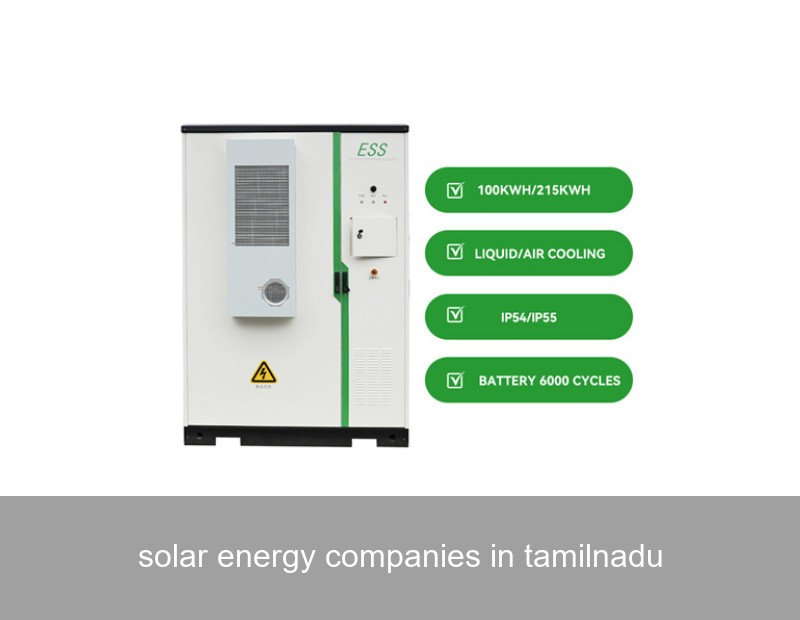
For the demanding C&I and microgrid applications prevalent in Tamil Nadu, our Modular CubeStack BESS is ideal. Its containerized, plug-and-play design allows for seamless scaling. Whether it's a 100 kWh installation for a medium enterprise or a multi-MWh system for a large factory or campus microgrid, the technology is robust, safe, and built for high-cycling applications. Our systems use Lithium Iron Phosphate (LFP) chemistry, known for its long life, thermal stability, and safety—a critical consideration for any installation.

Image source: Unsplash (Representative image of a modern BESS installation)
By partnering with solar energy companies in Tamil Nadu, Highjoule provides the technological backbone that turns a solar project into a 24/7 clean power plant. We handle the complexity of system integration, ensuring our storage solutions work in perfect harmony with existing or new solar PV and the local grid conditions.
The Future of Tamil Nadu's Energy Landscape
The trajectory is set. The state is moving towards an energy ecosystem dominated by renewables. The next phase of growth will be defined by intelligence and flexibility. We will see more hybrid systems (solar + wind + storage), virtual power plants aggregating distributed resources, and energy trading within microgrids.
For international observers in Europe and the US, Tamil Nadu's experience is a compelling preview. It demonstrates that high renewable penetration is achievable, but it must be paired with storage and smart controls. The innovative solar energy companies in Tamil Nadu are at the forefront of this integration, proving that the business case for solar-plus-storage is not just about sustainability—it's a sound financial strategy for energy-intensive industries.
So, as you look at your own energy challenges or opportunities, consider this: Is your organization merely generating green energy, or are you building a resilient, intelligent, and cost-optimal energy system? What would a 95% self-consumption rate for your solar asset do for your bottom line and your sustainability targets?
 Inquiry
 Online Chat