


Navigating the Future: A Guide for Solar Energy Investors and Companies
For forward-thinking solar energy investors and companies, the landscape is brighter than ever, yet more complex. While solar panel adoption soars, a critical question emerges: how do we unlock the full value of every photon when the sun isn't shining? The answer, and the next monumental opportunity, lies not just in generation, but in intelligent storage. This shift is transforming how investors evaluate assets and how companies deliver value, moving beyond simple LCOE calculations to holistic energy resilience and grid service models.
Table of Contents
- The New Reality: Intermittency as the Core Challenge
- Data Drives Investment: The Storage Imperative
- Case Study: From Solar Farm to Grid Partner in Texas
- The Technology Evolution: What Smart Investors Look For
- Highjoule's Role: Powering Intelligent Energy Assets
The New Reality: Intermittency as the Core Challenge
You've seen the headlines: "Solar breaks another generation record." It's true. The U.S. alone is projected to add over 40 GW of new solar capacity in 2024. But as any grid operator will tell you, this success creates its own puzzle. The famous "duck curve" – the deep dip in net load during sunny afternoons followed by a steep evening ramp – is no longer a California curiosity; it's a global phenomenon. This volatility can suppress energy prices at peak solar output and strain grids during the transition to evening demand. For solar energy investors and companies, this translates to revenue uncertainty and capped growth potential. The asset is producing, but is it producing optimal returns?
Data Drives Investment: The Storage Imperative
The market has spoken. Co-locating storage with solar is rapidly shifting from a "nice-to-have" to a financial necessity. According to the Solar Energy Industries Association (SEIA), the U.S. solar and storage market is expected to grow by 19% in 2024, with a significant portion being hybrid projects. Why? The numbers are compelling:
- Revenue Stacking: A standalone solar farm sells energy. A solar-plus-storage asset can sell energy, provide frequency regulation, offer capacity services, and reduce curtailment.
- Enhanced PPA Terms: Off-takers, especially corporations with 24/7 clean energy goals, pay a premium for firm, dispatchable solar power.
- Grid Resilience: Assets that can provide grid support during outages or congestion become critical infrastructure, opening up new revenue streams and community goodwill.
This isn't just about adding a battery; it's about integrating an intelligent energy management system that can decide in milliseconds when to store, when to discharge, and which service to prioritize for maximum financial return.

Credit: Photo by American Public Power Association on Unsplash. Modern solar farms are increasingly integrated with battery storage for optimal grid performance.
Case Study: From Solar Farm to Grid Partner in Texas
Let's ground this in a real-world example. Consider a 150 MW solar farm in the ERCOT (Texas) market, a region known for its competitive grid and extreme weather events. Initially, the farm faced significant price cannibalization during midday peaks and had no role in grid stability.
The Project: In 2023, the owners integrated a 75 MW / 150 MWh DC-coupled battery energy storage system (BESS).
The Strategy: The system was designed not just for energy arbitrage (buy low, sell high) but to participate in ERCOT's ancillary services markets, particularly Frequency Responsive Reserve Service (FRRS).
The Results (First 12 Months):
| Metric | Standalone Solar | Solar + Highjoule BESS | Change |
|---|---|---|---|
| Annual Revenue | $21.5M | $31.2M | +45% |
| Capacity Factor (Effective) | 24% | 89%* | Massive Increase |
| Grid Service Contracts | 0 | 2 | New Revenue Line |
This transformation was enabled by an advanced, DC-coupled storage solution with sophisticated energy management software capable of real-time market bidding. The asset evolved from a passive generator to an active, grid-supportive power plant, fundamentally de-risking the investment for its owners.
The Technology Evolution: What Smart Investors Look For
For solar energy investors and companies conducting due diligence, understanding storage technology nuances is key. The core differentiators are no longer just $/kWh.
- DC vs. AC Coupling: DC-coupled systems, where batteries connect directly to the solar array's DC current, are typically 3-5% more efficient for solar charging, capturing more energy and improving project IRR.
- Battery Chemistry: While lithium-ion phosphate (LFP) is the dominant, safe standard for stationary storage, look for providers with robust supply chains and cell-level quality control to ensure 20+ year lifespan.
- The "Brain": The software and controls are the true value drivers. Can the system perform multiple applications simultaneously? Does it have proven grid-interconnection experience? Is its forecasting and bidding algorithm AI-driven and market-aware?

Credit: Photo by Science in HD on Unsplash. Advanced control systems are the 'brain' that maximizes the financial return of solar-storage assets.
Highjoule's Role: Powering Intelligent Energy Assets
This is where Highjoule, as a global leader in advanced energy storage since 2005, directly empowers solar energy investors and companies. We don't just supply hardware; we deliver a fully integrated, performance-guaranteed asset.
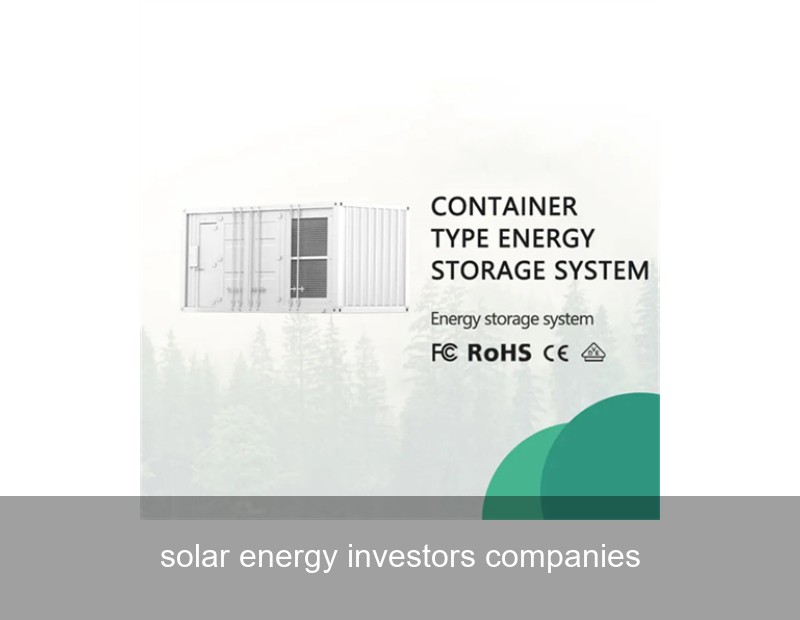
For our utility and large-scale commercial clients, our HPS Series containerized BESS is the cornerstone. Its DC-coupled architecture, using market-leading LFP cells, is engineered from the ground up for solar optimization. Paired with our Helios Energy Management Platform, the system becomes a autonomous revenue-generator. Helios uses machine learning to forecast solar output and market prices, executing the optimal stack of revenue-generating services every single day.
For developers and EPCs, this translates to reduced interconnection studies, faster commissioning, and a clear, bankable performance model to present to financiers. For asset owners, it means a predictable, enhanced cash flow from day one. We bridge the gap between the physical asset and the complex energy market, turning a capital expenditure into a sophisticated financial instrument.
Beyond Large-Scale: The Distributed Energy Revolution
The opportunity isn't limited to vast solar farms. Commercial & Industrial (C&I) sites with rooftop solar are prime candidates. Highjoule's HCS Series modular storage solutions allow factories, data centers, and retail chains to maximize self-consumption of their solar power, demand charge reduction, and participate in demand response programs—creating a compelling ROI often under 5 years while ensuring operational continuity.
The Future Horizon: Questions Every Solar Investor Should Ask
The integration of intelligent storage is defining the next era of solar investment. As you evaluate opportunities or plan your next project, the conversation must evolve.
- Is this project's financial model based on merchant exposure to volatile market prices, and how could storage hedge that risk?
- Does the storage technology partner have a proven track record in the target market's specific grid ecosystem (e.g., ERCOT, CAISO, National Grid)?
- How does the proposed system's software ensure it remains adaptable to new market rules and revenue streams over its 20-year life?
The most successful solar energy investors and companies will be those who see electrons not just as a commodity, but as a flexible tool for building a more resilient and profitable energy future. Is your portfolio ready to adapt, and what's the first step you'll take to integrate intelligence into your energy assets?
 Inquiry
 Online Chat