


Navigating the Shifting Landscape of Solar Energy Prices in South Africa
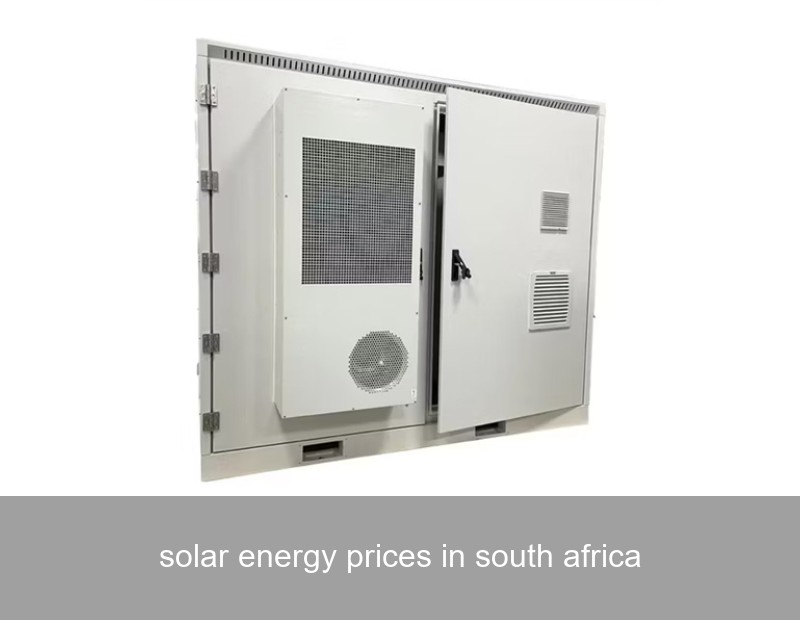
If you're following the energy sector in South Africa, you've likely heard a compelling story: the dramatic fall and recent fluctuations in solar energy prices. For businesses, industries, and homeowners burdened by an unreliable grid and escalating electricity costs, this presents both a massive opportunity and a complex puzzle. Understanding the forces behind solar pricing isn't just about cost per watt; it's about unlocking energy independence and long-term financial resilience. As a global leader in advanced energy storage, Highjoule has been partnering with clients worldwide since 2005 to navigate these very transitions, turning volatile energy prices into predictable, clean power.
Table of Contents
- The Great Price Plunge: A Global Trend Hits Home
- South Africa's Unique Market: More Than Just Module Costs
- The Storage Imperative: Why Solar Alone Isn't the Full Answer
- Case Study: A Johannesburg Manufacturing Plant's Journey to Stability
- The Future Outlook: Smart Systems Over Simple Panels
- What's Your Energy Resilience Plan?
The Great Price Plunge: A Global Trend Hits Home
Globally, the cost of solar photovoltaic (PV) modules has plummeted by over 80% in the last decade, according to data from the International Renewable Energy Agency (IRENA). This trend, driven by manufacturing scale, technological improvements, and supply chain optimization, has fundamentally changed the economics of solar power. In South Africa, this global phenomenon translated into increasingly accessible rooftop solar and commercial-scale PV installations. For a time, the primary narrative was straightforward: solar was getting cheaper, fast.
However, if you've sought a quote for a solar system recently, you may have noticed a nuanced shift. While the long-term trend remains favorable, short-term factors like global supply chain constraints, raw material costs for polysilicon, and currency exchange rates have introduced volatility. The Rand's fluctuation against major currencies can significantly impact the landed cost of imported solar equipment. So, while the "sunshine" is free, the hardware to capture it has a price tag that isn't entirely immune to global economic winds.

Solar farm scaling reduces costs. Credit: Unsplash
South Africa's Unique Market: More Than Just Module Costs
When analyzing solar energy prices in South Africa, one must look beyond the module price sheet. The total cost of a functional, reliable solar power system—and its true value—is determined by several local factors:
- Balance of System (BOS) Costs: This includes inverters, mounting structures, cabling, and crucially, energy storage systems. These components often represent a larger portion of the total system cost than the panels themselves.
- Installation & "Soft" Costs: Skilled labor, permitting, and grid connection fees can vary widely.
- The Load-Shedding Premium: High demand and urgency due to Eskom's unreliability can strain supply and installation capacity, potentially affecting prices. The value proposition, however, shifts from mere savings to business continuity.
- Policy & Incentives: The lack of a robust national net-metering policy (compared to some European or U.S. states) changes the financial calculus, making self-consumption and storage even more critical.
This is where the conversation evolves from buying solar panels to investing in an intelligent energy ecosystem. The goal is no longer just to generate cheap kilowatt-hours at noon, but to have dependable, high-quality power 24/7.
The Core Components of a Modern Solar Investment
| Component | Cost Driver | Impact on System Value |
|---|---|---|
| PV Modules | Global commodity prices, import tariffs, exchange rates | Determines base energy generation potential. |
| Inverter & Power Electronics | Technology tier (basic vs. smart hybrid), brand, scalability | Dictates efficiency, grid management capability, and system intelligence. |
| Battery Energy Storage System (BESS) | Battery chemistry (Li-ion, LFP), capacity, cycle life, software | Enables time-shifting of solar energy, provides backup power, and maximizes self-consumption. This is the key to unlocking full value. |
| Integration & Software | System design complexity, energy management platform | Turns hardware into a responsive, optimizing asset that reduces demand charges and predicts usage. |
The Storage Imperative: Why Solar Alone Isn't the Full Answer
Imagine producing abundant solar energy during the day, only to buy expensive power from the grid at night or during a stage 4 load-shedding slot. Without storage, a significant portion of your solar investment's potential goes unrealized. This is the critical piece that stabilizes your energy costs against both grid tariff hikes and solar price variability.
At Highjoule, we've specialized in this very challenge for nearly two decades. Our intelligent battery storage solutions, like the Highjoule H-Series Commercial BESS, are engineered to seamlessly integrate with solar PV. They use stable, long-life Lithium Iron Phosphate (LFP) chemistry and are governed by our proprietary energy management system (EMS). This software doesn't just store and release energy; it learns your load patterns, prioritizes critical operations, and can be configured to participate in future energy trading schemes. By pairing solar with smart storage, you effectively lock in your personal energy price for 15-20 years, insulating your operations from external volatility.
Case Study: A Johannesburg Manufacturing Plant's Journey to Stability
Let's ground this in a real example. A medium-sized automotive parts manufacturer in Johannesburg faced annual electricity cost increases of 12-15% and crippling production stoppages due to load-shedding. In 2022, they moved beyond just comparing solar energy prices in South Africa and opted for an integrated Highjoule solution.
- System: 850 kWp rooftop solar PV + 1.2 MWh Highjoule H-Series BESS.
- Challenge: Maintain continuous 18-hour production cycles and reduce reliance on costly, polluting diesel generators.
- Result: The system now provides over 65% of the plant's annual electricity needs. During grid outages, the BESS seamlessly takes over critical loads, eliminating downtime. The solar energy stored in the afternoon powers the early evening shift. Their diesel consumption has dropped by 90%, and they have a predictable, flat energy cost structure for the life of the system. The payback period, factoring in lost production savings, was under 5 years.

Industrial battery storage system control. Credit: Unsplash
The Future Outlook: Smart Systems Over Simple Panels
The future of energy in South Africa lies in intelligent, decentralized systems. While module prices will continue to see cyclical movements, the real innovation—and value—is accruing at the system integration level. Microgrids that can island from the grid, AI-driven energy forecasting, and virtual power plants are becoming realities.
Highjoule's approach for commercial, industrial, and residential clients is built on this principle. We don't just supply components; we provide a complete, intelligent power solution. Our services encompass initial energy auditing, custom system design, financing guidance, professional installation, and remote monitoring via our Highjoule Pulse platform. This ensures that regardless of where solar energy prices in South Africa go next, your system is optimized to deliver the highest possible return on investment and operational resilience.
Key Questions to Ask Beyond the Price per Watt
- How does this system perform during a grid outage?
- What is the expected degradation rate of the batteries, and what is the warranty?
- Can the energy management software adapt to changing tariff structures or my future energy needs?
- Does the provider offer long-term performance monitoring and support?
What's Your Energy Resilience Plan?
The conversation about solar power has matured. It's no longer a simple question of "how cheap are the panels?" but "how do I build a resilient, cost-effective, and sustainable energy foundation for my home or business?" With the right technology partner, the volatility of grid power and energy prices can be transformed into a predictable, clean energy future.
Is your organization simply watching the solar energy prices in South Africa, or are you ready to design a system that defines your own energy costs for the next two decades? We invite you to share your biggest energy challenge in the comments below, or contact Highjoule's team for a personalized assessment of your energy landscape.
 Inquiry
 Online Chat