


Unlocking Maximum Efficiency: Why the Solar Monocrystalline Panel Dominates Modern Installations
If you're researching solar energy, you've undoubtedly encountered the term "solar monocrystalline panel." It's often touted as the premium, high-efficiency choice. But what exactly sets it apart in a market filled with options? More importantly, how does this technology translate into real-world savings and reliability for your home or business? This article dives deep into the crystalline heart of solar technology, explaining why monocrystalline silicon has become the benchmark for performance and how pairing it with the right storage system unlocks the full potential of your renewable energy investment.
Table of Contents
- What is a Solar Monocrystalline Panel?
- The Science Behind the Shine
- Monocrystalline vs. Polycrystalline & Thin-Film
- Real-World Impact: A Case Study from California
- Beyond the Panel: The Critical Role of Energy Storage
- The Highjoule Solution: Intelligent Storage for Premium Solar
- Future Trends and Your Next Step
What is a Solar Monocrystalline Panel?
Let's start with the basics. A solar monocrystalline panel is constructed from cells made of single-crystal silicon. Imagine a single, pure silicon crystal carefully grown into a cylindrical ingot, which is then sliced into thin wafers. This uniform crystal structure is the key to its high performance. The cells are recognizable by their dark black color and rounded edges (a result of the cylindrical wafering process). This purity allows electrons, the particles that generate electricity when hit by sunlight, to move with less resistance. The result? More sunlight is converted into usable electricity from the same surface area compared to other common types.

Image Source: Unsplash - A rooftop installation featuring high-efficiency monocrystalline panels.
The Science Behind the Shine: Efficiency and Longevity
The phenomenon we see on rooftops is driven by solid-state physics. Monocrystalline silicon's uniform atomic lattice creates an optimal path for electron flow. Industry and laboratory data consistently show monocrystalline panels leading the pack with commercial efficiency ratings typically between 20-23%, with premium models pushing even higher. For you, the system owner, this means needing fewer panels to generate the same amount of power, a crucial advantage when roof space is limited.
Furthermore, this robust crystal structure contributes to exceptional longevity and performance retention. Most reputable manufacturers offer 25 to 30-year performance warranties, guaranteeing that after 25 years, your monocrystalline panels will still produce at least 80-87% of their original output. This degradation rate of about 0.3-0.5% per year is typically lower than that of polycrystalline alternatives, making it a sound long-term investment.
Monocrystalline vs. Polycrystalline & Thin-Film: A Clear Comparison
How does the "mono" king stack up against the competition? Here’s a quick breakdown:
| Feature | Monocrystalline | Polycrystalline | Thin-Film |
|---|---|---|---|
| Efficiency | High (20-23%) | Medium (15-18%) | Lower (10-13%) |
| Space Efficiency | Best | Good | Poor |
| Cost (Historically) | Higher | Lower | Varies |
| Heat Tolerance | Better | Good | Varies |
| Lifespan & Warranty | Longest (25+ yrs) | Long (25+ yrs) | Shorter |
While the initial price per panel for monocrystalline has been higher, the gap has narrowed significantly. When you factor in the higher energy yield per square meter over 25+ years, the levelized cost of energy (LCOE) often makes monocrystalline the most cost-effective choice over the system's lifetime.
Real-World Impact: A Case Study from California
Let's move from theory to practice. Consider a real-world example: a medium-sized commercial warehouse in Fresno, California, with a 100 kW DC roof space constraint. The facility's goal was to maximize self-consumption and reduce demand charges from the grid.
- Choice A (Polycrystalline): A 100 kW system using lower-efficiency panels would have utilized 100% of the available roof.
- Choice B (Monocrystalline): A 100 kW system using high-efficiency monocrystalline panels used only 85% of the roof area.
The result? The monocrystalline installation not only met the power goal but left valuable roof space for future expansion. More critically, due to its superior temperature coefficient and low-light performance, the annual energy production was 8-10% higher than the estimated output of a polycrystalline system of the same nominal power. This translated to an additional $1,200-$1,500 in annual energy savings at local rates, accelerating the payback period. Data from the National Renewable Energy Laboratory (NREL) confirms the continuous efficiency gains in monocrystalline technology that make such outcomes possible.
Beyond the Panel: The Critical Role of Energy Storage
Here's a pivotal insight: the value of a high-efficiency solar monocrystalline panel is magnified when paired with intelligent energy storage. Your premium panels produce the most power during peak sunlight hours, which often doesn't align with peak energy consumption in the evening. Without storage, excess energy is fed back to the grid, often at a lower rate than the cost to buy it back later.
This is where the modern energy ecosystem evolves. An advanced battery energy storage system (BESS) acts as your personal energy reservoir, capturing the surplus daytime generation for use when you need it most. This maximizes self-consumption, provides backup power during outages, and in many markets, allows for participation in grid services. The synergy is clear: top-tier generation deserves top-tier storage.
The Highjoule Solution: Intelligent Storage for Premium Solar
This is precisely where Highjoule's expertise becomes essential. Since 2005, we have specialized in designing storage systems that complement and enhance high-performance solar arrays. Our philosophy is that generation and storage should be a seamlessly integrated, intelligent system.
For residential clients with premium monocrystalline installations, our HomePower Stack series offers scalable lithium-ion solutions with integrated energy management. Our software learns your consumption patterns, automatically optimizing when to store solar energy and when to draw from the battery to maximize savings and comfort.
For commercial and industrial (C&I) applications, the stakes are higher. Demand charges and time-of-use rates can make up a significant portion of the electricity bill. Highjoule's GridMax Commercial BESS is engineered for this challenge. It doesn't just store energy; it provides sophisticated peak shaving, allowing a business to draw from the battery during periods of highest grid demand, dramatically reducing costs. Furthermore, its grid-forming capabilities can support microgrid applications, ensuring operational continuity. Paired with a field of high-output solar monocrystalline panel arrays, this system transforms a business from a passive energy consumer into an active, resilient energy hub.

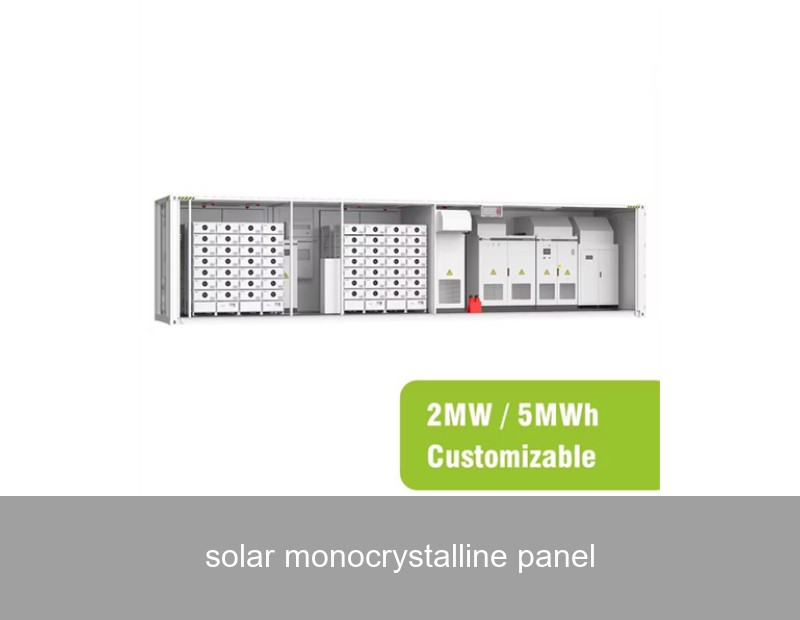
Image Source: Unsplash - A containerized BESS unit, similar to commercial-scale solutions, operating alongside a solar farm.
Key Features of a Highjoule System for Solar Integration:
- Advanced Lithium-Ion Chemistry: For high cycle life, safety, and depth of discharge, ensuring you get the most from your stored solar energy.
- AI-Powered Energy Management System (EMS): The brain of the operation, making real-time decisions to optimize economic and operational goals.
- Scalable & Modular Design: Start with what you need and expand as your energy requirements grow, protecting your initial investment.
- Global Standards & Compliance: All our systems are designed and tested to meet rigorous international safety and grid codes, a critical factor for installations in Europe and North America.
Future Trends and Your Next Step
The trajectory for solar technology points toward even higher efficiencies, with innovations like PERC (Passivated Emitter and Rear Cell), TOPCon, and heterojunction (HJT) technologies pushing monocrystalline performance boundaries further. According to the International Energy Agency (IEA), solar PV is set to become the largest source of global electricity capacity by 2027. This growth will be inextricably linked with storage adoption.
Choosing a solar monocrystalline panel system is a forward-thinking decision for maximum energy harvest. But to truly build a modern, resilient, and cost-effective energy asset, the conversation must include intelligent storage from the outset. How will you design your system not just for today's sunlight, but for tonight's needs and tomorrow's energy landscape?
What specific energy challenge—whether it's reducing a stubborn demand charge, achieving energy independence, or future-proofing your property—could a synergistic combination of high-efficiency solar and smart storage solve for you?
 Inquiry
 Online Chat