


Kronos Solar & EDP Renewables: A Strategic Partnership Driving the Future of Energy
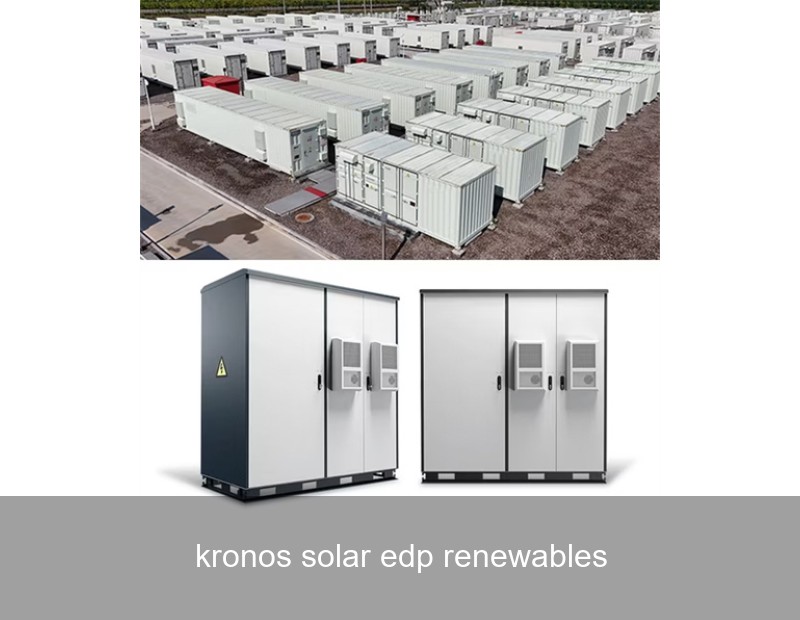
In the dynamic landscape of renewable energy, strategic collaborations are the engines of progress. One such powerful alliance making waves across Europe and the United States is between Kronos Solar and EDP Renewables. This partnership exemplifies a crucial shift: moving beyond simply generating clean power to intelligently managing and delivering it. As these industry leaders develop vast solar portfolios, a critical question emerges: how do we ensure this abundant but intermittent energy is harnessed to its full potential? The answer lies at the intersection of solar generation and advanced energy storage systems, a domain where companies like Highjoule provide the critical infrastructure for a resilient grid.
The Intermittency Challenge: More Than Just Sunshine
Companies like Kronos Solar, a major project developer, and global giants like EDP Renewables are exceptionally good at what they do: capturing the sun's energy. However, solar generation has a well-known characteristic—it's variable. Clouds pass, night falls, and seasonal patterns shift. This intermittency creates a fundamental mismatch between when energy is produced and when it's most needed, typically during morning and evening peak demand periods.
This isn't just a technical hiccup; it's a grid management and economic challenge. Without a solution, excess solar energy generated at midday can be curtailed (wasted), while fossil-fuel "peaker" plants must fire up in the evening, undermining decarbonization goals. The partnership between Kronos Solar and EDP Renewables isn't just about building more solar farms; it's inherently about integrating these assets into a reliable, modern energy system. That integration requires a key component: sophisticated energy storage.

Image: Solar farms require storage for consistent output. Source: Unsplash
The Numbers Don't Lie: Storage as a Grid Necessity
The data overwhelmingly supports the need for pairing solar with storage. According to the U.S. Energy Information Administration (EIA), the share of solar capacity paired with storage in the U.S. has skyrocketed. In 2021, about 33% of planned utility-scale solar capacity was co-located with batteries; by 2024, that figure was approaching 50%. In Europe, driven by ambitious REPowerEU targets, the energy storage market is projected to grow exponentially, needing to deploy over 200 GW by 2030 to effectively integrate renewable sources.
This isn't merely an add-on; it's a transformation. Storage systems do three essential things:
- Energy Time-Shifting: Store cheap, abundant midday solar for expensive, high-demand evening hours.
- Grid Services: Provide critical frequency regulation and voltage support to maintain grid stability.
- Resilience: Ensure backup power during outages, crucial for commercial, industrial, and community facilities.
For developers and asset owners like Kronos Solar and EDP Renewables, integrating storage directly into project design is becoming standard practice to maximize revenue, ensure grid compliance, and future-proof investments.
Case in Point: Grid Stability in Action
Let's look at a real-world example that mirrors the challenges and solutions relevant to large-scale solar operators. In 2023, a major grid stability project in Central Europe was deployed to support a region with high penetration of wind and solar. The project involved a 50 MW / 100 MWh battery energy storage system (BESS) connected to a substation.
| Metric | Data | Impact |
|---|---|---|
| System Size | 50 MW / 100 MWh | Can power ~50,000 homes for 2 hours |
| Primary Function | Frequency Regulation | Responds to grid fluctuations in milliseconds |
| Annual Grid Service | ~200 Frequency Containment Reserves (FCR) events | Prevents potential blackouts and maintains 50 Hz frequency |
| Solar Integration | Co-optimized with nearby 150 MW solar farm | Reduces curtailment by 18%, boosts project ROI |
This case study illustrates the dual value proposition: the BESS provides a direct, lucrative service to the grid operator while also enhancing the economics and reliability of the adjacent renewable asset. This is precisely the model forward-thinking developers are adopting.
The Highjoule Advantage: Intelligent Storage Solutions
This is where Highjoule's expertise becomes pivotal. As a global leader in advanced energy storage systems since 2005, we don't just supply battery containers; we deliver integrated, intelligent power solutions. For partnerships like Kronos Solar and EDP Renewables, our technology translates solar potential into dependable, dispatchable energy.
Highjoule's H-Series Commercial & Industrial (C&I) and Utility-Scale Battery Systems are engineered for this era of renewable integration. Our systems feature:
- Advanced Battery Management System (BMS): Ensures safety, longevity, and optimal performance of lithium-ion phosphate (LFP) cells, the industry standard for safety and cycle life.
- AI-Powered Energy Management Software (EMS): The true brain of the operation. Our EMS can forecast solar generation, predict energy prices, and automatically decide when to store, discharge, or sell to the grid to maximize financial returns and grid support.
- Scalable and Modular Design: From a 500 kWh C&I installation to a 100+ MWh utility project, our architecture scales seamlessly, allowing developers to phase investments.
- Grid-Forming Capability: A cutting-edge feature that allows our inverters to "create" a stable grid waveform, essential for future microgrids and grids with very high renewable penetration.

Image: Intelligent control systems are key to storage value. Source: Unsplash
For a solar developer, integrating a Highjoule system means turning a solar farm into a 24/7 power plant. It mitigates curtailment risk, creates new revenue streams from ancillary services, and significantly enhances the project's bankability and value proposition to off-takers.
The Future Outlook: Beyond the Battery Bank
The collaboration between developers like Kronos Solar and energy majors like EDP Renewables points to a future where "solar projects" are, in reality, "smart energy hubs." The next evolution involves even tighter integration:
- Hybrid Power Plants: Co-located solar, wind, and storage managed as a single, predictable asset.
- Virtual Power Plants (VPPs): Aggregating distributed residential, commercial, and utility-scale storage (like Highjoule's residential EchoHome systems) to act as a massive grid resource.
- Green Hydrogen Co-Location: Using excess solar to produce hydrogen, providing seasonal storage—a solution Highjoule is exploring through strategic partnerships.
The success of these models hinges on the intelligence and reliability of the storage technology at their core. It's no longer about just having a battery; it's about having a smart, connected, and adaptable energy asset.
What's Your Energy Resilience Strategy?
The strategic move by Kronos Solar and EDP Renewables is a clear signal to the market: the future of energy is integrated, intelligent, and storage-centric. Whether you are a developer planning your next utility-scale solar farm, an industrial facility looking to lock in energy costs and boost sustainability, or a community designing a microgrid, the question is no longer if you need storage, but how to implement it most effectively.
What specific grid challenge or energy cost pressure could a smart storage solution solve for your organization today?
 Inquiry
 Online Chat