


Demystifying the Solar Panel 50000 Watt Price: Your Guide to Commercial & Industrial Solar
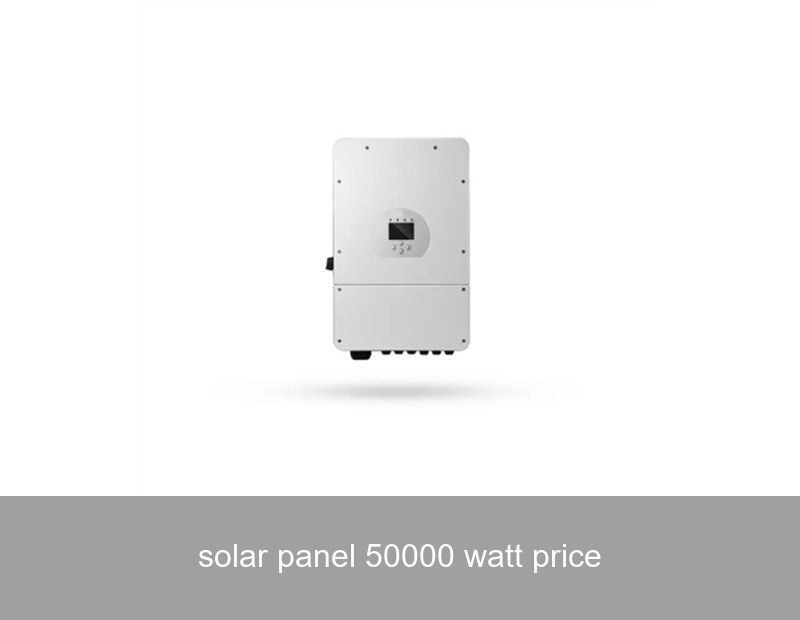
So, you're exploring a 50-kilowatt (kW) solar installation. That's a significant and savvy move, typically targeting the energy needs of medium-sized businesses, agricultural operations, or large residential estates. A common starting point is the search for the "solar panel 50000 watt price." But here's the professional insight: focusing solely on the panel cost is like buying a car based only on the tire price. The true value—and the final invoice—encompasses a complete, intelligent power system designed for reliability and return on investment. Let's unpack what goes into that figure and how to ensure your system delivers for decades.
Solar Panel 50000 Watt Price: A Detailed System Breakdown
The quoted price for a 50kW system is a composite of hardware, "soft costs," and long-term performance engineering. For commercial and industrial applications in Europe and the US, a turnkey installation typically ranges between $75,000 and $150,000+ before incentives. This variance isn't arbitrary; it's dictated by the quality and integration of components.

Image: A commercial rooftop solar installation. Source: Unsplash
Here’s a simplified breakdown of where your investment goes:
| System Component | Approx. % of Total Cost | What It Encompasses |
|---|---|---|
| Solar Panels & Mounting | 25-30% | High-efficiency monocrystalline panels (125-150+ units), racking, and hardware for secure installation. |
| Inverter System | 15-20% | Central or string inverters that convert DC to usable AC power. For reliability, many opt for module-level power electronics (MLPE). |
| Balance of System (BOS) | 20-25% | Wiring, conduits, disconnect switches, combiner boxes, and the critical energy storage system if included. |
| Installation & Labor | 15-20% | Professional system design, engineering, permitting, and skilled installation labor. |
| Sales & Overhead | 10-15% | Project management, customer acquisition, and warranty services. |
As you can see, the panels themselves are just one piece. The inverter technology and, increasingly, the battery energy storage system (BESS) are where modern systems gain their intelligence and resilience. This is where partnering with an experienced provider like Highjoule makes a profound difference. We don't just sell components; we engineer integrated solutions where our high-efficiency panels, advanced hybrid inverters, and flagship H-Joule Cube battery storage work in concert. This seamless integration avoids costly compatibility issues and ensures every kilowatt-hour you generate is managed optimally.
The Storage Imperative: Why a Battery Isn't an "Extra" Anymore
For a business, a 50kW system without storage is often an underutilized asset. It produces power when the sun shines, but what about during peak evening demand or a grid outage? Without storage, you're still subject to high time-of-use rates and operational vulnerability. Integrating storage from the outset flattens your energy cost curve and provides backup power. Highjoule's H-Joule Cube systems, scalable from 10 kWh to multi-megawatt-hour configurations, are designed specifically for this commercial duty cycle, with advanced lithium iron phosphate (LFP) chemistry for safety and longevity.
From Quote to Kilowatt: A Real-World Case Study
Let's move from theory to practice. Consider a mid-sized dairy farm in Bavaria, Germany. Their challenge: high and volatile energy costs for cooling and milking operations, with a peak demand of around 45kW.
- System Installed: A 52kWp rooftop solar array coupled with a 60kWh Highjoule H-Joule Cube battery storage system.
- Financials: Total project cost was €128,000. After leveraging the German Federal Office for Economic Affairs and Export Control (BAFA) funding for storage, the net investment was reduced to approximately €95,000.
- Results: The system now meets 78% of the farm's annual electricity consumption. More critically, the battery allows them to avoid drawing power during high-price periods (4 PM - 9 PM), reducing their grid consumption by over 90% during those hours. Projected payback period: 6.8 years. Furthermore, the system provides uninterrupted power for critical refrigeration, a value beyond pure euros.
This case illustrates how the "solar panel 50000 watt price" transforms into a strategic capital expenditure with a clear ROI when paired with intelligent storage and local incentives. You can explore more about commercial storage incentives in the US via the U.S. Department of Energy.
Maximizing Your Solar Investment: Key Considerations
To ensure your 50kW project is a success, look beyond the per-watt sticker price.
1. Prioritize System Design & Lifetime Value
A cheap system with poor design will underperform for 25+ years. Ask your provider about:
- Production Guarantees: More important than panel warranty. Will they guarantee annual kWh output?
- Degradation Rates: High-quality panels degrade slower (e.g., 0.3% per year vs. 0.7%).
- Monitoring & O&M: Does the price include professional monitoring software and a service plan?

Image: Advanced monitoring is key for commercial system performance. Source: Unsplash
2. Understand Your Local Incentive Landscape
In the US, the Investment Tax Credit (ITC) currently covers 30% of the total installed cost, including storage! In Europe, programs vary by country but can be substantial. For accurate, up-to-date information on EU policies, the European Commission's PVGIS tool is an authoritative resource for solar potential and policy contexts.
3. Choose a Partner, Not Just an Installer
For a system of this scale, your provider should act as a long-term energy partner. Highjoule, for instance, supports clients from initial feasibility study and financial modeling through to installation, grid interconnection, and ongoing performance optimization via our proprietary energy management platform. This holistic approach ensures your system adapts to changing energy tariffs and your business needs.
Is a 50kW System Right for Your Energy Future?
The journey to energy independence starts with the right questions. Rather than just "What's the solar panel 50000 watt price?", consider: What is my facility's specific load profile day and night? How critical is operational continuity during a grid outage? What are my local utility's net metering or time-of-use rate structures? Answering these questions will reveal whether a standalone solar array or an integrated solar-plus-storage solution is the optimal path.
We invite you to share your biggest hurdle when evaluating a commercial-scale solar investment. Is it navigating the complexity of incentives, qualifying the long-term reliability of storage, or accurately projecting your site's financial returns?
 Inquiry
 Online Chat