


Navigating the Solis 40kW Inverter Price in Sweden for a Smarter Solar Investment
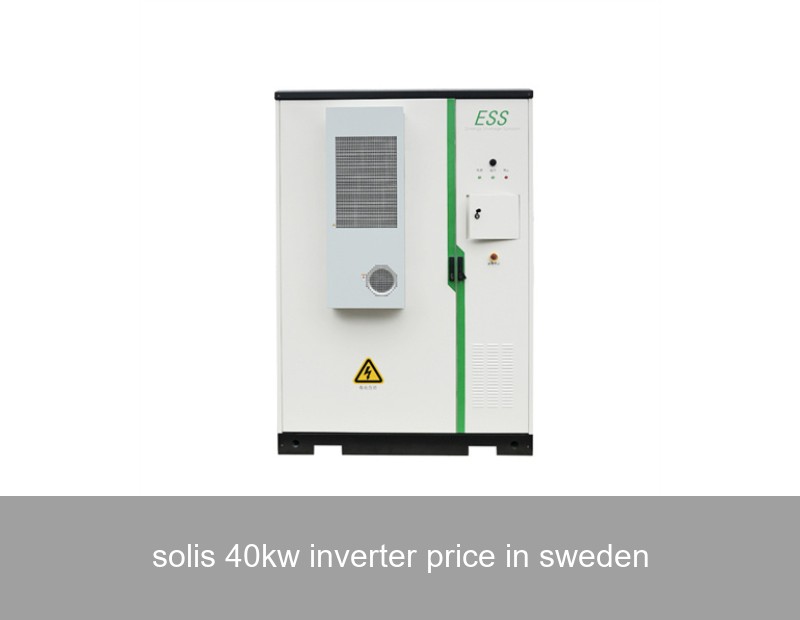
If you're planning a commercial or large-scale residential solar installation in Sweden, you've likely encountered the Solis 40kW inverter as a robust contender. A quick search for "Solis 40kW inverter price in Sweden" reveals a range of figures, often between 25,000 to 40,000 SEK. But here's the crucial insight seasoned installers know: focusing solely on the inverter's price tag is like buying a car based only on the cost of the engine. The true value—and the ultimate return on your investment—lies in the complete energy storage system it powers and the intelligence that manages it.

Image Source: Unsplash - Representative image of a commercial solar installation.
Understanding Inverter Pricing: More Than Just a Sticker Price
The quoted price for a Solis 40kW inverter in Sweden is influenced by several key factors. Firstly, it's a powerful three-phase inverter perfectly suited for businesses, agricultural operations, or larger multi-family homes. Its price reflects its capacity to efficiently convert a significant amount of solar DC power into usable AC power for your property. However, market dynamics play a role. Supply chain logistics, currency exchange rates, and the specific distributor's markup (including VAT, which is 25% in Sweden) all cause fluctuations. Furthermore, the model variant matters—does it include advanced grid-support functions or specific communication protocols needed for Swedish grid codes?
The Solis 40kW Inverter in the Swedish Context
Sweden's energy landscape presents unique opportunities and challenges. With long summer days offering superb solar production and darker winters demanding efficient energy use, your system design is critical. The Solis 40kW inverter is a reliable workhorse known for its durability and efficiency, often exceeding 98%. But in a market increasingly focused on self-consumption and energy independence, an inverter alone is not enough. The real question becomes: how do you store excess summer energy for winter use, or manage consumption against time-of-use tariffs?
This is where the conversation shifts from a component price to a system solution. An inverter is just one part of the puzzle. To truly capitalize on Sweden's solar potential and navigate its electricity market, you need a seamlessly integrated system comprising solar panels, the inverter, a battery energy storage system (BESS), and most importantly, an intelligent energy management system.
Breaking Down the Cost: A Closer Look
| Cost Component | Approximate Range (SEK) | Notes & Considerations |
|---|---|---|
| Solis 40kW Inverter Unit | 25,000 - 40,000 | Base price varies by distributor, features, and warranty terms. |
| Professional Installation & Grid Connection | 15,000 - 30,000 | Crucial for safety, warranty, and compliance with Swedish regulations. |
| Complementary Battery Storage (e.g., 20-30kWh) | 80,000 - 150,000+ | This is where long-term value is created, enabling true energy autonomy. |
| System Monitoring & Smart Energy Manager | 5,000 - 15,000 | The "brain" that optimizes consumption, storage, and grid interaction. |
| Total System Value (Approx.) | 125,000 - 235,000+ | This holistic view determines your payback period and ROI. |
A Real-World Case Study: Västerås Industrial Facility
Let's move from theory to practice. A medium-sized manufacturing plant in Västerås faced rising energy costs and wanted to lock in long-term price stability while boosting its sustainability profile. Their initial search also started with inverter prices. However, after a comprehensive analysis with a system integrator, they installed a 45kWp solar array coupled with a Solis 40kW inverter and a Highjoule H-Stack 30 modular battery system (30kWh capacity).
The key was integrating this hardware with Highjoule's Energy Intelligence Platform (EIP). The platform doesn't just monitor; it actively decides when to store solar energy, when to use it directly, and even when to sell small amounts back to the grid during peak price hours. In the first year, the system achieved a 78% self-consumption rate—far above the typical 30-40% for solar-only systems. This reduced their grid electricity purchases by an estimated 65%, leading to a calculated payback period of under 8 years, considering current energy price trends. The inverter was a vital component, but the intelligent storage and management provided by Highjoule's solution unlocked the full financial return.
Image Source: Unsplash - Representative image of a battery energy storage system in an industrial setting.
The Highjoule Solution: Beyond the Inverter
At Highjoule, with nearly two decades of experience as a global advanced energy storage provider, we view the inverter as a critical but single component in a symphony of energy flow. Our approach for the Swedish and broader European market is to deliver tailored, intelligent systems.
For a project considering a Solis 40kW inverter, we would likely propose our Highjoule H-Stack Commercial Series batteries. These modular, lithium iron phosphate (LFP) based systems are known for safety, longevity (over 6000 cycles), and excellent performance in a range of temperatures. They pair seamlessly with leading inverters, including Solis models, through standardized protocols.
Our true differentiator is software. The Highjoule EIP acts as the central nervous system, employing AI-driven forecasts (using weather and consumption data) to optimize every kilowatt-hour. It can be configured for various goals: maximize self-consumption, participate in demand response programs (increasingly relevant in Sweden), or ensure backup power for critical loads. We provide a complete, warranty-backed solution—from design and compliant installation to ongoing monitoring and support—ensuring your investment in a Solis inverter and solar panels delivers its maximum potential for years to come.
Why System Integration Matters Most
- Safety & Warranty: Mismatched components can void warranties and create safety risks. Highjoule systems are pre-engineered and tested for compatibility.
- Performance Optimization: An integrated system ensures the inverter, battery, and software communicate perfectly, maximizing efficiency and battery life.
- Future-Proofing: Modular systems like ours allow for easy capacity expansion as your energy needs grow.
- Single Point of Responsibility: With Highjoule, you have one expert partner for the entire system, simplifying service and support.
Making the Right Investment for Your Swedish Project
So, while the "Solis 40kW inverter price in Sweden" is a valid starting point, the most empowering question you can ask is: "What is the optimal system to achieve my energy independence and financial goals?" The market is evolving from simple solar PV to integrated solar-plus-storage solutions. According to a report by the International Energy Agency (IEA), the global capacity of battery storage is set to multiply exponentially, driven by the need for flexibility and reliability in renewable energy systems.
When evaluating proposals, look beyond the line item for the inverter. Scrutinize the total system design, the battery technology's specs and warranty, and the capabilities of the energy management software. How will it handle Sweden's seasonal variations? Can it adapt to changing electricity prices? A robust system from a provider like Highjoule, though a larger initial investment, typically yields a superior lifetime value and a faster return on investment by capturing and intelligently using every possible kilowatt-hour you produce.

Image Source: Unsplash - Representative image of an energy management dashboard.
Ready to see what an intelligent, Highjoule-powered system designed around your specific needs—whether for a farm in Skåne, a factory in Stockholm, or a large estate in Dalarna—could look like? What is the primary energy challenge you'd like to solve for your property: reducing peak demand charges, achieving backup power, or simply gaining complete control over your energy costs?
 Inquiry
 Online Chat