


Understanding Solar Panel Electricity Production: From Sunlight to Your Socket
Have you ever looked at your solar panels on a bright, sunny day and wondered, "How much electricity are they actually producing right now?" You're not alone. For homeowners and businesses across Europe and the US, maximizing solar panel electricity production is the key to energy independence and significant cost savings. But the journey from a photon hitting your panel to powering your appliances involves more than just clear skies. In this article, we'll demystify the factors that influence your solar output, explore real-world data, and show how modern technology ensures you get every possible kilowatt-hour from your investment.
Table of Contents
The Phenomenon: It's Not Just About Sunshine
Many people assume that solar panel electricity production is simple: more sun equals more power. While sunlight is the essential ingredient, the reality is far more nuanced. We've all seen a cloudy day still produce some solar energy, or a hot, sunny afternoon where system efficiency dips. Why does this happen? The phenomenon of variable output is driven by a cocktail of environmental and technical factors. From the angle of your roof and local temperature to something as simple as dust accumulation, each element plays a part in the final yield of your photovoltaic (PV) system. Understanding this complexity is the first step toward optimizing it.
The Data: What Determines Your System's Output?
Let's break down the key variables with some tangible numbers. A standard residential solar panel rated at 400 watts doesn't produce 400 watts continuously. Its actual output is a product of several conditions:
- Solar Irradiance: This is the power per unit area received from the sun. It peaks at about 1000 Watts per square meter (W/m²) under ideal, "peak sun" conditions. Clouds, seasonal sun angle, and geographic location (Southern Spain vs. Northern Germany) dramatically affect this number.
- Panel Temperature: Solar panels ironically become less efficient as they get hotter. A panel might lose 0.3% to 0.5% of its output for every degree Celsius above 25°C (77°F). So, a cool, bright spring day can often yield more power than a scorching summer one.
- System Losses: Inverters (which convert DC to AC), wiring, and other components have inherent efficiency losses, typically totaling 8-15%. Modern inverters, however, are achieving efficiencies above 98%.
| Factor | Impact on Production | Typical Range of Influence |
|---|---|---|
| Sunlight Intensity & Hours | Direct, primary driver | +/- 40% seasonally |
| Panel Tilt & Orientation | Optimization crucial | Up to 30% gain with optimal angle |
| Temperature | Negative correlation | -10% to -25% on very hot days |
| Shading & Soiling | Significant reduction | Can reduce output by 50%+ if severe |
For a deeper dive into the science of photovoltaic conversion, resources like the National Renewable Energy Laboratory (NREL) provide excellent, authoritative research.
The Case Study: A German Bakery's Sweet Success
Let's look at a concrete example from Bavaria, Germany. A family-run bakery with high energy demands for ovens and refrigeration installed a 50 kW rooftop solar array. Initially, they faced a classic problem: their peak solar panel electricity production occurred in the middle of the day, but their energy consumption spiked in the early morning (baking) and late afternoon. They were exporting excess power to the grid at low feed-in tariffs and drawing expensive power from the grid during their peak hours.
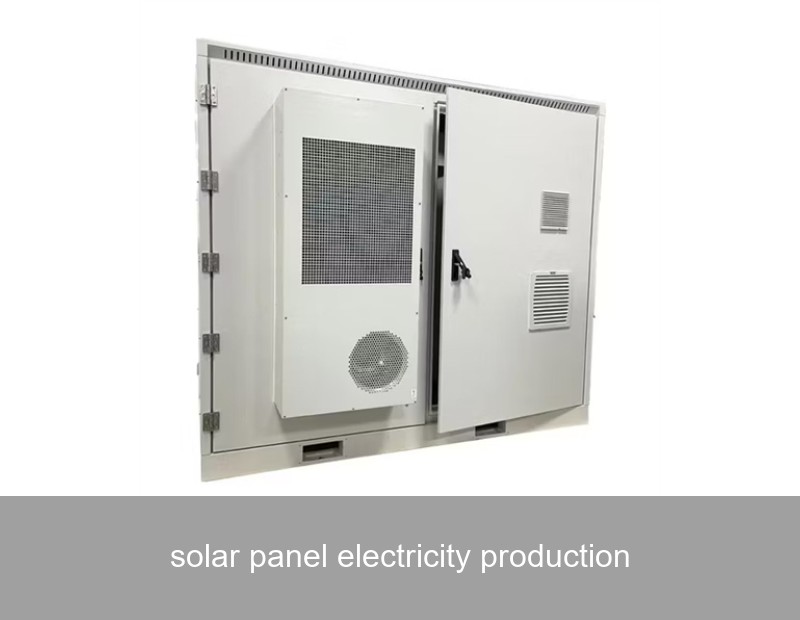
The solution wasn't adding more panels. Instead, they integrated a Highjoule HJ-Commercial 60 battery energy storage system (BESS). This 60 kWh system stores the midday solar surplus. Now, the bakery uses stored solar power to fire up its ovens at 4 AM and keep the lights on during the evening rush. The data speaks for itself:
- Solar Self-Consumption Rate: Increased from 35% to over 80%.
- Grid Energy Cost Reduction: Slashed by 65% annually.
- Return on Investment (ROI): Achieved in under 7 years, significantly shortened by rising energy prices.

Image: Commercial solar installation on a bakery rooftop. (Source: Unsplash, representative image)
This case highlights a critical insight: maximizing the value of your solar production is often more about smart management and storage than simply maximizing raw panel output.
The Modern Solution: Beyond the Panels Themselves
Today, a solar installation is more than just panels on a roof. It's an integrated energy system. To tackle the intermittency of solar production, advanced inverters and battery storage have become game-changers. They allow you to time-shift your solar energy, using it when you need it most, not just when the sun shines. This is where the concept of a solar-plus-storage system comes into play, transforming a one-way solar producer into a resilient, personal energy asset.
Highjoule's Role: Intelligent Energy Management
Since 2005, Highjoule has been at the forefront of this evolution. We understand that solar panel electricity production is just the starting point. Our mission is to provide intelligent, efficient, and sustainable power solutions that make every watt count.
For residential customers, our Highjoule HomePower series integrates seamlessly with existing solar arrays. Its AI-driven energy management system learns your consumption patterns and automatically optimizes when to store solar energy, power your home, or even sell back to the grid at the most profitable times. Imagine your system proactively charging your batteries before a forecasted cloudy period—that's smart energy resilience.
For commercial and industrial applications, like the Bavarian bakery, our HJ-Commercial and HJ-Industrial battery systems provide scalable, safe, and reliable storage. Coupled with our Energy Management Platform (EMP), businesses can perform peak shaving, demand charge reduction, and ensure backup power for critical operations. We don't just sell hardware; we deliver a comprehensive energy strategy. You can explore the latest grid-scale storage trends from the Energy Storage News platform to see the broader industry context.
Image: Inside a modern battery energy storage system (BESS) unit. (Source: Unsplash, representative image)
Future Trends & Your Next Step
The future of solar panel electricity production is integration and intelligence. We're moving towards virtual power plants (VPPs), where thousands of distributed solar-and-storage homes and businesses are aggregated to support the main grid during times of high demand. Technologies like bifacial panels (capturing light from both sides) and perovskite solar cells promise even higher efficiencies. The core principle remains: the true value is unlocked not at the panel, but at the point of consumption.
So, whether you're a homeowner curious about your next energy bill or a facility manager tasked with cutting operational costs and carbon footprint, the question is no longer just "How much solar can I produce?" The more powerful question to ask is: "How can I intelligently harness and control every kilowatt-hour my solar panels produce to meet my specific energy goals?"
 Inquiry
 Online Chat