


Solar Panel Per Watt Price in Sweden Today: A 2024 Investor's Guide
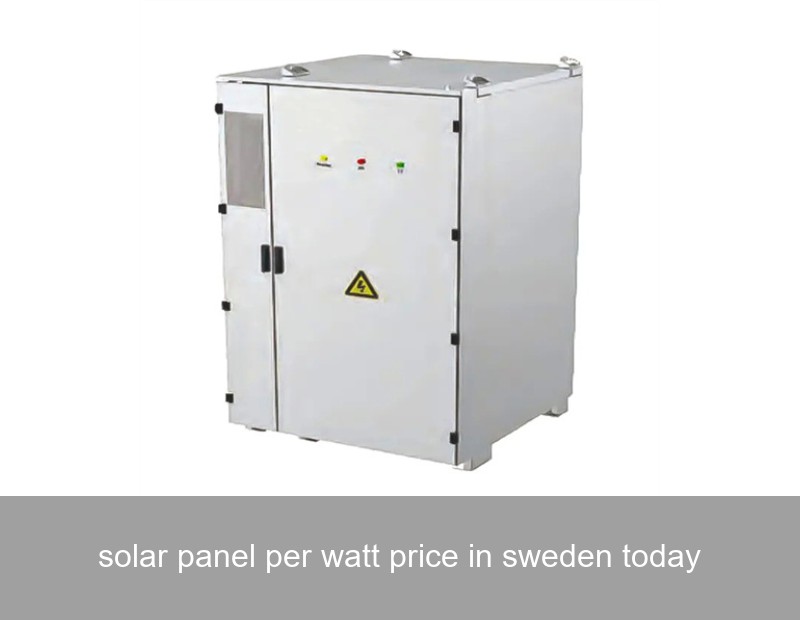
If you're researching the solar panel per watt price in Sweden today, you're asking the right first question. But here's a crucial insight from the industry: focusing solely on that module cost is like buying a car based only on the tire price. The true value—and your ultimate return on investment—lies in the complete, intelligently integrated solar energy system. In 2024, Swedish homeowners and businesses are looking beyond the initial quote to understand lifetime performance, durability against Nordic weather, and smart integration with storage. This guide will not only illuminate current pricing but also show you how to evaluate the entire ecosystem for maximum savings and energy independence.
Introduction: Beyond the Sticker Price
So, what does "per watt" (often written as SEK/Wp) actually mean? It's a standard metric that refers to the cost of the solar panel's power output under ideal conditions. While it's a useful benchmark, it doesn't tell the whole story. Two systems with identical "per watt" costs can deliver vastly different annual energy yields. Factors like panel efficiency (how well they convert limited Swedish sunlight into power), degradation rate, and performance in low-light conditions are paramount. Furthermore, the panel is just one component. The inverter, mounting system, wiring, and critically—the energy storage solution—are where the magic of modern solar happens.
The Current Swedish Solar Panel Price Landscape
As of mid-2024, the average solar panel per watt price in Sweden for a residential system ranges between 1.8 to 2.8 SEK per watt peak (Wp) for the hardware. This translates to roughly 15,000 to 25,000 SEK for a standard 10kW system in components. However, the installed, turnkey system price typically ranges from 3.0 to 4.5 SEK/Wp, encompassing installation, planning, and grid connection work.
This price has stabilized after years of decline, influenced by global supply chains and high European demand. The Swedish market uniquely favors high-quality, durable panels that can withstand snow loads, temperature fluctuations, and deliver over a long lifespan. Monocrystalline PERC and N-type TOPCon panels, known for higher efficiency and better temperature coefficients, are particularly popular despite a slight premium.
Image: High-efficiency solar panels are key in the Swedish climate. Source: Unsplash

Key Price Drivers in Sweden
- Panel Technology & Efficiency: Premium high-efficiency panels (21%+ efficiency) command a higher per-watt price but require less roof space and often yield more energy annually.
- System Size: Larger systems benefit from economies of scale, lowering the average per-watt cost.
- Installation Complexity: Roof type, angle, and accessibility can affect labor costs.
- Integrated Components: Including a hybrid inverter and a battery storage system increases upfront cost but dramatically enhances ROI and self-consumption.
Breaking Down the "Per Watt" Cost
To make an informed decision, let's dissect what goes into a final quote. A holistic system view is essential.
| System Component | Approx. Share of Total Cost | Why It Matters |
|---|---|---|
| Solar Panels (Modules) | 25-35% | The engine. Efficiency and warranty are key. |
| Inverter(s) & Power Electronics | 15-20% | The brain. Converts DC to AC. Hybrid inverters enable battery storage. |
| Mounting System & Balance of System | 10-15% | The skeleton. Critical for durability and safety in Swedish weather. |
| Installation & Labor | 20-30% | Expertise ensures optimal tilt, orientation, and safe, code-compliant installation. |
| Battery Energy Storage System (BESS) | 20-35% (if added) | The game-changer. Stores excess solar for use at night, increasing self-consumption from ~40% to 70%+. |
This is where a provider's expertise becomes critical. Companies like Highjoule focus on integrating these components into a seamless, smart system. For instance, pairing premium panels with Highjoule's HES Series Hybrid Energy Storage system allows homeowners to store midday sun for use during the long evening hours, effectively maximizing the utility of every krona spent on the panels themselves. The storage system acts as a force multiplier for your solar investment.
Real-World Impact: A Swedish Business Case Study
Let's move from theory to practice. Consider a medium-sized dairy farm in Västra Götaland. In 2022, they installed a 50kW solar array. The initial solar panel per watt price
In 2023, they partnered with Highjoule to retrofit a 120kWh Highjoule C&I Battery Storage System. The results within a year were transformative:
- Self-Consumption Rate: Increased from 38% to 82%.
- Grid Electricity Costs: Reduced by 73% annually.
- Payback Period: The combined solar+storage system payback is projected at under 8 years, thanks to optimized energy arbitrage and reduced demand charges.
This case illustrates that the true metric of success isn't the lowest cost per watt of panel, but the lowest levelized cost of energy (LCOE) over 25+ years. The intelligent addition of storage transformed their solar array from a partial solution into a comprehensive energy asset.
Image: A commercial battery storage system, similar to those used in case studies. Source: Unsplash

Maximizing Your Investment: The System Behind the Panel
To truly capitalize on Sweden's solar potential, your system needs intelligence and resilience. This is the core of Highjoule's offering. Beyond supplying high-grade panels, our role is to engineer the complete energy ecosystem.
Our HES Series for Residential and HES-C Series for Commercial & Industrial applications are more than just batteries. They are integrated systems featuring:
- AI-Powered Energy Management: Software that learns your consumption patterns, weather forecasts, and electricity prices to autonomously optimize charging and discharging cycles.
- Scalable & Modular Design: Start with what you need and expand storage capacity as your needs grow.
- Grid Services Ready: For larger installations, systems can be configured to provide grid stability, potentially opening up additional revenue streams.
- Robust Design for Nordic Climates: Built to operate reliably in a wide temperature range, ensuring year-round performance.
By choosing a solution like this, you're not just buying components; you're investing in a long-term energy partner that ensures every watt your panels produce is used in the most economical way possible.
Future Trends for Solar Prices in Sweden
Looking ahead, panel prices are expected to see moderate decreases, but the most significant innovations will be in system integration and software. The value will increasingly shift from the panel itself to the smart energy platform that manages it. We anticipate:
- Increased Demand for Storage: As electricity prices remain volatile and feed-in tariffs diminish, battery storage will become a standard part of most installations.
- Vehicle-to-Grid (V2G) Integration: Your electric vehicle will become an integral part of your home energy system, acting as a mobile storage unit.
- Community & Virtual Power Plants: Aggregated networks of home solar+storage systems will play a larger role in the national grid's balance. Highjoule's systems are designed with this future in mind.
For the most current data on solar adoption and policy, organizations like International Energy Agency (IEA) and Energimyndigheten (Swedish Energy Agency) provide authoritative reports.
Your Solar Journey: What's the Next Step?
Now that you understand the solar panel per watt price in Sweden today is just the starting point, what factors are most critical for your specific situation—is it maximizing self-sufficiency, achieving a specific financial payback period, or ensuring resilience during grid outages? How will you evaluate the partners who can deliver not just panels, but a complete, intelligent energy solution for the next two decades?
 Inquiry
 Online Chat