


Understanding Solar Panel Price per Watt in China: A Global Market Perspective
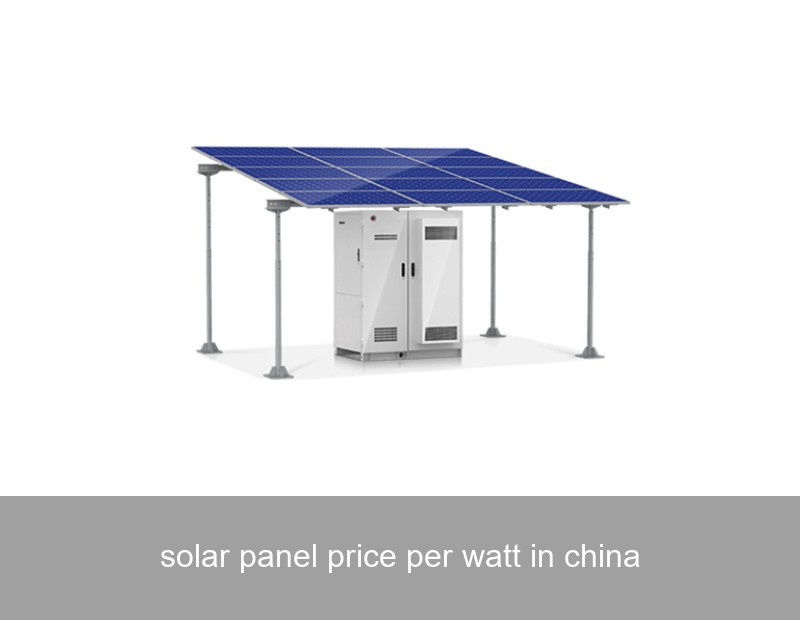
If you're exploring solar energy in Europe or the United States, you've likely encountered a critical metric: the price per watt. This figure, often hovering around $0.20 to $0.35 per watt for modules in Western markets, is fundamentally shaped by a powerhouse thousands of miles away. The solar panel price per watt in China is more than just a domestic statistic; it's the global benchmark that influences project economics from California to Cologne. But what drives this cost, and how does it translate into a reliable, efficient energy system for your home or business? Let's demystify the numbers and look at the complete picture of value beyond the initial module price.
The Price Phenomenon: Why China Sets the Benchmark
China's dominance in solar photovoltaic (PV) manufacturing is a story of scale, vertical integration, and relentless technological advancement. Companies have mastered the entire supply chain, from polysilicon production to final panel assembly. This control, coupled with massive government-supported capacity, creates unparalleled economies of scale. According to industry analyses, Chinese-manufactured solar modules can be produced at costs significantly lower than in other regions, directly impacting the global solar panel price per watt.
For you, the end-user, this means the base hardware for your solar project is more affordable than ever. However, it's crucial to understand that this price typically refers to the module itself, often quoted as FOB (Free On Board) from a Chinese factory. The real story—and the real cost—begins when that panel is destined for your rooftop or commercial facility.
Beyond the Module: The True Cost of a Solar Energy System
Focusing solely on the module's price per watt is like buying a high-performance car engine and forgetting about the chassis, transmission, and fuel system. A complete, functional solar energy system comprises several key components, each contributing to the final installed cost and long-term performance:
- Balance of System (BOS): This includes racking, wiring, conduits, and combiner boxes.
- Power Conversion: Inverters, which convert the DC electricity from panels to usable AC electricity, are a major cost and performance factor.
- Energy Storage (The Game Changer): To truly maximize solar investment, pairing it with a battery energy storage system (BESS) is becoming standard. This allows you to store excess daytime generation for use at night or during grid outages, dramatically increasing self-consumption and energy independence.
- Soft Costs: Permitting, design, installation labor, and grid connection fees can vary widely between the EU and US but are a substantial part of the total price.
This is where the conversation shifts from simple hardware cost to lifetime value. A cheaper panel might save capital expenditure (CAPEX) upfront, but a premium, intelligently integrated system with superior storage can deliver far greater operational savings (OPEX) and reliability over 25+ years.

Image Source: Unsplash - A modern commercial solar installation. The panels are just one part of a complex energy ecosystem.
Case Study: A German Mittelstand Company's Strategic Choice
Let's ground this in reality with a case from Bavaria, Germany. A mid-sized manufacturing plant (a classic "Mittelstand" company) faced rising grid electricity costs and sought to lock in long-term energy price stability. Their initial analysis fixated on securing the lowest solar panel price per watt in China for a 500 kW rooftop array.
However, a deeper energy audit revealed a critical insight: their production peaks in the early morning and evening, while solar production peaks at midday. Simply installing cheap panels would lead to massive over-generation at noon (sold back to the grid at a low feed-in tariff) and continued grid dependence during expensive peak hours.
| Metric | Option A: Basic Solar Array | Option B: Solar + Highjoule BESS |
|---|---|---|
| Initial System Cost | €320,000 | €480,000 |
| Estimated Annual Grid Import Reduction | 55% | 92% |
| Payback Period (Years) | 7 | 8.5 |
| Projected Energy Cost Savings (Year 10) | €68,000 | €112,000 |
| Grid Independence & Resilience | Low | High (Critical load backup included) |
The company chose Option B, integrating a Highjoule H2 Series Commercial Battery System with their solar array. The Highjoule system's intelligent energy management software dynamically optimizes energy flow, storing midday solar surplus and dispatching it during high-tariff periods. While the initial investment was higher, the long-term savings and energy security were vastly superior. The lesson? The lowest module cost did not deliver the optimal financial or operational outcome. True value was unlocked through system intelligence and storage.
Where Highjoule Fits In: Adding Intelligence to the Equation
At Highjoule, we view competitively priced solar panels as a fantastic starting point—the raw fuel for a smarter energy system. Our role as a global advanced energy storage provider is to transform that intermittent fuel into dependable, controllable, and maximized power for your business, home, or community.
Our solutions, like the H-Series for residential applications and the scalable H2/H3 Series for commercial and industrial (C&I) use, are designed to seamlessly integrate with PV arrays from any global manufacturer. We don't just add batteries; we provide an integrated AC-coupled storage solution with our proprietary Helios Energy Management Platform. This platform acts as the brain of your energy ecosystem, making real-time decisions to:
- Maximize self-consumption of your solar generation.
- Perform peak shaving to reduce demand charges (a major cost for C&I users).
- Provide backup power during grid outages.
- Enable participation in grid services programs where available.

Image Source: Unsplash - A sleek home battery storage unit, similar to residential solutions like Highjoule's H-Series.
By focusing on the synergy between generation and storage, we help you build a system where the value of every solar watt-hour produced is amplified, making the initial solar panel price per watt just one data point in a much more favorable financial equation.
Making the Right Decision for Your Energy Future
So, how should you, as a savvy consumer or business owner in Europe or the US, approach the allure of low Chinese module prices? Conduct a total lifetime cost analysis. Request quotes that include not just PV modules, but also quality inverters, a Highjoule storage system, and intelligent software. Consider local incentives for storage (like those in certain EU member states or the U.S. federal investment tax credit (ITC) for storage paired with solar).
Look for partners who understand system integration, not just component sales. The future of energy is not just about generating cheap power; it's about generating smart, resilient, and sustainable power. The solar panel price per watt in China gets you in the game, but the right storage and intelligence strategy wins it.
 Inquiry
 Online Chat