


Wat Kost een Zonnepaneel per Stuk? The Real Answer Lies in Your Total Energy Solution
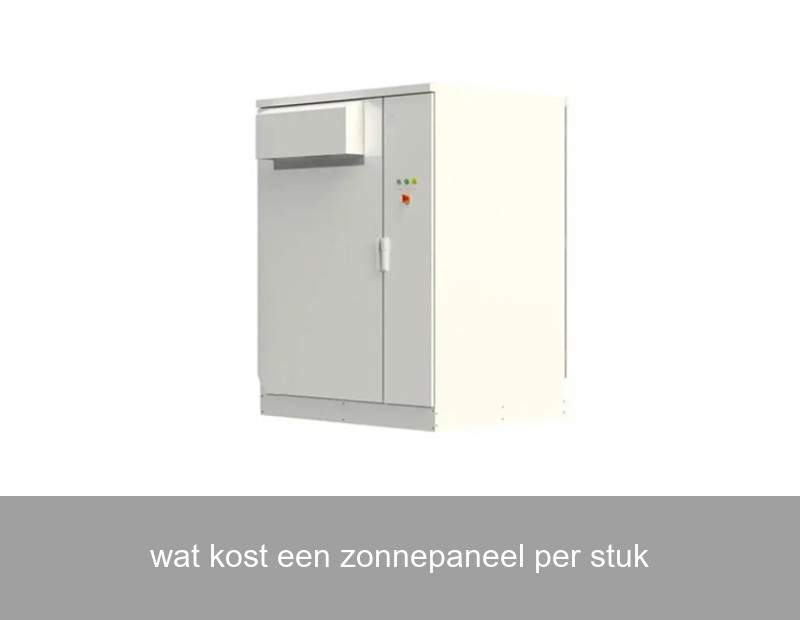
If you're searching for "wat kost een zonnepaneel per stuk" (what does a solar panel cost per piece), you're asking the right first question. But as a seasoned expert in renewable energy systems, I must tell you: focusing solely on the per-panel price is like buying a car based only on the cost of a single tire. The true value—and the ultimate return on your investment—is found in the complete, integrated system. A high-quality panel is crucial, but it's just one actor in a performance that includes inverters, mounting, and, most importantly today, intelligent energy storage.
Let's unravel the real cost story together. We'll move from the simple sticker price to understanding how a holistic approach, like the solutions we design at Highjoule, transforms a capital expense into a long-term strategic asset for your home or business.
Breaking Down the Cost per Solar Panel
In 2024, the price for a single premium solar panel in Europe or the US typically ranges between €200 and €400 (or $250 to $500), depending on wattage, brand, and technology. You might find cheaper options, but this initial figure is just the tip of the iceberg. The real financial and energy picture becomes clear when we look at the total installed system cost and its performance over 25+ years.
Consider a standard residential installation. The panel itself often accounts for only about 15-25% of the total project cost. The rest comes from:
- Balance of System (BOS): Inverters, mounting structures, cabling, and combiner boxes.
- Soft Costs: Permits, design, installation labor, and inspection.
- The Game Changer - Storage: Adding a battery storage system is an additional but transformative cost layer.
| Cost Component | Approx. % of Total System Cost | Impact on Long-Term Value |
|---|---|---|
| Solar Panels | 15-25% | Determines initial power generation efficiency. |
| Inverter & BOS | 20-25% | Ensures safe, efficient conversion and distribution of DC to AC power. |
| Installation & Soft Costs | 30-40% | Critical for safety, reliability, and securing permits/rebates. |
| Battery Storage System | 25-40% (if added) | Maximizes self-consumption, provides backup, and enables energy independence. |
The Hidden Value: Efficiency, Longevity, and System Synergy
Why does a panel from a reputable manufacturer cost more? It comes down to engineering that delivers over decades. A panel with a 22% efficiency rating will generate significantly more power in the same space over its lifetime than an 18% panel, effectively lowering your cost per generated kilowatt-hour (kWh). Furthermore, premium panels degrade slower, often guaranteed to retain 92% of their output after 25 years, compared to 85% or less for budget options.
But here's the key insight: Even the best solar panel's value is diminished without a smart way to use the energy it produces. This is where the conversation evolves from "wat kost een zonnepaneel" to "how can I optimize my entire energy ecosystem?"

Image: High-efficiency panels are the foundation, but the full system unlocks their potential. Source: Unsplash
Case Study: A Dutch Dairy Farm's Holistic Calculation
Let's look at a real example from our work at Highjoule in the Netherlands. A medium-sized dairy farm was quoted for a 50kW solar array. The cheapest bid offered panels at €185 per piece. Our proposal, featuring tier-1 panels, came in at €235 per panel—a seemingly higher upfront cost.
However, our integrated proposal included the Highjoule HES Series Hybrid Energy Storage, a system designed for commercial robustness. Here’s the data-driven outcome after one year:
- Self-Consumption Rate: The farm's solar-only system would have exported over 60% of its daytime production back to the grid at a low feed-in tariff. With the HES storage system, self-consumption jumped to 85%.
- Energy Bill Savings: By storing excess midday energy and using it during high-rate evening hours for milking and cooling, the farm reduced its grid electricity purchases by 91%.
- ROI Timeline: Despite the higher initial investment, the combined solar + storage system achieved a payback period of 6.2 years, compared to an estimated 8.5 years for the solar-only setup, thanks to dramatically higher on-site energy utilization.
This case clearly shows that the most impactful metric isn't cost per panel, but cost per optimized kilowatt-hour consumed on-site.
Beyond the Panel: The Critical Role of Energy Storage
This brings us to the core of modern energy independence. Solar panels produce intermittently. Without storage, you're still tethered to the grid, subject to its price volatility and outages. A battery storage system is what allows you to capture every bit of your solar investment.
At Highjoule, we've spent nearly two decades perfecting this synergy. Our Residential Energy Hub (REH) isn't just a battery; it's an intelligent energy manager. It learns your consumption patterns, integrates with your solar inverter, and decides the most economical moment to store energy or power your home—all while keeping essential circuits running during a blackout. For our commercial clients, the HES Series provides scalable, containerized storage that can manage demand charges, participate in grid services, and form the backbone of a microgrid.
Integrating storage from the start often leads to a more optimally sized solar array and inverter, creating system-wide savings. It’s a coordinated dance, not a collection of parts.

Image: Intelligent battery storage, like Highjoule's systems, is the brain that maximizes solar ROI. Source: Unsplash
Making the Right Choice for Your Investment
So, how should you approach your decision? Follow this logical ladder:
- Phenomenon: High energy bills and a desire for resilience.
- Data: Analyze your last 12 months of utility bills. Note your consumption (kWh) and peak demand (kW). Calculate your average and peak costs. Tools from authorities like the European Commission's Energy Department or the U.S. Department of Energy can provide benchmarks.
- Case: Use examples like the Dutch farm to frame your expectations. Seek out case studies relevant to your region and sector.
- Insight: The goal is a customized, integrated system where components are engineered to work together for 25+ years, maximizing your Levelized Cost of Energy (LCOE).
Questions to Ask Your Provider (Beyond Panel Price)
- How do you design for optimal self-consumption, not just maximum production?
- What is your recommended storage solution, and how is its lifecycle managed?
- Can the system provide backup power, and how is that integrated?
- What is the projected 25-year financial performance, including degradation and maintenance?
As you ponder the question "wat kost een zonnepaneel per stuk," I invite you to shift your perspective. Instead of asking for the price of a single component, consider posing a more powerful question to potential providers: "Can you show me a comprehensive design for a resilient, intelligent energy system that minimizes my lifetime cost of electricity?" What would that kind of energy independence look like for your home or business?
 Inquiry
 Online Chat