


Solar Panel That Follows the Sun: Maximizing Your Renewable Energy Harvest
Have you ever watched a sunflower slowly turn its face to follow the sun across the sky? This natural phenomenon, called heliotropism, is a brilliant strategy for capturing maximum light. Now, imagine if your rooftop solar panels could do the same. This isn't science fiction; it's the smart technology behind solar tracking systems, often called a solar panel that follows the sun. For homeowners and businesses across Europe and the U.S., understanding this technology is key to unlocking the highest possible return from a solar investment. While fixed panels are a great start, tracking systems dynamically adjust their angle throughout the day, leading to significant gains in energy production. As a leader in intelligent energy storage, Highjoule often integrates with such advanced generation systems to create fully optimized, resilient power solutions for homes and businesses.
Table of Contents
- What is a Solar Tracker? Beyond the Fixed Panel
- How Does a Sun-Following Solar Panel Work?
- The Bright Side: Benefits and Practical Challenges
- Real-World Impact: A Case Study from California
- The Storage Synergy: Why Trackers Pair Perfectly with Highjoule Systems
- Is a Solar Panel That Follows the Sun Right for You?
What is a Solar Tracker? Beyond the Fixed Panel
At its core, a solar tracker is a mounting system for photovoltaic (PV) panels that moves to follow the sun's path. Unlike fixed-tilt systems, which are set at an optimal annual angle, trackers are dynamic. Think of it this way: a fixed panel is like a photographer taking a single, well-composed shot at noon. A tracking system is that photographer actively following the subject all day, capturing the best light from sunrise to sunset, resulting in a far richer portfolio of energy.
There are two main types of trackers:
- Single-Axis Trackers: These panels rotate on one axis, typically following the sun from east to west. They are the most common type for large-scale commercial and utility installations, offering a great balance of increased output and cost.
- Dual-Axis Trackers: These are the ultimate sun followers. They pivot on two axes, tracking not only the daily east-west movement but also the sun's seasonal altitude changes in the sky. This yields the absolute maximum energy harvest possible.
 Image Source: Wikimedia Commons, Creative Commons
How Does a Sun-Following Solar Panel Work?
The magic is in the combination of hardware and smart software. The system typically uses sophisticated sensors to pinpoint the sun's exact location or relies on pre-programmed astronomical data based on GPS coordinates. A controller then sends signals to actuators or motors that gently tilt the panel array. Modern trackers are remarkably efficient, using a minimal amount of the electricity they generate to power their own movement. The goal is simple: to keep the sun's rays hitting the panel surface at a near-perpendicular (90-degree) angle for as many hours as possible. This dramatically reduces the "cosine loss" experienced by fixed panels when the sun is at a low angle.
The Bright Side: Benefits and Practical Challenges
Let's talk numbers. According to the National Renewable Energy Laboratory (NREL), a single-axis tracker can increase energy production by 25-35% annually compared to a fixed-tilt system. In sun-rich regions, dual-axis trackers can boost output by over 40%. That’s a transformative difference for meeting energy goals.
| System Type | Estimated Annual Energy Gain* | Best Application |
|---|---|---|
| Fixed-Tilt Rooftop | Baseline (0%) | Residential, limited-space commercial |
| Single-Axis Tracker | +25% to +35% | Utility-scale farms, large commercial ground mounts |
| Dual-Axis Tracker | +35% to +45% | Research, high-value commercial sites with space constraints |
*Compared to an optimally tilted fixed array. Source: NREL data and industry estimates.
However, it's not just about peak output. Trackers also flatten the generation curve, producing more usable power in the early morning and late afternoon. This helps align better with typical energy demand patterns, a crucial factor for grid stability.
But what's the catch? Trackers involve more moving parts, which can lead to slightly higher maintenance needs and initial costs than fixed systems. They also require more space between rows to prevent shading, making them less ideal for small, constrained rooftops. They are predominantly a ground-mount technology.
Real-World Impact: A Case Study from California
Let's move from theory to practice. A compelling example comes from a mid-sized winery in California's Central Valley. The facility had high daytime energy demands for cooling and processing but found its existing fixed-panel solar array only met about 60% of its peak load, leaving it exposed to high utility rates during crucial operational hours.
In 2022, they expanded their solar capacity by installing a 500 kW single-axis tracker system. The results were telling:
- Energy Output: The new tracker system produced 42% more energy per installed kW than the existing fixed array on-site.
- Financials: This boosted their total solar energy coverage to over 90% of daily demand, slashing their utility bill by an additional $28,000 annually.
- Operational Profile: The extended generation period of the trackers provided more consistent power throughout the workday, reducing the facility's draw from the grid during expensive peak periods.
This case highlights how a solar panel that follows the sun isn't just about total kilowatt-hours; it's about delivering energy when it's most valuable.
The Storage Synergy: Why Trackers Pair Perfectly with Highjoule Systems
Here's where the story gets even more powerful. A solar tracker maximizes generation, but what happens when you produce more than you can use immediately, or when the sun sets? That's where intelligent storage comes in. This is Highjoule's expertise.
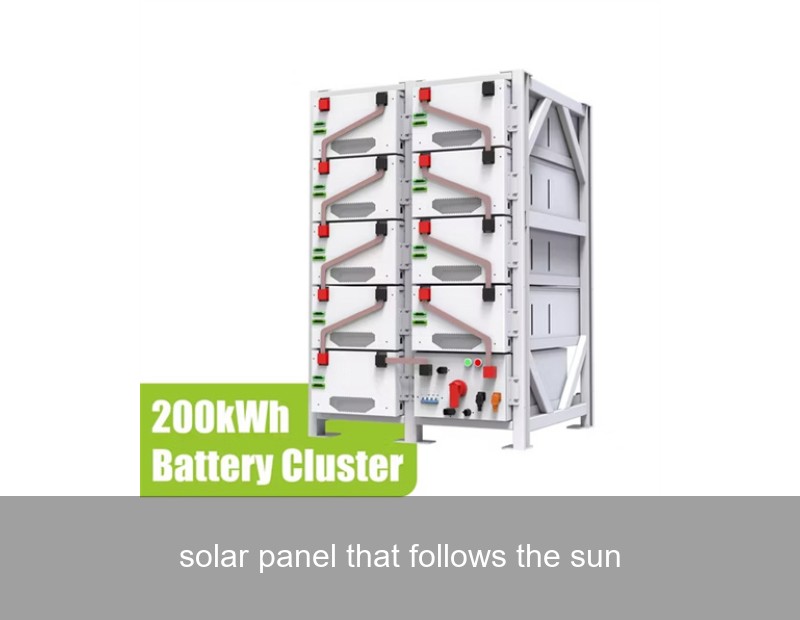
A Highjoule battery energy storage system (BESS) acts as the perfect partner to a tracking solar array. Think of the tracker as a highly efficient water pump, and the Highjoule battery as a smart reservoir. The tracker fills the reservoir more quickly and for longer periods each day. Our Highjoule H2 Series commercial storage systems are designed to seamlessly integrate with high-output solar, storing surplus midday energy for use during evening peaks or periods of low sunlight.
For residential clients with ground-mounted tracking systems, our HomePower+ solution provides the same intelligence. It doesn't just store energy; our AI-driven energy management platform predicts generation from your tracking system and learns your consumption patterns to optimize every kilowatt-hour. It ensures the extra 30% energy your tracker captures doesn't go to waste but instead powers your home at night, increases your energy independence, and provides critical backup power.
 Image Source: Unsplash
Beyond Backup: Microgrids and Grid Services
On a larger scale, for industrial or microgrid applications, combining solar trackers with a Highjoule Microgrid Controller creates a truly resilient and economically optimized asset. The system can use predictable, enhanced solar generation to participate in grid demand response programs or to maintain critical operations independently during outages, turning a sustainability project into a revenue-generating or risk-mitigating investment.
Is a Solar Panel That Follows the Sun Right for You?
So, should you be considering this technology? Ask yourself these questions:
- Do I have sufficient, unshaded ground space? Trackers are primarily ground-mounted.
- Is maximizing energy yield per square foot a top priority? This is crucial for sites with limited expandable area.
- Are my energy costs highest in the early morning and late afternoon? Trackers excel at generating during these shoulder hours.
- Am I planning to pair solar with storage? The increased and extended generation from a tracker can dramatically improve the ROI of a battery system by filling it more completely each day.
For many large commercial, industrial, or agricultural operations, the answer is a resounding yes. For residential homeowners with ample land, it's an exciting premium option. The key is to view it as part of an integrated system.
At Highjoule, we don't just provide storage; we provide intelligent energy ecosystems. Whether you're evaluating a new solar project with trackers or looking to supercharge an existing array, our solutions are designed to capture, store, and manage every possible drop of solar energy you produce. The future of energy isn't just about generating power; it's about harnessing it intelligently, 24/7.
What specific energy challenge—be it peak shaving, backup resilience, or simply maximizing a green investment—could a combination of sun-following solar and smart storage solve for you?
 Inquiry
 Online Chat