


Understanding Solar Panel Watts Per Square Meter: Your Key to Smarter Energy Investment
You're considering solar panels for your home or business. You've heard about "high efficiency" and "more power," but when you look at the specs, you're met with a technical term: watts per square meter (W/m²). What does this number really mean for your roof, your energy bills, and your sustainability goals? More than just a spec, it's the critical metric that determines how much clean electricity you can harvest from every ray of sun that hits your property. Let's demystify this concept and explore how maximizing this figure is central to modern, intelligent energy systems like those designed by Highjoule, a global leader in advanced energy storage since 2005.
Table of Contents
What Exactly Are Watts Per Square Meter?
In simple terms, solar panel watts per square meter is a measure of power density. It tells you how much electrical power (in watts) a solar panel can generate under standard test conditions for every square meter of its area. Think of it like the productivity of your rooftop. A higher W/m² rating means the panel converts sunlight to electricity more efficiently, packing more generating capacity into a limited space.
For a homeowner with a small roof, this metric is crucial. Choosing panels with a higher watt-per-square-meter output could be the difference between meeting your energy needs or falling short. For commercial and industrial applications with vast roof space, optimizing this efficiency translates directly into lower installation costs and a faster return on investment.
The Standard Test Condition (STC) Baseline
It's important to know that the W/m² figure quoted on spec sheets is measured under Standard Test Conditions (STC): 1000 W/m² of solar irradiance, at 25°C cell temperature. This provides a consistent benchmark for comparing panels. Real-world performance, as we'll see, depends on several environmental factors.
Key Factors That Impact Your Solar Panel's Power Density
Why do some panels produce more watts per square meter than others? The answer lies in the technology and the environment.
- Cell Technology: Monocrystalline silicon panels, with their pure, single-crystal structure, typically achieve the highest efficiencies (often above 22%), resulting in a higher W/m² output. Polycrystalline and thin-film technologies generally have lower power density.
- Temperature Coefficient: Solar panels oddly become less efficient as they get hotter. A panel with a better (lower) temperature coefficient will maintain a higher real-world W/m² output on a scorching summer day.
- Local Climate & Irradiance: The actual "input" of sunlight, measured in kilowatt-hours per square meter per day (kWh/m²/day), varies greatly. Southern Spain naturally receives more solar irradiance than Northern Scotland, fundamentally affecting daily energy yield.
- Installation & Orientation: The angle, direction, and even shading from trees or chimneys dramatically impact the effective solar energy hitting each square meter of your panel.
From Theory to Reality: A German Case Study
Let's move beyond the lab and into a real-world scenario. Consider a medium-sized manufacturing facility in Munich, Germany. The facility has a 1,000 square meter south-facing roof space. Their goal: maximize self-consumption of solar energy to reduce grid dependence and volatile energy costs.
The Phenomenon: The facility manager installed standard-efficiency panels (approx. 320W per panel, ~180 W/m²). While the system produced energy, a significant portion was exported to the grid during peak production (midday) when factory consumption was lower. They then had to buy expensive grid power in the evening when the sun was down, missing the full financial benefit.
The Data & Solution: A post-installation audit revealed that by upgrading to high-efficiency panels (400W per panel, ~220 W/m²) on the same roof area, they could have increased their peak capacity by over 20%. However, simply adding more panels wasn't the complete solution. The core issue was the mismatch between production and consumption.
The Insight: This case highlights a critical lesson: Maximizing watts per square meter is about more than just panel choice. True efficiency is achieved when every watt generated is effectively captured and used. This is where intelligent energy storage becomes non-negotiable. By pairing high-density solar arrays with a battery system, the Munich facility could store its midday surplus and use it during the high-rate evening hours, effectively "time-shifting" its solar production.

Image: Modern industrial solar installations must be paired with storage to maximize the value of every watt generated per square meter.
Why Your Solar Panels Are Only Half the Story
Focusing solely on panel-level W/m² is like buying a high-performance sports car but only driving it in city traffic. You're not unlocking its full potential. The modern energy system is an integrated ecosystem:
| System Component | Role in Maximizing Solar Value |
|---|---|
| High-Efficiency Solar Panels | Provides the maximum possible raw energy input (high W/m²). |
| Smart Inverter | Converts DC to AC power efficiently and manages grid interaction. |
| Advanced Battery Storage (BESS) | The game-changer. Captures excess production for use when needed, increasing self-consumption from ~30-40% to 70% or more. |
| Energy Management System (EMS) | The "brain" that optimizes energy flow between panels, battery, grid, and loads based on weather forecasts, tariffs, and usage patterns. |
How Highjoule's Systems Maximize Your Solar Investment
This is where Highjoule's expertise transforms your solar investment. We don't just sell batteries; we provide integrated, intelligent power solutions that ensure every watt per square meter on your roof works harder for you.
For our residential clients, the Highjoule HomePower Stack is a prime example. It's a modular lithium-ion battery system designed with a compact footprint (its own high power density!). Its intelligent inverter communicates seamlessly with your solar array, deciding in real-time whether to power your home, charge the battery, or sell back to the grid based on cost and need. This system ensures the high W/m² output of your premium panels doesn't go to waste.
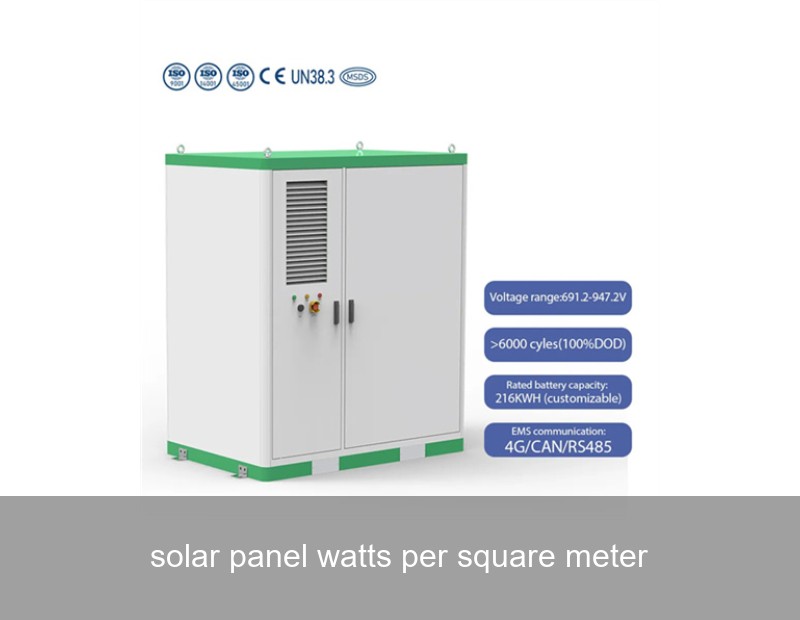
For commercial and industrial (C&I) applications, like the Munich facility, our Highjoule C&I Energy Platform is the answer. This scalable Battery Energy Storage System (BESS) can be configured from hundreds of kilowatt-hours to multi-megawatt-hours. Coupled with our AI-driven energy management software, it performs peak shaving, demand charge reduction, and backup power, providing a predictable energy cost and enhancing sustainability. By integrating with high power-density solar arrays, we create a resilient microgrid that maximizes the utility of every square meter of solar installation.

Image: Integrated home energy storage systems are essential for leveraging high-efficiency solar panel output.
The Future of Power Density and Solar Technology
The race for higher panel efficiency continues, with technologies like perovskite-silicon tandem cells on the horizon, promising to push commercial panel efficiencies—and thus W/m²—beyond 30% (source: Joule, 2020). But the parallel and equally important evolution is in system intelligence. The future belongs to platforms that don't just generate power, but predict, learn, and autonomously optimize it.
Highjoule is at the forefront of this evolution. Our systems are designed to be future-ready, capable of integrating with next-generation panels and adapting to new grid service markets. We believe the ultimate metric of success isn't just watts per square meter on your roof, but dollars and carbon saved per square meter per year.
Ready to See What Your Roof Can Really Do?
So, the next time you evaluate a solar proposal, look beyond the total system cost and the panel's W/m² rating. Ask the critical question: "What is the integrated system doing to ensure I use every single kilowatt-hour my panels produce?" How would your energy profile change if you could shift 90% of your solar production to when you actually need it?
 Inquiry
 Online Chat