


The Complete Guide to Your Solar Panel with Battery and Inverter System
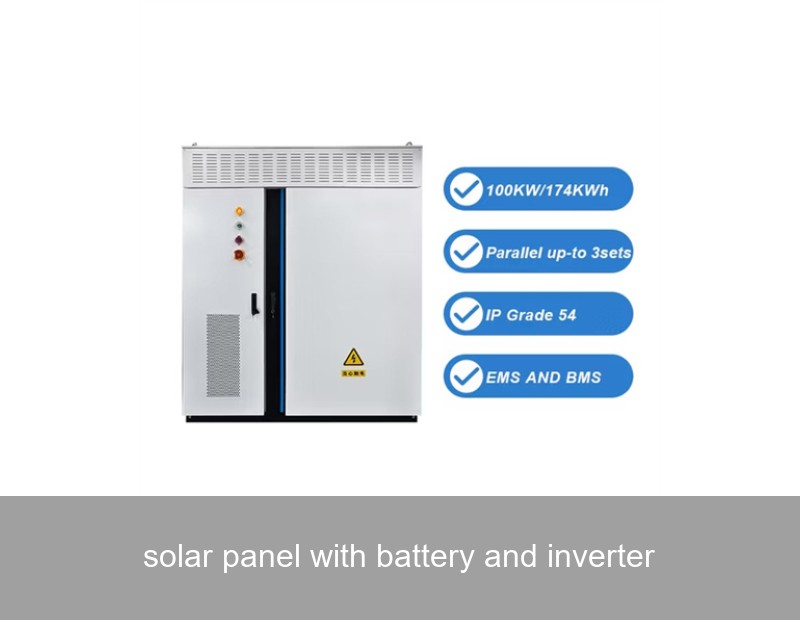
You've seen the solar panels on your neighbor's roof, and you've heard about home batteries. But how do these pieces actually come together to power your home reliably, day and night? The true magic—and maximum value—happens when you seamlessly integrate a solar panel with battery and inverter into a single, intelligent system. This isn't just about generating clean energy; it's about taking full control of it. Let's demystify this powerful trio and explore how it's revolutionizing energy independence for homes and businesses across Europe and the US.
Table of Contents
- The Energy Trio: Panel, Battery, Inverter Explained
- Why Integration Matters More Than Individual Parts
- A Real-World Case: The German Household Study
- Beyond Backup: Financial and Grid Benefits
- Choosing the Right System: Key Considerations
- Highjoule's Integrated Solutions
- What Will Your Energy Independence Look Like?
The Energy Trio: Panel, Battery, and Inverter Explained
Think of your solar energy system like a sophisticated team. Each member has a critical role:
- The Solar Panels (The Generators): These are your power plants, converting sunlight into direct current (DC) electricity. Their efficiency determines how much raw energy you harvest.
- The Inverter (The Brain & Translator): This is the system's crucial hub. Most homes and the grid use alternating current (AC). The inverter's primary job is to convert the DC power from your panels into usable AC power. But in a modern solar panel with battery and inverter setup, the inverter does much more. It intelligently manages energy flow—sending power to your home, the grid, or to charge the battery.
- The Battery (The Bank): This is your energy savings account. Instead of sending all excess solar energy to the grid (often for a low feed-in tariff), you store it for later use in the evening, during peak rate hours, or a power outage.
When these three are disconnected or poorly matched, you lose efficiency and capability. The goal is a harmonious, integrated system.

Image Source: Unsplash - A modern home with an integrated solar and battery system.
Why Integration Matters More Than Individual Parts
Here’s the pivotal insight: a collection of top-tier components does not guarantee a top-tier system. The communication and coordination between the solar panel, battery, and inverter are what unlock true potential. A fully integrated system, often called an AC-coupled or hybrid system, allows for:
- Seamless Mode Switching: It can instantly redirect solar energy to charge the battery during a grid outage while still powering your home—a feat many standalone systems cannot perform.
- Advanced Energy Arbitrage: The system can be programmed to store solar energy when grid prices are low and discharge when they are high, maximizing savings in regions with time-of-use rates.
- Optimized System Health: Integrated components communicate to operate at ideal voltages and temperatures, enhancing longevity and safety.
The Data Point That Changes Everything
According to the National Renewable Energy Laboratory (NREL), adding a battery to a solar system can increase a homeowner's consumption of self-generated solar power from 30-50% to over 80%. That's a dramatic reduction in grid dependence and energy bills.
A Real-World Case: The German Household Study
Let's look at a concrete example from Bavaria, Germany. A family of four installed a 9.8 kWp solar array in 2019. Initially, their self-consumption rate was around 35%. In 2022, they retrofitted a 13.5 kWh lithium-ion battery with a compatible hybrid inverter.
| Metric | Before Battery | After Battery Integration |
|---|---|---|
| Grid Electricity Purchased | 4,200 kWh/year | 850 kWh/year |
| Self-Consumption of Solar | ~35% | ~89% |
| Annual Energy Cost | €1,450 (at €0.345/kWh) | €293 |
This case, documented by the Fraunhofer Institute for Solar Energy Systems ISE, highlights the transformative financial and energy autonomy impact of a properly integrated solar panel with battery and inverter system. The payback period for the added battery was calculated at just under 8 years, a figure improving as energy prices rise.
Beyond Backup: Financial and Grid Benefits
While backup power is a major driver, especially in areas of the US prone to wildfires or storms, the benefits are broader.
- Peak Shaving: For commercial and industrial users, batteries can discharge during short periods of highest demand, drastically cutting "demand charges" that can constitute up to 50% of a utility bill.
- Grid Services: In some markets, aggregated home batteries can provide grid stability services, creating a potential revenue stream for homeowners. This is a growing trend in the UK and parts of the US.
- Future-Proofing: An integrated system is ready for vehicle-to-home (V2H) electric car charging and can adapt to evolving utility rate structures.
Choosing the Right System: Key Considerations
Navigating the market requires focus on a few critical questions:
- AC-Coupled vs. DC-Coupled: AC-coupled systems offer more flexibility for retrofits, while DC-coupled can be slightly more efficient for new installations. Your installer should explain the best architecture for your needs.
- Inverter Capability: Is the inverter "battery-ready" or a true hybrid model designed for seamless integration from the start? The latter is often superior.
- Software & Monitoring: The system's intelligence is in its software. Look for user-friendly apps that allow you to set preferences, monitor production/consumption, and receive updates.
- Scalability: Can you easily add more battery capacity later if your needs change (e.g., buying an EV)?

Image Source: Unsplash - Advanced monitoring software is key to system control.
Engineered for Harmony: Highjoule's Integrated Solutions
At Highjoule, we've focused on this exact challenge since 2005: creating not just components, but optimized, intelligent energy ecosystems. We understand that the value lies in the seamless interaction between the solar panel, battery, and inverter.
Our HPS Series Hybrid Power Systems are designed from the ground up as unified solutions. The high-efficiency hybrid inverter communicates natively with our modular lithium-ion battery cabinets and can be paired with virtually any solar array. Our proprietary energy management system (EMS) acts as the conductor, making real-time decisions to maximize your economic return and energy resilience.
For commercial and industrial clients, our GridSynergy Microgrid Controllers take this further, allowing large-scale battery storage to interact with on-site solar, generators, and the grid to achieve unparalleled cost savings and operational continuity. Whether it's a home in California seeking backup and time-of-use optimization, or a manufacturing plant in Germany aiming for peak shaving and carbon reduction, Highjoule provides the integrated intelligence to make it happen.
What Will Your Energy Independence Look Like?
The journey from being a passive consumer to an active energy manager starts with a single question. Is your goal to simply lower your next utility bill, or to build a resilient, cost-effective power system for your home or business that will serve you for the next 25 years? How would your daily life or operations change with the certainty of a solar panel with battery and inverter system working in perfect harmony for you?
 Inquiry
 Online Chat