


Solar Panels in Parking Lots: The Smart Energy and Business Upgrade You Need
Look around your local supermarket, office park, or stadium. That vast expanse of asphalt, baking in the sun, is more than just a place to leave your car. It's a massive, untapped opportunity. Across Europe and the US, forward-thinking businesses and communities are turning their parking lots into power plants by installing solar panels in parking lots. This isn't just about being "green"—it's a strategic move that delivers immediate financial returns, enhances property value, and future-proofs operations against rising energy costs. Let's explore why solar carports are becoming the hallmark of a modern, resilient business.
Table of Contents
The Phenomenon: From Heat Islands to Power Hubs
Traditional parking lots are classic "urban heat islands"—they absorb and radiate solar heat, contributing to local temperature rise and increasing the cooling load for adjacent buildings. They generate stormwater runoff and offer little community value beyond their primary function. Now, imagine covering those spaces with a canopy of solar panels. Suddenly, you've transformed a passive liability into an active asset. These solar canopies, or carports, provide shade for vehicles (a customer and employee perk!), generate clean electricity on-site, and manage rainwater. The phenomenon is growing rapidly because it solves multiple problems at once: energy generation, land-use efficiency, and customer experience.

Image Source: Unsplash - Representative image of a commercial solar carport.
The Data: Why the Numbers Add Up
The business case for solar panels in parking lots is compelling. According to the National Renewable Energy Laboratory (NREL), the United States has over 15,000 square kilometers of parking lot area. Harnessing just a fraction of this space could generate a significant portion of the nation's electricity needs. For an individual business, the math is clear:
- Reduced Energy Costs: On-site generation directly offsets electricity purchased from the grid at retail rates, often leading to savings of 20-50% on utility bills.
- Additional Revenue: In many regions, excess power can be sold back to the grid via feed-in tariffs or net metering programs.
- Reduced Peak Demand Charges: For commercial and industrial users, demand charges can make up 30-70% of the electricity bill. Solar+storage systems can shave these peaks, delivering massive savings.
- EV Charging Synergy: The canopy provides the perfect infrastructure for installing EV charging stations, attracting a growing demographic of electric vehicle drivers.
- Asset Appreciation: The installation increases property value while providing a visible symbol of corporate sustainability, enhancing brand reputation.
A Real-World Case Study: The Bristol Airport Solar Carport
Let's look at a concrete example from Europe. Bristol Airport in the UK installed a massive solar carport system across its short-stay and staff parking areas. The project involved over 10,000 solar panels, creating one of the largest solar carports in the country.
| Project Metric | Data |
|---|---|
| Total Capacity | 4.2 MWp |
| Annual Generation | ~4,000 MWh |
| CO2 Savings | ~1,000 tonnes annually |
| Key Feature | Integrated with the airport's electrical infrastructure, powering terminals and ancillary buildings. |
This project wasn't just about carbon targets. It provided a hedge against volatile energy prices, secured a long-term, low-cost energy source, and improved the customer experience by offering shaded parking. It's a prime example of turning operational necessity—large parking areas—into an engine for financial and environmental resilience. You can read more about such initiatives in reports from the International Renewable Energy Agency (IRENA).
The Highjoule Solution: Beyond Just Panels
Installing solar panels in parking lots is a significant infrastructure project. Success hinges on more than just mounting panels on steel frames. This is where Highjoule's expertise as a global advanced energy storage system provider becomes critical. Since 2005, we have specialized in integrating generation with smart storage and management to deliver complete, turnkey solutions.
For a solar carport project, Highjoule doesn't just provide the hardware; we provide the brain. Our approach includes:
- High-Efficiency Solar Carport Structures: Engineered for local wind, snow, and seismic loads, ensuring durability and safety for decades.
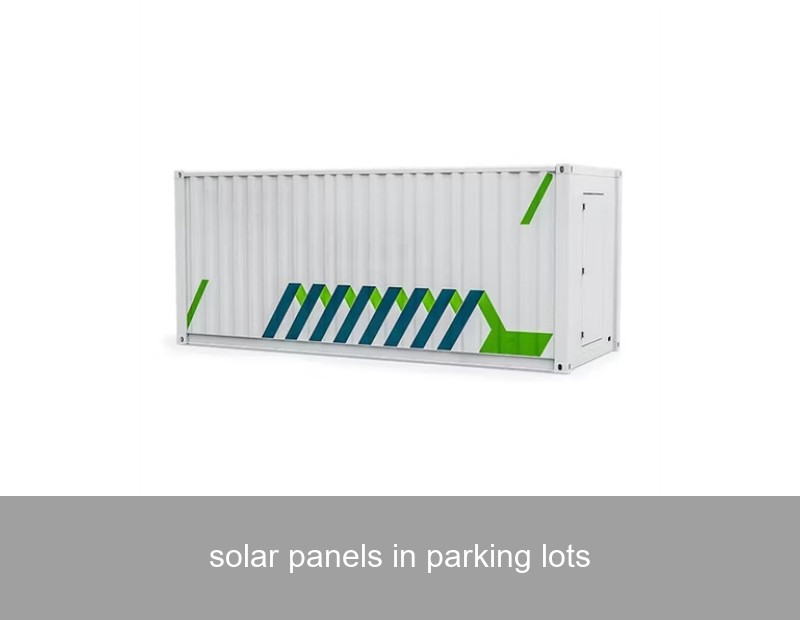
- Intelligent Battery Storage (BESS): This is the game-changer. Our containerized or modular battery energy storage systems, like the Highjoule H-Cube, store excess solar energy generated during the day. This stored power can then be used in the evening, during grid outages, or to strategically reduce peak demand charges, maximizing the financial return of your solar investment.
- Advanced Energy Management System (EMS): Our proprietary software acts as the command center, intelligently deciding when to use solar power directly, when to charge or discharge the batteries, and when to interact with the grid. It optimizes for cost, carbon footprint, and grid stability.
- EV Charging Integration: We seamlessly integrate DC fast chargers and AC charging points under the canopy, creating a true energy ecosystem that powers both your facility and the transportation of your customers and employees.

Image Source: Unsplash - Representative image of a battery storage container.
Key Considerations for Implementing Your Solar Carport
Thinking about a project? Here are the crucial steps and factors:
1. Site Assessment and Feasibility
Highjoule experts begin with a detailed analysis of your parking lot's orientation, shading, structural substrate, and electrical interconnection points. We model energy yield and financial returns specific to your location and consumption profile.
2. Regulatory and Incentive Landscape
Navigating permits, grid connection agreements, and available incentives (like the U.S. Investment Tax Credit or European Union grants) is complex. Our team has deep experience in both the U.S. and European markets, ensuring you capture all available benefits.
3. Design for Dual-Use
The design must balance energy production with user experience. We ensure adequate height clearance, lighting integration under the canopy, and efficient traffic flow. The structure should be an aesthetic enhancement, not an eyesore.
4. The Critical Role of Storage
Without storage, a significant portion of your solar energy might be exported to the grid at low value. Integrating a Highjoule BESS allows you to consume 70-90% of your solar generation on-site, dramatically improving the project's economics and providing backup power resilience. This is our core expertise.
The Future is Integrated
The evolution of solar panels in parking lots is moving towards fully integrated "smart microgrids." Imagine a corporate campus where the parking lot solar, coupled with battery storage, EV chargers, and the building's own load, operates as a self-optimizing island of energy. During a grid outage, it can power critical operations. During times of high grid stress, it can support the local network. Highjoule is at the forefront of designing these intelligent systems for commercial, industrial, and community applications.
This technology is ready today. The question isn't whether it's viable, but what opportunity cost your business bears by leaving your parking lot as a mere heat island. What could you power with that untapped space above your asphalt?
 Inquiry
 Online Chat