


How Do Solar Panels Make Electricity? A Clear Guide to Powering Your World
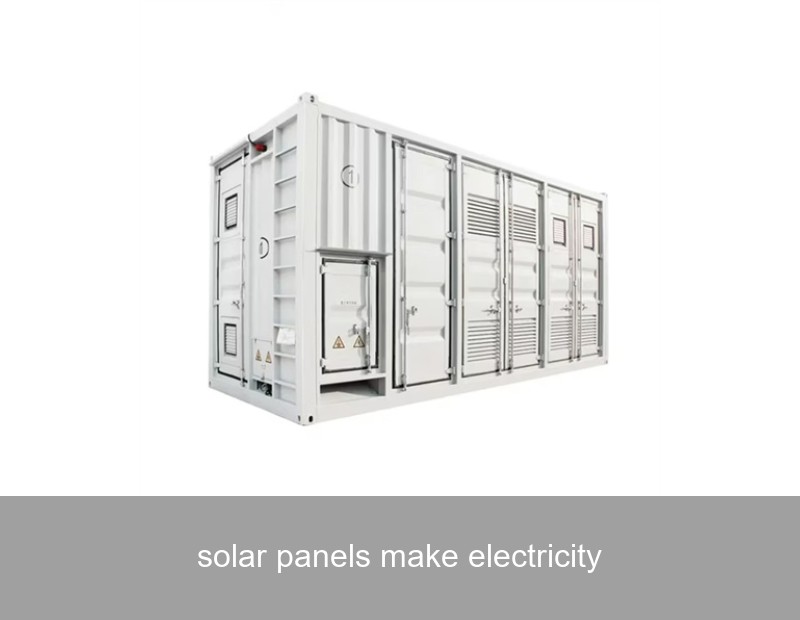
You’ve seen them on rooftops and in vast fields, silently glinting under the sun. But have you ever stopped to wonder, how exactly do solar panels make electricity? It’s a question at the heart of the global shift towards clean energy. For homeowners and businesses across Europe and the U.S., understanding this process is the first step toward energy independence, significant cost savings, and a reduced carbon footprint. In this article, we'll demystify the science, explore the real-world impact, and show how pairing solar generation with intelligent storage, like solutions from Highjoule, creates a truly resilient and efficient power system.
Table of Contents
- The Phenomenon: From Sunbeams to Electrons
- The Data: Quantifying Solar's Potential
- The Case Study: A German Bakery's Recipe for Energy Independence
- The Key Insight: Generation is Only Half the Story
- Highjoule Solutions: Bridging the Gap Between Solar and Security
- Future Horizons: What's Next for Solar Technology?
The Phenomenon: From Sunbeams to Electrons
The magic behind solar panels making electricity is rooted in a 19th-century discovery called the photovoltaic (PV) effect. In simple terms, it's the process of converting light (photons) into electrical voltage. Modern solar panels are composed of many individual cells, typically made from silicon, a semiconductor material.
Here’s a step-by-step breakdown of what happens when sunlight hits your roof:
- Photon Absorption: Sunlight, composed of energy particles called photons, strikes the solar cell.
- Electron Excitation: These photons transfer their energy to electrons in the silicon atoms, "knocking" them loose.
- Creating a Flow: The solar cell is engineered with a positive (p-type) and a negative (n-type) layer, creating an internal electric field. This field forces the freed electrons to move in a specific direction – creating a direct current (DC) flow of electricity.
- Conversion to Usable Power: The DC electricity travels via wiring to an inverter, which converts it into alternating current (AC) – the standard form of electricity used in homes, businesses, and the grid.
It's a silent, fuel-free, and elegant process with no moving parts. But the real question for any energy consumer is: what can this process actually deliver for me?
The Data: Quantifying Solar's Potential
The theoretical science is sound, but the practical data is even more compelling. Let's look at the numbers shaping markets in the U.S. and Europe.
| Metric | United States | European Union | Implication |
|---|---|---|---|
| Average Residential System Cost (post-incentive) | $15,000 - $25,000 | €10,000 - €20,000 | Initial investment is offset by long-term savings and incentives. |
| Typical Payback Period | 6-10 years | 7-12 years | Systems then produce virtually free electricity for their remaining 15+ year lifespan. |
| Average CO2 Offset per 6kW System/Year | ~8,000 lbs | ~3,600 kg | Equivalent to planting over 100 trees annually. |
According to the International Energy Agency (IEA), solar PV is now the cheapest source of electricity in history for most of the world. In 2023, the U.S. saw a record 32.4 gigawatts of new solar capacity installed, while the EU continues to accelerate deployments to meet its REPowerEU goals. The data confirms: solar is a mature, economically viable mainstream technology.

Image Source: Unsplash - A modern rooftop solar installation.
The Case Study: A German Bakery's Recipe for Energy Independence
Let's move from macro data to a micro success story. "Bäckerei Schmidt" (a real bakery in Bavaria, Germany) faced a common dilemma: high, volatile energy costs for ovens and refrigeration, and a desire to operate sustainably.
- Challenge: Reduce grid dependence and stabilize operational costs against energy price spikes.
- Solution (2021): Installation of a 50 kW rooftop solar array paired with a 40 kWh Highjoule C&I (Commercial & Industrial) battery storage system.
- Results:
- 70% reduction in grid electricity consumption during daylight hours.
- The bakery now uses stored solar energy to power its pre-dawn baking shifts, maximizing self-consumption.
- During a local grid outage in 2022, the bakery remained fully operational, avoiding thousands of euros in lost product and sales.
- Projected ROI of 8 years, thanks to Germany's favorable regulations for self-consumption.
This case highlights a critical insight: the true value of solar panels making electricity is unlocked not just by generation, but by intelligent management and storage of that power.
The Key Insight: Generation is Only Half the Story
Solar panels have one inherent "flaw": they are intermittent. They generate power only when the sun shines. This creates a mismatch between production (highest at noon) and consumption (often highest in mornings and evenings). Without a solution, excess solar energy is fed back to the grid for often modest credits, and you remain reliant on the grid at night.
This is the fundamental challenge that advanced energy storage systems are designed to solve. Think of it this way: solar panels are your personal power plant, and a battery is your personal energy bank. Storing surplus solar energy for use on-demand transforms a solar installation from a cost-reduction tool into a comprehensive energy security asset.

Image Source: Unsplash - A professional inspecting a commercial battery storage system.
Highjoule Solutions: Bridging the Gap Between Solar and Security
This is where Highjoule's expertise becomes pivotal. Since 2005, we have specialized in creating intelligent storage solutions that maximize the value of the electricity your solar panels make. Our systems are designed for seamless integration with any solar PV installation.
Highjoule Product Portfolio
- Residential ESS (H-Res Series): Scalable, wall-mounted systems for homeowners. Our AI-driven energy management software learns your consumption patterns, automatically optimizing when to store solar energy, power your home, or even provide backup power during an outage.
- Commercial & Industrial ESS (H-CI Series): Robust, modular systems for businesses like Bäckerei Schmidt. They enable peak shaving (reducing demand charges), load shifting, and ensure critical operations continue during grid interruptions.
- Microgrid Controllers: For campuses or remote communities, Highjoule technology can integrate solar, storage, and other generation sources into a stable, independent microgrid.
Our philosophy is that storage should be intelligent, safe, and durable. Using top-tier lithium iron phosphate (LFP) battery chemistry, we prioritize longevity and safety. Our cloud-based monitoring platform gives users, from homeowners to facility managers, complete visibility and control over their energy ecosystem.
Future Horizons: What's Next for Solar Technology?
The journey of a photon to a powered appliance is already impressive, but innovation continues. Perovskite solar cells promise higher efficiencies and lower production costs. Building-integrated photovoltaics (BIPV) will turn windows and facades into generators. Furthermore, the synergy between solar panels making electricity and emerging technologies like vehicle-to-grid (V2G) will create even more flexible and resilient energy networks.
The constant, however, will be the need to store and manage this decentralized energy intelligently. As battery densities improve and smart grid capabilities expand, the role of companies like Highjoule in providing the essential "brain and brawn" for these systems will only grow more critical.
Ready to See How Your Solar Electricity Could Work Smarter?
Understanding how solar panels make electricity is the first step. The next step is designing a system that ensures none of that precious, self-generated power goes to waste. Whether you're a homeowner tired of being at the mercy of utility rates, or a business owner looking to lock in long-term operational stability, the combination of solar and smart storage is the answer.
What would energy independence look like for your home or business? What critical loads would you want to keep running if the grid went down? We invite you to explore Highjoule's solutions and start a conversation about your specific energy goals today.
 Inquiry
 Online Chat