


Your Solar Power Plant Business Plan: The Blueprint for a Profitable and Future-Proof Energy Venture
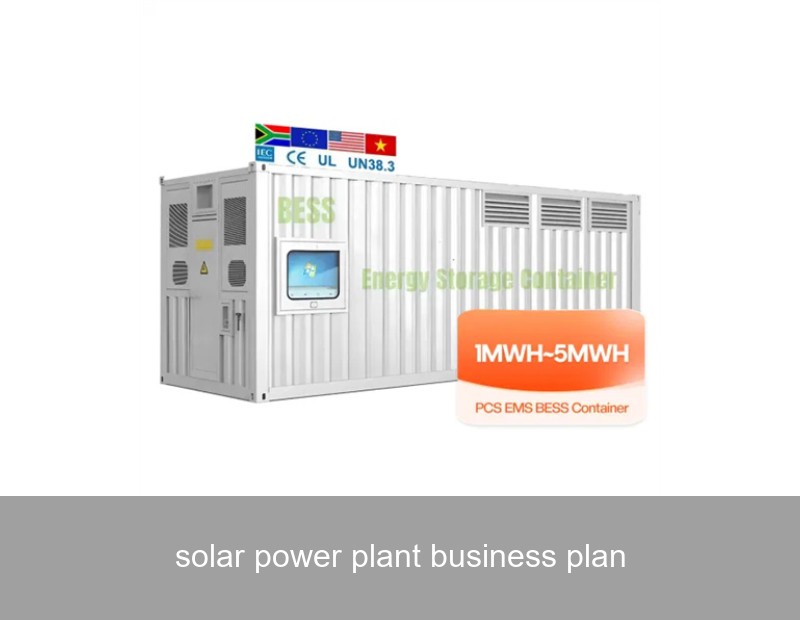
So, you're thinking about entering the solar energy market. That's a brilliant move. With global energy demands shifting and sustainability goals becoming more urgent, a well-crafted solar power plant business plan is your most critical asset. It's more than just a document for investors; it's your strategic roadmap from concept to a fully operational, revenue-generating asset. This guide will walk you through the essential components, highlight common pitfalls, and show you how integrating advanced energy storage is no longer an option—it's the key to maximizing profitability and resilience.
Table of Contents
- The New Reality: Why Storage is Non-Negotiable in Modern Solar Plans
- De-risking Your Plan: The Data Behind Solar-Plus-Storage Economics
- Case in Point: A 5MW Community Solar + Storage Success Story
- Crafting the Core of Your Solar Power Plant Business Plan
- The Highjoule Advantage: Intelligent Storage for a Smarter Business Model
- Final Blueprint Check: Are You Ready to Build?
The New Reality: Why Storage is Non-Negotiable in Modern Solar Plans
Gone are the days when a solar power plant business plan could focus solely on panels and inverters. The energy landscape, especially in markets like Europe and the U.S., has evolved. Grid operators are grappling with the duck curve—the steep drop in net load during sunny days followed by a sharp evening ramp-up. This phenomenon, documented by entities like the California ISO, creates two challenges: potential grid instability and volatile energy prices.
Think of it this way: your solar plant produces the most when the sun is highest, but what if that's when electricity prices are lowest? And what happens when the sun sets, but demand—and prices—peak? Without a solution, you're leaving significant revenue on the table and offering less value to the grid. The answer, now central to any competitive solar power plant business plan, is battery energy storage systems (BESS).

Storage transforms your project from a variable generator into a dispatchable power asset. It allows you to shift energy production to high-value periods, provide grid services, and ensure a more stable, predictable output. In short, it future-proofs your investment against market shifts and policy changes.
De-risking Your Plan: The Data Behind Solar-Plus-Storage Economics
Let's talk numbers. Incorporating storage isn't just a technical upgrade; it's a financial lever. According to the National Renewable Energy Laboratory (NREL), pairing storage with solar can significantly increase the value of the solar asset. Here's a simplified breakdown of the revenue streams a co-located system unlocks:
| Revenue Stream | Solar-Only Plant | Solar + Storage Plant |
|---|---|---|
| Energy Arbitrage | Limited to daytime production | Sell stored energy during peak evening prices |
| Capacity & Grid Services | Minimal or none | Revenue from frequency regulation, grid balancing |
| Increased Self-Consumption | N/A for utility-scale | Critical for C&I and microgrid models |
| Power Purchase Agreement (PPA) Premium | Standard rate | Potential for higher, more stable rates due to dispatchability |
The financial model in your solar power plant business plan must account for these stacked revenues. While the initial CapEx is higher, the ROI and internal rate of return (IRR) often become more attractive and resilient over the project's 20-25 year lifespan.
Case in Point: A 5MW Community Solar + Storage Success Story
Consider a real-world example from the northeastern United States. A developer aimed to build a 5MW community solar garden but faced grid interconnection challenges and uncertain offtake revenue. Their revised solar power plant business plan integrated a 2.5MWh battery storage system.
- Challenge: Grid upgrade costs were prohibitive, and the utility needed help managing local peak demand.
- Solution: The plan proposed a smaller grid interconnection, using the battery to "firm" the solar output and never export more than a set limit. The battery would also discharge during the regional peak demand period (5-8 PM).
- Outcome: The utility agreed to a more favorable interconnection agreement, saving the project over $500,000 upfront. Furthermore, the battery's participation in the wholesale capacity market generates an additional ~$80,000 in annual revenue. The project secured financing faster due to its diversified income and lower grid-related risk.
This case illustrates the transformative power of a storage-integrated plan. It turned a grid constraint into a revenue opportunity.
Crafting the Core of Your Solar Power Plant Business Plan
With the "why" of storage established, let's structure the "how." Your business plan should be comprehensive and address these key sections with storage as a central pillar.
1. Executive Summary & Market Analysis
Clearly state that your project is a solar-plus-storage facility. Highlight the specific market need you're addressing, whether it's providing peak power in Texas, supporting grid stability in Germany, or enabling a behind-the-meter industrial microgrid. Cite local renewable portfolio standards or incentive programs, like the Investment Tax Credit (ITC) in the U.S. for standalone storage.
2. Technical Design & Technology Selection
This is where expertise matters. Don't just specify panel wattage. Detail:
- DC/AC Ratio: Oversizing solar relative to inverter capacity to maximize daytime battery charging.
- Storage Sizing: Energy (MWh) and Power (MW) capacity based on target revenue streams (e.g., 2-hour vs. 4-hour storage).
- System Architecture: DC-coupled vs. AC-coupled storage, impacting efficiency and cost.

3. Financial Projections & Funding Strategy
Provide detailed, transparent models. Include:
- CapEx breakdown with a clear line item for the BESS.
- Operational Expenditures (OpEx), including storage performance management.
- Projected revenue from energy sales, capacity markets, and ancillary services.
- Sensitivity analysis showing how the project performs under different electricity price scenarios.
4. Operations & Maintenance (O&M) Strategy
Storage adds complexity. Your plan must outline a sophisticated O&M strategy that monitors battery health, state-of-charge cycling, and safety protocols. Partnering with a technology provider that offers advanced monitoring and performance guarantees is crucial.
The Highjoule Advantage: Intelligent Storage for a Smarter Business Model
This is where your plan gains a competitive edge. As a global leader in advanced energy storage since 2005, Highjoule doesn't just sell battery containers; we provide the intelligence that maximizes the profitability of your solar power plant business plan.
For developers and asset owners, our HiveMind Energy Operating System is a game-changer. It's an AI-driven platform that doesn't just monitor your solar-plus-storage asset—it actively optimizes it. HiveMind analyzes real-time market data, weather forecasts, and grid signals to make automated decisions on when to store energy, when to discharge, and which revenue stream to prioritize at any given moment. This turns your storage system from a passive component into an active, profit-maximizing asset.
Our GridMaster Commercial & Industrial (C&I) and Utility-scale BESS are built with this intelligence in mind. They feature:
- Ultra-high efficiency: Minimizing round-trip losses means more of your generated solar power becomes revenue.
- Modular, scalable design: Start with what your plan needs and expand as your business grows.
- Unmatched safety: Built with cell-to-system level safety protocols, giving peace of mind to investors, insurers, and local communities.
Integrating Highjoule's technology into your plan's technical and financial sections signals to investors that you've partnered with a proven expert, de-risking the project and leveraging best-in-class operational intelligence.
Final Blueprint Check: Are You Ready to Build?
Your solar power plant business plan is the foundation. In today's market, a plan without storage is like building a house without a foundation—it might stand for a while, but it won't withstand the first major storm. By embracing solar-plus-storage, you're not just building a power plant; you're creating a flexible, resilient, and highly valuable energy asset.
As you finalize your projections and technical specs, ask yourself this critical question: Does my storage strategy have the built-in intelligence to adapt to tomorrow's energy markets, or is it just a simple battery? The answer could define your project's success for decades to come.
What specific grid challenge or market opportunity in your target region is driving the storage sizing in your plan?
 Inquiry
 Online Chat