


Demystifying Solar Power Plant Financing: Your Roadmap to Renewable Energy Investment
So, you're captivated by the promise of solar energy—clean power, long-term savings, and a tangible step towards sustainability. But when you start exploring the idea of building or acquiring a solar power plant, one question inevitably takes center stage: How on earth do we finance it? You're not alone. The journey from a brilliant sunny idea to a fully operational, revenue-generating solar asset is paved with complex financial models, diverse funding options, and critical technical decisions. This article will guide you through the essential landscape of solar power plant financing, blending financial insight with the engineering reality that ultimately determines a project's bankability.
Table of Contents
The Financing Puzzle: More Than Just Sunshine
Financing a solar power plant is fundamentally about risk mitigation. Lenders and investors don't just bet on sunny weather; they bet on a project's predictable, long-term cash flow. This predictability hinges on several pillars: a robust Power Purchase Agreement (PPA), proven technology, reliable performance guarantees, and meticulous operational planning. A weak link in any of these areas can increase perceived risk, leading to higher financing costs or even a deal falling through. It's a classic example of how technical excellence directly fuels financial viability.
Key Financing Models for Solar Power Plants
Understanding the available financial structures is your first step. The right choice depends on your entity's balance sheet, tax appetite, and long-term operational goals.
| Model | How It Works | Best For | Key Consideration |
|---|---|---|---|
| Project Finance (Non-Recourse) | Financing is secured against the project's own assets and cash flows, not the sponsor's balance sheet. | Large-scale utility projects (10MW+). | Requires extremely robust project due diligence and rock-solid contracts. |
| Corporate Financing | The company developing the project borrows directly or uses its equity, leveraging its overall credit. | Industrial or commercial entities adding solar to their portfolio. | Simpler but ties up corporate credit lines. |
| Tax Equity Partnerships | In the U.S., investors provide capital in exchange for a project's tax credits and depreciation benefits. | Projects in jurisdictions with strong tax incentives. | Highly complex structuring but can significantly lower capital cost. |
| Third-Party Ownership (PPA) | A developer owns and operates the system, selling the power to a host customer via a long-term PPA. | Businesses or municipalities wanting zero upfront cost and stable energy rates. | Host gets clean power without asset ownership; developer handles financing. |
The Role of PPAs and Government Incentives
A long-term Power Purchase Agreement (PPA) is often the cornerstone of any financing model. It provides the revenue certainty that lenders demand. Similarly, government incentives like the Investment Tax Credit (ITC) in the U.S. or contract-for-difference (CfD) schemes in Europe can dramatically improve a project's internal rate of return (IRR), making it more attractive to investors. Staying abreast of these policies, like those outlined by the International Energy Agency (IEA), is crucial for financial modeling.
The Critical Tech-Finance Nexus: Where Engineering Meets the Balance Sheet
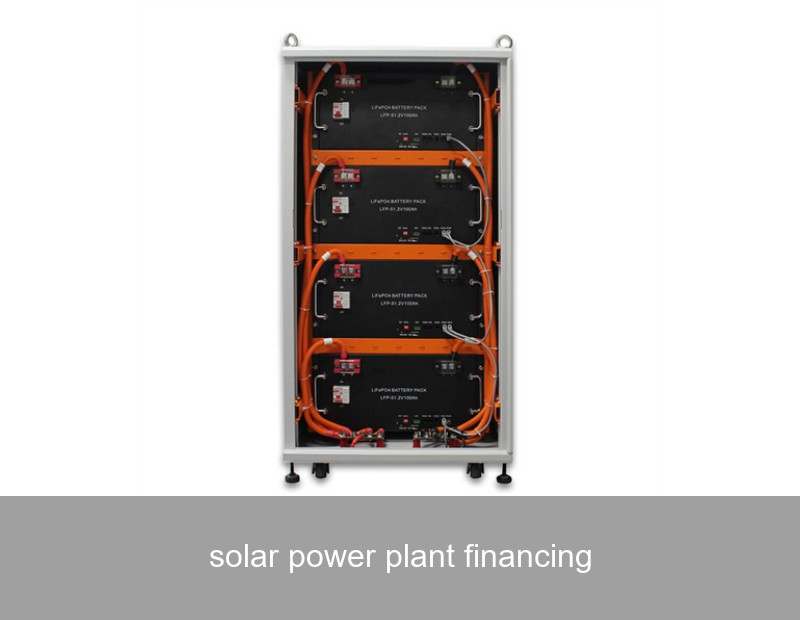
Here's a truth every financier knows: the quality of the technology stack is a direct financial variable. An underperforming or unreliable battery energy storage system (BESS), for instance, can derail revenue from frequency regulation services or peak shaving. This is where partnering with a seasoned technology provider becomes a strategic financial decision.
Highjoule, as a global leader in advanced energy storage systems since 2005, understands this nexus intimately. Our role is to de-risk the technical core of your project. For a solar plant integrating storage—which is increasingly the norm for enhancing dispatchability and value—the choice of BESS impacts everything from performance warranties to maintenance cost projections. Highjoule's HPS Series for utility-scale applications offers industry-leading cycle life and degradation warranties, providing banks with the confidence that the asset will perform as modeled for 20+ years. Our integrated energy management system (EMS) ensures optimal charging/discharging, maximizing revenue streams that are directly input into your financial proforma.

Utility-scale solar plants require robust technology to secure long-term financing. (Image: Unsplash)
Case Study: Securing Debt for a 50MW PV + 10MW/20MWh Storage Plant in Spain
Project: A 50MW photovoltaic solar plant coupled with a 10MW/20MWh battery storage system in Andalusia, Spain.
Challenge: The developer needed to secure non-recourse project debt at a competitive interest rate. Lenders were concerned about the relatively novel integration of large-scale storage for the Spanish market and the long-term performance risk of the BESS.
Solution & Highjoule's Role: The developer selected Highjoule's HPS Series containerized BESS for its proven track record in similar climates and its comprehensive performance guarantee package. Highjoule provided:
- A 10-year performance warranty guaranteeing 70% capacity retention at end of term.
- Detailed, bank-approved energy yield and storage simulations for the combined system.
- Remote monitoring and predictive maintenance services to ensure uptime.
Financial Outcome: The technical due diligence package, centered on Highjoule's bankable technology and guarantees, satisfied the lenders' risk committee. The project secured €35 million in senior debt at a rate 75 basis points lower than initially quoted for a storage-less variant, as the BESS model showed stronger, more grid-resilient revenue. The plant is now operational, supporting grid stability and providing firm, dispatchable renewable power.
How Highjoule's Expertise Secures Project Finance
For over 18 years, Highjoule has been the silent partner behind financially successful energy projects. We go beyond supplying hardware to becoming a facilitator of finance. Our services directly address the checklist of any project finance bank:
- Bankable Technology: Our systems are designed with longevity and reliability as the primary metrics, backed by transparent data and white papers.
- Performance Guarantees: We offer clear, enforceable warranties on capacity, efficiency, and cycle life that can be included in project contracts.
- Lifetime Value Optimization: Our AI-driven JouleMind OS doesn't just run the system; it optimizes for the highest possible financial return, whether through energy arbitrage, frequency response, or capacity markets.
- Comprehensive Support: From feasibility studies and system design to long-term O&M support, we provide the continuity that investors seek.
For commercial and industrial (C&I) clients, Highjoule's on-site energy solutions offer a different financing angle. By providing a predictable cost of energy and protecting against volatility, a Highjoule system improves a company's financial profile and can be financed through operational expenditures (OpEx) models, removing capital expenditure (CapEx) barriers.

Advanced monitoring and control systems are critical for meeting performance guarantees. (Image: Unsplash)
The Due Diligence Checklist: What Lenders Look For
When evaluating a solar-plus-storage project, lenders will scrutinize the technology provider. Being prepared with answers from a partner like Highjoule is key:
- What is the provider's operational history and reference list?
- Are the performance warranties aligned with the debt tenor?
- What is the strategy for end-of-life battery management?
- How does the EMS ensure revenue stack optimization?
Future Opportunities and Your Next Step
The landscape of solar power plant financing is evolving rapidly. The rise of sustainability-linked loans (SLLs), green bonds, and new blended finance mechanisms from institutions like the European Bank for Reconstruction and Development (EBRD) are creating more avenues for capital. The integration of artificial intelligence for predictive maintenance and revenue optimization is further reducing operational risk, a trend Highjoule is pioneering with its intelligent platform.
The most successful projects will be those that view financing and technology not as separate silos, but as two sides of the same coin. The right technology partner doesn't just sell you components; they enhance your creditworthiness.
Given the unique financial and technical profile of your next renewable energy project, which revenue stream—energy arbitrage, grid services, or pure capacity—do you believe holds the most untapped potential for improving your project's IRR, and how can your technology choice unlock it?
 Inquiry
 Online Chat