


Solar Speicher Lithium Eisen Phosphat: The Modern Choice for Home Energy Independence
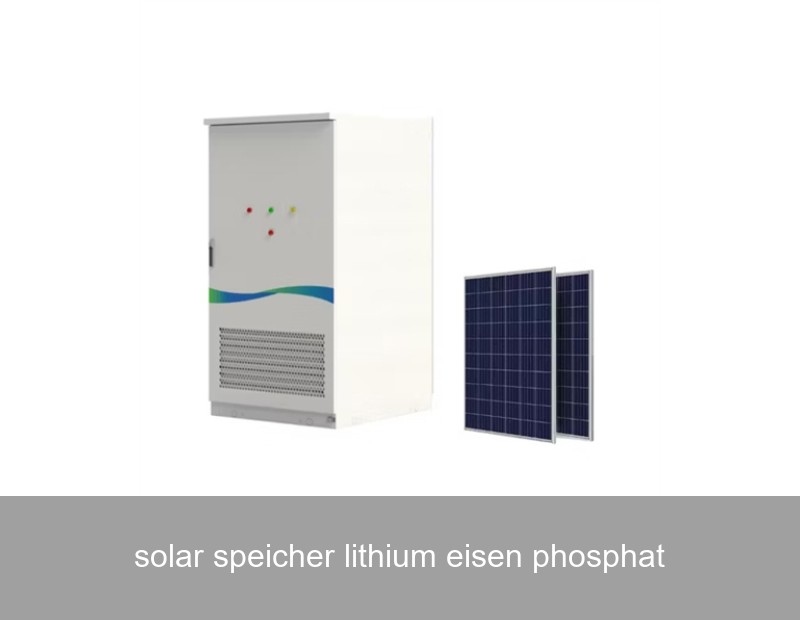
Imagine a bright, sunny day. Your rooftop solar panels are generating more electricity than your home can use. What happens to that excess, clean energy? Without a battery, it's fed back to the grid, often for a minimal return. This is the phenomenon millions of solar owners face, a gap between generation and consumption. But the landscape is changing rapidly, driven by a key technology: the solar speicher lithium eisen phosphat (LFP) battery. This isn't just another battery; it's becoming the cornerstone for intelligent, safe, and long-lasting home energy storage systems in Europe and the US. As a leader in advanced energy storage, Highjoule has been at the forefront of this shift since 2005, integrating superior LFP chemistry into our smart, sustainable power solutions for residential and commercial applications.
Table of Contents
- What is a Lithium Eisen Phosphat (LFP) Battery?
- Why LFP is Winning the Home Solar Storage Game
- The Data: Market Trends and Real-World Performance
- A Real-World Case: The Schmidt Family Home in Bavaria
- Highjoule's Intelligent Approach to LFP Storage
- Looking Ahead: What Does Your Energy Future Hold?
What is a Lithium Eisen Phosphat (LFP) Battery?
Let's break down the technical name. A solar speicher lithium eisen phosphat is a type of lithium-ion battery where the cathode is made from Lithium Iron Phosphate (LiFePO4). This chemistry differs significantly from the older, more common lithium-ion variants using Nickel Manganese Cobalt (NMC) or Nickel Cobalt Aluminum (NCA).
Think of it this way: if batteries were cars, NMC might be a high-performance sports car—powerful but requiring more careful handling and maintenance. LFP, in contrast, is like a rugged, reliable SUV—built for safety, longevity, and everyday dependability. The key advantages stem from its stable chemical structure, which inherently reduces the risk of thermal runaway (a chain reaction leading to fire). For a homeowner, this means a battery that can be safely installed in a garage or utility room with greater peace of mind.

Image: Modern LFP battery modules offer compact, safe energy storage. Source: Unsplash
Why LFP is Winning the Home Solar Storage Game
The shift towards LFP for residential solar speicher isn't accidental. It's a direct response to what homeowners truly value: safety, longevity, and total cost of ownership. Here’s how LFP delivers:
- Unmatched Safety Profile: The strong chemical bonds in the iron phosphate cathode make it far more stable under stress, such as overcharging or high temperatures. This intrinsic safety is a primary reason companies like Highjoule standardize on LFP chemistry for our residential HOMESMART series.
- Legendary Cycle Life: A typical high-quality LFP battery can withstand 6,000 to 10,000 charge/discharge cycles while retaining 80% of its original capacity. For context, that’s over 20 years of daily use. This dwarfs the 2,000-3,000 cycles common with older NMC batteries.
- Cost-Effectiveness Over Time: While the upfront price per kilowatt-hour (kWh) can be comparable, the longer lifespan means a lower "cost per cycle." You're buying a system designed to last the lifetime of your solar panels.
- High Performance in Wide Temperatures: LFP batteries maintain performance better in both hot and cold climates, a crucial factor for diverse markets like sunny California or chilly Germany.
The Data: Market Trends and Real-World Performance
The numbers speak volumes. According to the International Energy Agency (IEA), global energy storage capacity is set to expand dramatically, with batteries leading the charge. Within this, LFP's market share is soaring. By 2025, it's projected to represent over 50% of the global lithium-ion battery market for stationary storage, a significant leap from just a few years ago.
Why this rapid adoption? Data from real installations shows LFP systems consistently achieving a higher depth of discharge (DoD) without significant degradation. Homeowners can regularly use 90-100% of their battery's stored energy, whereas other chemistries might recommend only 80-90% DoD to preserve lifespan. This means more usable energy from the same nominal capacity.
| Feature | Lithium Eisen Phosphat (LFP) | Nickel Manganese Cobalt (NMC) |
|---|---|---|
| Typical Cycle Life (to 80% capacity) | 6,000 - 10,000 cycles | 2,000 - 3,500 cycles |
| Thermal & Safety Stability | Excellent | Good (requires more complex BMS) |
| Common Depth of Discharge (DoD) | 90-100% | 80-90% |
| Key Material | Iron, Phosphate (Abundant, low-cost) | Cobalt, Nickel (Less abundant, volatile pricing) |
A Real-World Case: The Schmidt Family Home in Bavaria
Let's move from theory to practice. The Schmidt family, living in a detached home near Munich, Germany, installed a 12 kWp solar system in 2020. Initially without storage, their self-consumption rate was only 35%. In early 2023, they decided to upgrade with a solar speicher lithium eisen phosphat system to increase energy independence amidst rising electricity prices.
They chose a Highjoule HOMESMART 10 system, featuring a 13.8 kWh LFP battery and our intelligent energy management system. The results after one year were compelling:
- Self-Consumption Rate: Jumped from 35% to over 85%.
- Grid Independence: Achieved 70% average grid independence from March to October.
- Financial Impact: Reduced their annual electricity bill by €1,850, projecting a full system payback in under 8 years.
"The peace of mind with the safe LFP technology was a big factor," says Mr. Schmidt. "But the real surprise was the system's intelligence. It automatically optimizes when to charge from the sun, when to power the house, and even when to sell a small surplus at peak grid prices." This case, mirrored by thousands across Europe and North America, highlights the tangible benefits of pairing modern solar with advanced LFP storage.

Image: Modern energy storage systems offer intuitive monitoring and control. Source: Unsplash
Highjoule's Intelligent Approach to LFP Storage
At Highjoule, we believe the battery cell is just the beginning. Our expertise lies in building complete, intelligent storage systems around the robust lithium eisen phosphat core. Our HOMESMART and COMMERCIO product lines are engineered for seamless integration, maximum efficiency, and future-proof operation.
What sets a Highjoule system apart?
- Adaptive Battery Management System (BMS): Our proprietary BMS doesn't just protect the LFP cells; it continuously learns your home's energy patterns and weather forecasts to optimize charge/discharge cycles, extending battery life even further.
- Grid-Smart Functionality: In regions with variable electricity tariffs or vulnerable grids, our systems can be configured to provide critical backup power or participate in grid-support services, turning your storage into an asset for community resilience.
- Scalable Design: Starting with a modular design, our systems can often be expanded by adding more LFP battery modules, allowing your storage to grow with your needs.
For us, providing a solar speicher means delivering a holistic energy solution. From initial consultancy and system design to installation support and long-term monitoring via our customer portal, we ensure our LFP technology delivers on its full promise of safety, sustainability, and savings.
The Sustainability Angle
Choosing LFP aligns with the core environmental motive for going solar. The chemistry uses abundant, non-toxic materials (iron and phosphate), avoiding controversial cobalt. This makes the battery's end-of-life recycling process more straightforward and environmentally sound. Highjoule is actively partnered with recycling initiatives across Europe and the US to ensure a closed-loop lifecycle for all our products, reinforcing our commitment to a truly sustainable energy ecosystem.
Looking Ahead: What Does Your Energy Future Hold?
The evolution of the solar speicher lithium eisen phosphat represents a fundamental step towards democratized, resilient energy. It’s no longer just about saving money—it’s about taking control, contributing to grid stability, and building a personal energy asset that lasts for decades. As electricity markets evolve and weather patterns become less predictable, the value of this independence will only increase.
So, we leave you with this question to ponder: As you look at your roof generating clean power, what potential is currently flowing back to the grid that could be powering your home, your electric vehicle, or securing your comfort during an outage? What would it mean for you to capture and control that potential with a technology built for the long haul?
 Inquiry
 Online Chat