


Powering Your Home Sustainably: The Complete Guide to a Solar System for Home Appliances
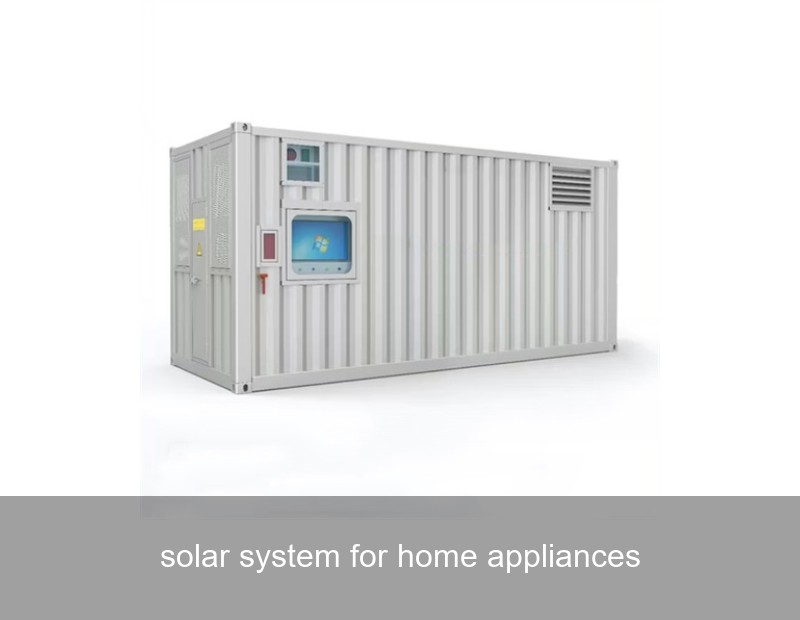
Table of Contents
- The Rise of Home Solar: More Than Just Panels
- How a Solar System for Home Appliances Actually Works
- Key Components of a Modern Home Solar Power System
- Real-World Case Study: The Smith Family's Energy Transformation
- Highjoule's Intelligent Solutions: Beyond Basic Solar
- Making the Decision: Is a Solar System Right for Your Home?

Image source: Unsplash - Representative image of a solar-powered home.
The Rise of Home Solar: More Than Just Panels
Have you ever looked at your monthly electricity bill and wondered, "There must be a better way"? You're not alone. Across Europe and the United States, homeowners are increasingly turning to a powerful solution: a dedicated solar system for home appliances. This isn't just about being eco-friendly (though that's a fantastic benefit); it's about taking control of your energy costs, increasing your home's resilience, and powering your daily life—from your refrigerator to your EV charger—with clean, self-generated electricity.
The phenomenon is clear. According to the International Energy Agency (IEA), residential solar PV capacity saw record growth globally. But the real story isn't just in the installation numbers; it's in the shifting mindset. Homeowners no longer see solar as a niche product. Instead, they view it as a reliable, mainstream power source for their most critical and energy-hungry appliances. The question has evolved from "Why solar?" to "How can I optimize my solar energy to run my home efficiently?"
How a Solar System for Home Appliances Actually Works
Let's demystify the process. A modern home solar system is an elegant dance of technology. It starts with the photovoltaic (PV) panels on your roof, which convert sunlight into direct current (DC) electricity. But here's the catch: your home appliances run on alternating current (AC). This is where the inverter, the brain of the operation, comes in, converting that DC power into usable AC power.
The real magic for appliance-specific power management happens with energy storage and smart controllers. Without storage, excess solar energy produced on a sunny afternoon goes back to the grid, and you draw power from the grid at night. To truly power your appliances around the clock with solar, you need a battery. This setup allows you to store surplus daytime energy to run your dishwasher, washing machine, or home entertainment system in the evening, maximizing self-consumption and independence.
Key Components of a Modern Home Solar Power System
Building a robust solar system for home appliances requires more than just panels. Here’s the essential toolkit:
- High-Efficiency Solar Panels: The primary energy harvesters. Modern monocrystalline panels offer the best efficiency, especially in space-constrained residential settings.
- Hybrid or Smart Inverter: This device does more than convert DC to AC. It manages energy flow between the panels, battery, home appliances, and the grid intelligently.
- Lithium-Ion Battery Storage System: The heart of 24/7 solar power. A quality battery stores excess energy for use when the sun isn’t shining.
- Energy Management System (EMS): The true commander. This software-based system learns your consumption patterns and automatically decides when to power appliances directly from solar, when to charge the battery, and when to draw from the grid, ensuring optimal efficiency and cost savings.
- Monitoring Platform: A user-friendly app that shows you exactly how much energy your solar system is producing, what your home is consuming, and which appliances are using power in real-time.
| Appliance | Average Power Consumption | How Solar + Storage Can Power It |
|---|---|---|
| Refrigerator | 100-200 kWh/month | Easily powered 24/7 by a properly sized system, with battery covering nighttime operation. |
| Electric Vehicle (Level 2 Charger) | ~30 kWh per full charge | Daytime solar can directly charge the EV; excess can be stored for evening charging. |
| Air Conditioning (Central) | High (seasonal peak) | Solar can offset peak daytime cooling costs; battery can provide short-term backup during grid outages. |
| Washing Machine & Dryer | 2-6 kWh per load | Smart EMS can schedule loads for peak solar production hours, maximizing free solar energy use. |
Real-World Case Study: The Smith Family's Energy Transformation
Let's look at a concrete example from Southern California, USA. The Smith family, living in a 2,200 sq. ft. home, faced average monthly electricity bills of $220, with peaks over $350 in summer due to air conditioning. Their goal was simple: power their essential appliances (AC, refrigeration, pool pump, and EV) and slash their grid dependence.
They installed an 8.5 kW solar array paired with a 15 kWh lithium-ion battery storage system. The results after one year, documented by their monitoring platform, were compelling:
- Annual Electricity Bill Reduction: 92% (from ~$2,640 to ~$210).
- Self-Consumption Rate: Increased from 35% (solar only) to 85% (solar + storage), meaning they used most of the energy they produced.
- Appliance Coverage: Their system consistently powered 100% of their critical loads (refrigerator, lights, internet) during two brief grid outages.
- EV Charging: They estimated 80% of their EV's 12,000 annual miles were powered directly by solar, saving an additional $450 in fuel costs.
This case underscores a critical insight: the integration of storage is what transforms a simple solar generator into a resilient solar system for home appliances. As noted by the National Renewable Energy Laboratory (NREL), pairing storage with solar increases the value and functionality of the system for the homeowner significantly.

Image source: Unsplash - Modern home battery storage unit.
Highjoule's Intelligent Solutions: Beyond Basic Solar
This is where Highjoule's expertise, honed since 2005, becomes pivotal. We understand that a cookie-cutter approach doesn't work for powering your unique set of home appliances. Our solutions are built on the principle of intelligent integration.
For residential clients, Highjoule offers the HomeSmart ESS (Energy Storage System). This isn't just a battery in a box. It's an integrated system featuring our high-density lithium-ion batteries, a hybrid inverter with grid-forming capabilities, and our proprietary Adaptive EMS. What does this mean for you? The system doesn't just store energy; it learns. It understands that you run the dishwasher at 8 PM and pre-charges the battery accordingly from afternoon sun. It knows a heatwave is coming and ensures your battery is at 100% to support your AC during peak rate hours.
Our systems are designed for scalability. You can start with a system that covers your critical appliances and easily expand later to include your EV charger or heat pump. This modular, future-proof design, backed by our global service network, ensures your investment is protected for the 20+ year lifetime of the solar panels.
Making the Decision: Is a Solar System Right for Your Home?
Considering a solar system for home appliances involves a few key considerations. First, assess your energy profile: look at your utility bills to understand your consumption patterns and peak usage. Second, evaluate your home's solar potential (roof orientation, shading). Third, define your priorities: is it bill savings, backup power during outages, or reducing your carbon footprint?
It's also crucial to work with a provider that offers a holistic system, not just components. The synergy between the panels, inverter, battery, and software is what delivers the promised results. As the U.S. Department of Energy highlights, proper system design and component compatibility are essential for safety and performance.
So, as you think about the hum of your refrigerator, the cycle of your washing machine, or the charge of your electric vehicle, ask yourself: What would it take to power the rhythm of your home life with the clean, quiet, and resilient energy of the sun?
 Inquiry
 Online Chat