


Understanding Solar System Malaysia Price: A Guide to Smart Investment
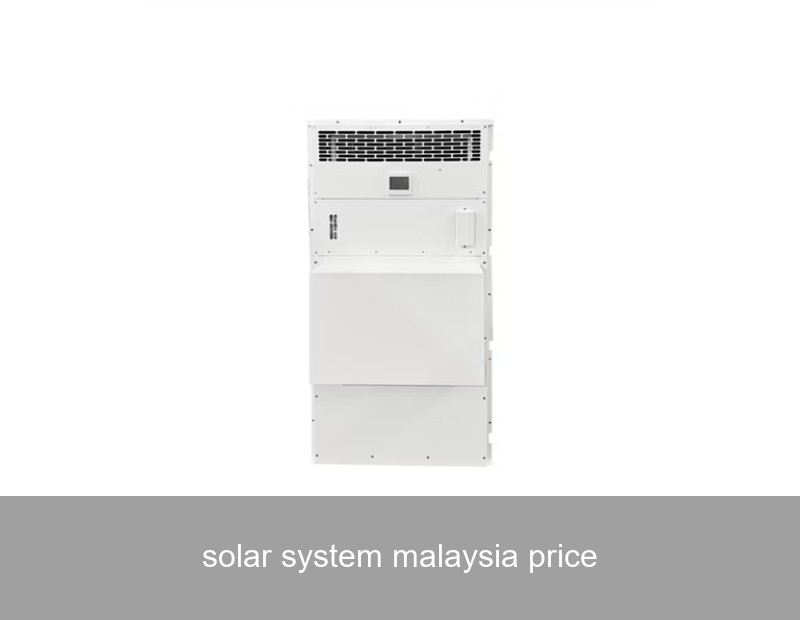
If you're researching a solar system Malaysia price, you're likely looking at more than just a number. You're evaluating an investment in energy independence, resilience against tariff fluctuations, and a commitment to sustainability. The price tag is a gateway to a complex equation involving system size, component quality, long-term performance, and the total value over 25+ years. This article will demystify the factors influencing solar costs in Malaysia and guide you toward making an informed decision that maximizes your return.
Table of Contents
- The Solar Price Puzzle: More Than Just Panels
- Key Factors Determining Your Solar System's Price
- Beyond the Panels: The Critical Role of the Inverter and Battery
- A Malaysian Case Study: From SEDA Data to Real Savings
- The Highjoule Solution: Intelligent Storage for Maximum Value
- Calculating True Value: LCOE and Your ROI
- Your Next Step: What's Your Energy Priority?
The Solar Price Puzzle: More Than Just Panels
When you get a quote for a solar system, it's easy to focus on the bottom line. However, two systems with identical price tags can deliver vastly different financial and operational outcomes. The phenomenon? A market flooded with options, where upfront cost often overshadows lifetime value. The data tells a clearer story. According to the Sustainable Energy Development Authority (SEDA) Malaysia, the country's total installed solar capacity is growing rapidly, driven by commercial and industrial users seeking to offset high operational costs. This surge in demand highlights a shift: savvy buyers are looking at solar as a strategic asset, not just an expense.

The initial solar system Malaysia price encompasses hardware (modules, inverters, mounting), soft costs (permits, grid connection fees), and installation labor. But the real cost—or saving—is realized over decades. A cheaper system with lower-efficiency panels or a subpar inverter may produce less energy and require earlier replacement, negating the initial savings. So, how do you decode the quote?
Key Factors Determining Your Solar System's Price
Let's break down the primary components that shape your investment. Think of it as building a high-performance vehicle; every part matters for the long journey ahead.
- System Size & Capacity (kWp): Measured in kilowatt-peak (kWp), this is the most direct price driver. A typical Malaysian home may need a 4kWp to 10kWp system, while commercial facilities can range from 100kWp to over 1MWp. Larger systems have a lower cost per kWp due to economies of scale.
- Solar Panel Quality & Technology: Monocrystalline panels, with higher efficiency rates (20%+), command a premium over polycrystalline but generate more power in limited roof space. Tier-1 manufacturer panels often come with better warranties and degradation rates, protecting your yield.
- Installation Complexity: Roof type, angle, shading, and required structural reinforcements significantly impact labor costs. A simple, large, unobstructed industrial roof is far less costly per watt to install than a complex residential roof with multiple angles.
- Regulatory & Grid Connection Costs: This includes SEDA registration, net energy metering (NEM) application fees, and any necessary upgrades to your main distribution board or the local grid connection point.
Beyond the Panels: The Critical Role of the Inverter and Battery
Here's where expertise truly matters. The inverter is the brain of your solar system, converting DC power from panels to usable AC power. Its quality dictates efficiency, grid interaction, and system longevity. A low-cost inverter might be 95% efficient, while a premium one reaches 98.5%. That 3.5% difference, compounded daily, represents a substantial amount of lost energy and revenue over time.
More importantly, the modern energy system is incomplete without storage. This is where companies like Highjoule redefine the value proposition. While the base solar system Malaysia price might not include storage, adding a battery energy storage system (BESS) transforms your solar array from a daytime-only generator into a 24/7 power asset. Highjoule's intelligent storage solutions, like our H-Stack Commercial Series, allow businesses to:
- Maximize Self-Consumption: Store excess solar energy for use at night, dramatically reducing reliance on the grid.
- Provide Backup Power: Ensure critical operations continue during grid outages.
- Participate in Demand Charge Management: For commercial users, the highest 15-minute power draw in a month sets a "demand charge." A BESS can discharge to "shave" this peak, leading to massive savings on utility bills—a benefit purely solar cannot offer.
Integrating Highjoule's smart storage may increase the initial capital outlay but enhances the financial returns and resilience multifold, making the overall energy solution far more valuable.
A Malaysian Case Study: From SEDA Data to Real Savings
Let's move from theory to practice with a real-world scenario. Consider a medium-sized manufacturing facility in Selangor with an average monthly electricity bill of RM 80,000. Their primary costs are energy consumption (kWh) and a significant demand charge (kW).
| Scenario | System Description | Estimated Initial Investment | Key Outcome |
|---|---|---|---|
| Solar-Only | 500 kWp rooftop system with string inverters. | ~RM 1.5 million | Reduces daytime grid consumption. Saves ~30% on energy (kWh) charges. Limited impact on demand charges. |
| Solar + Highjoule BESS | 500 kWp solar + 500 kWh/250 kW Highjoule H-Stack. | ~RM 2.2 million | Reduces energy charges by ~40%. Cuts peak demand by ~25%, slashing demand charges. Provides 2-3 hours of backup for critical loads. Achieves a faster ROI despite higher upfront cost. |
Data from a IRENA report on renewable costs shows that while solar PV costs have fallen, adding storage optimizes consumption patterns. For this factory, the integrated Highjoule solution turned their solar investment from a partial fix into a comprehensive energy management strategy, with a payback period often under 6-7 years in Malaysia's climate and tariff structure.

The Highjoule Solution: Intelligent Storage for Maximum Value
At Highjoule, we believe the true solar system Malaysia price should reflect its lifetime value, not just its initial cost. Our global experience since 2005 allows us to engineer storage systems that unlock the full potential of your solar investment. For the Malaysian market, we offer:
- Adaptable Battery Technology: We provide both high-cycle lithium ferro phosphate (LFP) batteries for daily solar shifting and longer-duration solutions for extended backup or arbitrage.
- Advanced Energy Management System (EMS): The intelligence behind the hardware. Our EMS predicts solar production, analyzes consumption patterns, and autonomously decides when to charge, discharge, or hold to achieve your goals—be it bill savings or carbon reduction.
- Scalable & Safe Architecture: From compact H-Res units for large homes and SMEs to multi-megawatt H-Grid solutions for industrial parks and microgrids, our systems are designed with safety and scalability at their core.
By integrating a Highjoule BESS, you're not just buying a battery; you're investing in a platform for energy intelligence that pays dividends for the life of the system.
Calculating True Value: LCOE and Your ROI
To move beyond the sticker shock, professionals evaluate the Levelized Cost of Energy (LCOE). This metric spreads the total system cost over its lifetime energy production, giving you a cost-per-kWh you can compare directly to your utility tariff. A high-quality, well-sized system with storage often has a lower LCOE than grid electricity in many parts of Malaysia, especially when future tariff hikes are considered. Your return on investment (ROI) is not just about the payback period, but also about the 15+ years of nearly free, clean energy that follows.

Your Next Step: What's Your Energy Priority?
As you ponder the solar system Malaysia price, ask yourself: Is your primary goal the lowest possible upfront cost, or the highest possible long-term savings and control? Are you looking to simply reduce your electricity bill, or to build a resilient, sustainable energy infrastructure for your home or business that can withstand grid volatility and contribute to a cleaner future?
The market is evolving from simple solar PV to integrated smart energy systems. With the right partner, your investment can do much more than you initially planned. What specific energy challenge—peak demand charges, backup power needs, or a sustainability target—is most critical for you to solve first?
 Inquiry
 Online Chat