


Understanding the Solar Central Energy Storage Cabinet Market: Powering a Sustainable Future
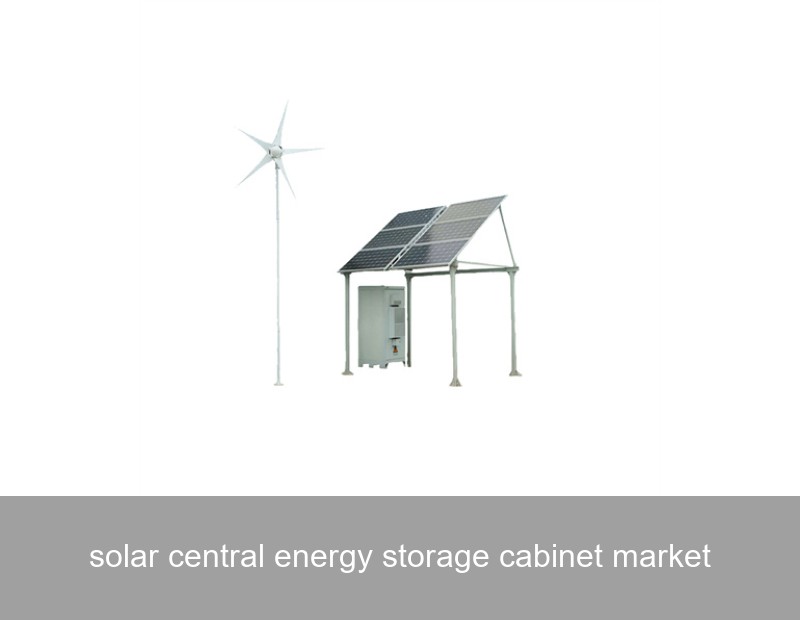
Imagine a world where every solar panel not only powers your home or business during the day but also stores abundant, clean energy for the night, for cloudy days, and even to support the wider grid. This vision is rapidly becoming a reality, thanks in large part to a critical yet often overlooked component: the solar central energy storage cabinet. This market is experiencing explosive growth, driven by the global push for energy independence and grid resilience. But what exactly is this market, and why is it so pivotal for our energy transition? Let's explore the forces shaping this dynamic sector and how advanced solutions, like those from Highjoule, are setting new standards for intelligence and reliability.
Table of Contents
- The Rise of Centralized Solar Storage
- Key Market Drivers: More Than Just Batteries
- Highjoule's Role: Intelligent Storage Solutions
- Future Trends and Challenges
The Rise of Centralized Solar Storage
Unlike residential setups with a battery in your garage, the solar central energy storage cabinet market focuses on larger-scale, integrated systems. Think of it as the heart and brain of a commercial, industrial, or community solar-plus-storage project. These cabinets aren't just containers for batteries; they are sophisticated enclosures housing battery modules, advanced power conversion systems (PCS), battery management systems (BMS), thermal management, and safety controls—all in one optimized, centralized unit.
The phenomenon is clear: as solar photovoltaic (PV) costs have plummeted, the intermittency of solar power remains its main challenge. The sun doesn't always shine when we need electricity. This creates a pressing need for storage. The data underscores this shift. According to the International Energy Agency (IEA), global renewable capacity additions jumped by almost 50% in 2023, with solar PV accounting for three-quarters of this growth. This surge directly fuels demand for large-scale storage to integrate this variable generation effectively.
Key Market Drivers: More Than Just Batteries
So, what's specifically propelling the solar central energy storage cabinet market? Several interconnected factors are at play.
- Grid Modernization and Resilience: From California to Bavaria, grids are under stress from extreme weather and shifting demand patterns. Central storage acts as a buffer, providing frequency regulation, peak shaving, and backup power to prevent outages.
- Economic Incentives and Policies: Legislation like the U.S. Inflation Reduction Act (IRA) and various EU Green Deal initiatives offer significant tax credits and subsidies for energy storage deployments, making projects financially compelling.
- Corporate Sustainability Goals: Companies worldwide are committing to 100% renewable energy. To achieve this reliably, they must pair solar with on-site storage, driving demand for commercial-scale cabinet solutions.
- Technological Advancements: Improvements in lithium-ion battery density, safety, and lifespan, coupled with smarter energy management software, are making central storage systems more efficient and cost-effective than ever.

Image Source: Unsplash - A modern solar farm, a prime candidate for central energy storage integration.
A Real-World Case: Stabilizing a German Industrial Park
Let's look at a concrete example from Europe. A mid-sized manufacturing park in North Rhine-Westphalia, Germany, faced two problems: volatile energy costs and strict grid connection limits that hampered expansion. Their 2 MW rooftop solar array often produced excess energy at noon that was sold to the grid at low prices, while they had to buy expensive power during morning and evening peaks.
The solution was a central energy storage system featuring a 1.5 MWh capacity cabinet. The system was configured to:
- Store excess solar generation for self-use later.
- Perform peak shaving, capping the facility's power draw from the grid.
- Provide grid services by offering frequency containment reserve (FCR).
The results, measured over 12 months, were impressive:
| Metric | Result |
|---|---|
| Solar Self-Consumption Increase | From 35% to over 80% |
| Peak Demand Charges Reduced | By 40% |
| Additional Revenue from Grid Services | Approx. €28,000 annually |
| Project Payback Period | Under 6 years |
Highjoule's Role: Intelligent Storage Solutions
In this complex and demanding market, not all solutions are created equal. This is where Highjoule distinguishes itself. Since 2005, we have evolved from a battery technology innovator to a global leader in providing intelligent, integrated storage systems. Our approach to the solar central energy storage cabinet is holistic.
Our flagship product line, the H-Series Central Storage Cabinet, is engineered for the rigorous demands of C&I and microgrid applications. What makes it stand out?
- All-in-One Design: Pre-integrated, factory-tested cabinets that include our proprietary BMS, high-efficiency PCS, and active liquid cooling for optimal thermal management, reducing on-site installation time and complexity by up to 50%.
- AI-Powered Energy Management System (EMS): The true brain of the system. Our EMS doesn't just store and release energy; it learns energy usage patterns, forecasts solar production, and automatically optimizes for the highest economic return—whether through self-consumption, arbitrage, or grid services.
- Unmatched Safety and Longevity: Built with cell-level monitoring, passive safety barriers, and multi-level fire suppression, the H-Series is designed for the highest safety standards. Our technology ensures cycle life that exceeds industry averages, protecting your investment.

Image Source: Unsplash - Technician interacting with a modern energy storage system control interface.
For a large-scale solar farm developer in Texas, Highjoule didn't just provide cabinets. We provided a turnkey energy storage solution including system design, grid interconnection support, and a long-term service agreement. Our system allows the farm to time-shift 4 MWh of solar energy daily, providing stable, dispatchable green power to the local utility under a Power Purchase Agreement (PPA), maximizing revenue in a competitive market.
Future Trends and Challenges
The solar central energy storage cabinet market is poised for continued innovation. We are closely watching trends like:
- Alternative Chemistries: While lithium-ion dominates, technologies like sodium-ion and flow batteries may play a role in specific long-duration storage niches within the cabinet format.
- Standardization and Modularity: The move towards plug-and-play, modular cabinet designs will further reduce costs and simplify scaling.
- Virtual Power Plants (VPPs): Individual storage cabinets will increasingly act as coordinated nodes in a VPP, aggregating to form a significant, grid-stabilizing resource.
Challenges remain, of course. Supply chain volatility, evolving regulatory landscapes, and the need for skilled installers are hurdles the industry must collectively overcome. However, the fundamental direction is unwavering: the integration of solar and storage is no longer an option but a necessity for a resilient, decarbonized grid.
Your Next Step in the Energy Transition
As you consider the potential of solar and storage for your business, community, or projects, the key is to look beyond the components to the system's intelligence and total lifecycle value. The right central storage cabinet is an investment that pays dividends in resilience, savings, and sustainability for decades.
What specific energy challenge—be it demand charge reduction, renewable integration, or backup power—is most critical for your operation, and how would a truly intelligent storage system transform your bottom line and energy strategy?
 Inquiry
 Online Chat