


Strategic Power Solutions for Ghana: Building a Resilient and Sustainable Energy Future
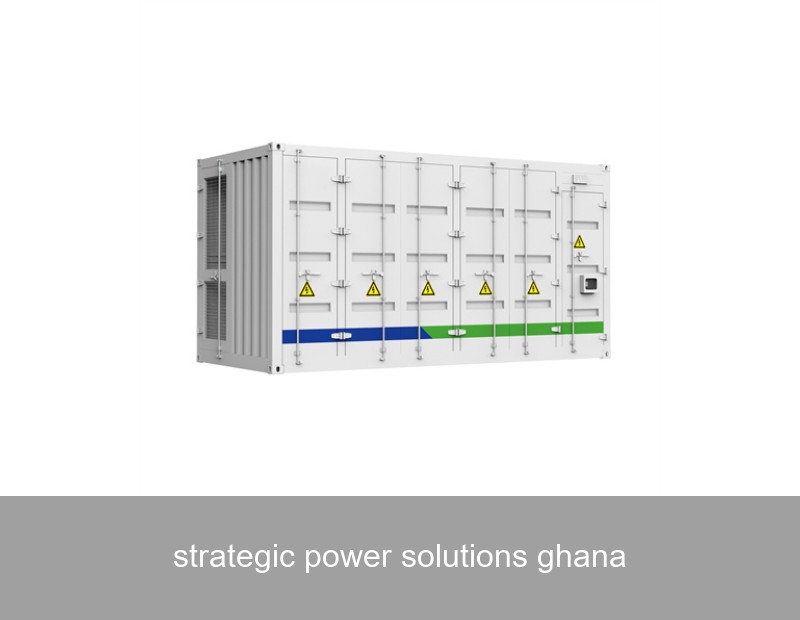
Ghana stands at a pivotal moment in its development journey. While significant strides have been made in expanding access to electricity, the nation's growing economy and ambitious industrial goals are increasingly strained by a familiar challenge: grid instability and the urgent need for reliable, strategic power solutions. For businesses, hospitals, data centers, and communities across Ghana, power interruptions are not just an inconvenience; they represent a direct threat to productivity, safety, and economic growth. This article explores how modern energy storage systems are transforming this challenge into an opportunity, providing the strategic backbone for a more resilient, efficient, and sustainable power infrastructure in Ghana.
Table of Contents
- The Challenge: Beyond Simple Power Outages
- The Data: Quantifying the Cost of Unreliable Power
- The Solution: Energy Storage as a Strategic Asset
- Case Study: Securing a Hospital's Lifeline in Accra
- Highjoule's Role: Tailored Strategic Power Solutions for Ghana
- The Future: Integrating Renewables and Building Microgrids
The Challenge: Beyond Simple Power Outages
If you operate a business in Ghana, you're intimately familiar with the term "dumsor" – the local parlance for the persistent, unpredictable power outages that have plagued the nation. But the strategic challenge runs deeper than just the lights going off. It's about voltage fluctuations that damage sensitive equipment, the high cost and environmental impact of running diesel generators 24/7, and the inability to harness Ghana's own abundant solar resources effectively due to grid limitations. For a country aiming to become a regional manufacturing and digital hub, this energy uncertainty is a critical roadblock. What's needed isn't just a backup system; it's a fundamental rethinking of how power is managed and secured on-site.
The Data: Quantifying the Cost of Unreliable Power
Let's talk numbers, because they tell a compelling story. According to a World Bank report, power outages can cost businesses in developing countries up to 10-20% of their annual sales. In Ghana specifically, a study by the Institute of Statistical, Social and Economic Research (ISSER) indicated that firms lose an average of 5-10% of production value due to power issues. Beyond direct losses, consider the operational costs:
- Diesel Fuel Expenditure: Continuous reliance on generators significantly inflates operational expenses.
- Equipment Depreciation: Frequent power surges and drops shorten the lifespan of machinery and electronics.
- Lost Productivity & Data Integrity: For IT and service sectors, sudden shutdowns can corrupt data and halt digital services entirely.
This data underscores that the status quo is economically unsustainable. The question then becomes, what is the strategic alternative?

Image Source: Unsplash - A combined solar and storage system, key to strategic energy independence.
The Solution: Energy Storage as a Strategic Asset
The cornerstone of modern strategic power solutions is the advanced Battery Energy Storage System (BESS). Think of it not just as a giant battery, but as an intelligent energy manager. A BESS does three critical things:
- Provides Instantaneous Backup: It switches on in milliseconds during a grid failure, ensuring seamless continuity.
- Stabilizes Power Quality: It acts as a buffer, smoothing out voltage and frequency fluctuations that harm equipment.
- Enables Renewable Integration: It stores excess solar energy generated during the day for use at night or during peak tariff periods, maximizing self-consumption and return on investment.
This transforms power from a volatile commodity into a predictable, controlled, and optimized asset. It's the difference between reactive coping and proactive management.
Case Study: Securing a Hospital's Lifeline in Accra
Consider the real-world example of a private hospital in Accra. Facing daily power fluctuations and weekly prolonged outages, their diesel generators were a constant source of noise, pollution, and soaring fuel costs. Most critically, the brief gap between grid failure and generator start-up posed a risk to life-saving equipment in operating theaters and ICUs.
The hospital implemented a strategic power solution centered on a 500 kWh / 750 kVA lithium-ion BESS, integrated with their existing solar PV array and generator set. Here are the outcomes after one year:
| Metric | Before BESS | After BESS |
|---|---|---|
| Diesel Fuel Consumption | 180,000 liters/year | 45,000 liters/year |
| Generator Runtime | Near-continuous | For long outages only (>4 hours) |
| Grid Power Cost during Peak | High, unavoidable | Reduced by 40% via load shifting |
| Power Quality Incidents | Weekly equipment alarms | Zero recorded incidents |
The system now uses solar+storage as the primary backup, with the generator as a final, seldom-used redundancy. This not only saved over $100,000 annually in fuel and maintenance but, more importantly, guaranteed 100% uptime for critical care units. As Clean Energy Wire notes, storage is becoming the essential glue for modern, resilient power systems.
Highjoule's Role: Tailored Strategic Power Solutions for Ghana
This is where Highjoule's nearly two decades of global expertise comes into play. Since 2005, we have specialized in designing and deploying intelligent storage systems that are not off-the-shelf products, but custom-engineered solutions. For the Ghanaian market, we understand that resilience is non-negotiable, and value is paramount.
Our approach involves a deep analysis of your load profile, energy costs, and operational goals. We then integrate our core product—the Highjoule H-Series Modular BESS—into your unique ecosystem. The H-Series is built for harsh conditions, with advanced thermal management suited to Ghana's climate, and intelligent software that learns your consumption patterns to optimize every kilowatt-hour. Whether for a large industrial plant in Tema seeking peak shaving, a commercial bank in Kumasi needing flawless uptime, or a utility-scale solar farm requiring grid compliance and firming, our systems provide the strategic control you need.
Our services extend beyond installation. We offer comprehensive energy audits, long-term performance monitoring via our cloud-based platform, and local technical support partnerships to ensure your strategic power asset delivers for its entire 15+ year lifespan.

Image Source: Unsplash - Expert monitoring and control are vital for strategic power assets.
The Future: Integrating Renewables and Building Microgrids
The ultimate vision for Ghana's energy sector is a decentralized, robust network of microgrids and renewable-powered facilities. Strategic power solutions are the enabler of this future. By pairing large-scale solar or wind projects with massive storage, Ghana can reduce its reliance on imported fossil fuels, lower the overall cost of energy, and create a more democratic and resilient grid. Imagine industrial parks or university campuses operating as self-sufficient energy islands, trading power with the national grid when it's beneficial, and isolating to protect operations when needed.
The technology is here, proven, and economically viable. The International Energy Agency highlights that global storage deployment is set to multiply exponentially, driven by its critical value in security and flexibility.
A Question for Your Consideration
As Ghana continues on its path of economic transformation, can any major business, institution, or community afford to view its energy strategy as anything less than a core competitive advantage? What would complete freedom from power anxiety allow your organization to achieve?
 Inquiry
 Online Chat